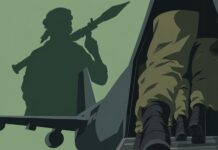

A car bomb killed Major General Fawzi al-Mansouri as he left evening prayers in Benghazi’s Hawari district on Monday, ending the career of the top military intelligence officer for Khalifa Haftar’s Libyan National Army. Hours earlier, an explosive drone struck a fuel tank at the Zawiya refinery west of Tripoli, the fourth such strike on the complex in four days.
Libya has lived under a fragile east-west split since the 2011 fall of Muammar Gaddafi, run by rival administrations that a 2020 ceasefire never fully reconciled. The near-simultaneous violence on opposite ends of the country now strains a Washington-brokered plan meant to stitch those halves back together.
A Killing Built On Precision
The assassination supplies the clearest evidence of what kind of actor Libya now faces. Al-Mansouri had run Haftar’s military intelligence department since 2024 and had appeared often alongside Haftar’s son Saddam, prompting talk that he sat inside the family’s inner circle.
Analyst Hamish Kinnear of Verisk Maplecroft said the intelligence needed to reach such a senior figure “is indicative of significant capabilities on the part of the responsible actor.”
No group has claimed the bombing, and Haftar’s son Khaled called it “a despicable terrorist tactic” while promising an investigation. The silence around responsibility counts as much as the killing itself, since a strike this precise inside an LNA stronghold narrows the list of plausible authors considerably.
Fire Meets Political Fault Lines
Zawiya’s fires did not erupt from nowhere either. The city sits at the centre of feuding militias loosely tied to Tripoli’s government, and armed groups there have clashed more than thirty times this year over territory and fuel smuggling.
Drones have now hit fuel tanks, a blending plant, a desalination unit and a power substation within a week, and the National Oil Corporation warned it may halt operations altogether if the strikes continue.
Losing Zawiya, the country’s largest working refinery, would cut into an economy still recovering record output levels reached earlier this year. Whoever is flying these drones seems focused on damaging Libya’s finances, striking a shared national asset both governments claim to protect.
Ankara Courts Both Sides Of Libya
Turkey’s response to the unrest came within a day. Foreign Minister Hakan Fidan flew to Tripoli on Tuesday and to Benghazi on Wednesday, meeting both Prime Minister Abdul Hamid Dbeibah and the man Ankara once fought, Khalifa Haftar. Fidan described the trip as proof of a “One Libya” policy that treats the west, east and south without distinction.
Turkey retains troops and drone bases around Tripoli, so its outreach to Benghazi carries the weight of a former adversary hedging its position as reunification talk grows louder. The visit followed the assassination by barely a day, giving Fidan’s hosts in Benghazi every reason to read Ankara’s timing as a gesture of solidarity.
Washington’s Quiet Wager On Unity
An American initiative that few outside Tripoli and Benghazi have fully seen still hangs over both attacks. Envoy Massad Boulos has spent over a year shuttling between Dbeibah and Haftar, pursuing a plan that would keep Dbeibah as premier while installing Saddam Haftar atop a Presidential Council.
Critics say the arrangement rewards two entrenched families over elections Libyans have awaited for years. Attacks that strike at Haftar’s inner circle and at oil infrastructure both governments depend on read easily as pressure meant to derail, or to harden, that very deal.
What The Timing Points To
A few explanations circulate among people who watch Libya closely. Some point to internal LNA rivals unhappy with al-Mansouri’s rise and his closeness to Saddam Haftar, since succession fights inside Haftar’s ageing camp have simmered for years.
Others suspect rival Zawiya militias using drones bought cheaply on regional markets to settle disputes over fuel smuggling routes, unrelated to any grander scheme.
A third reading treats both attacks as warnings from spoilers, inside or outside Libya, who stand to lose standing if Boulos succeeds in fusing the two administrations into one.
Libyan investigators have offered nothing conclusive so far. What the past week makes clear is that Libya’s calm rests on restraint that a single bomb or drone can easily overturn.
Fidan’s dual outreach, and Washington’s insistence that Dbeibah and Saddam Haftar can share power, both assume the men at the top can control what happens beneath them.
Al-Mansouri’s killing and the fires at Zawiya tell a different story, since neither administration has shown it can secure even its own ranks. If the reunification effort is to survive its first real trial, mediators will need enforceable guarantees on security integration long before any handshake in Washington.
Keep up with Daily Euro Times for more updates
Read also:
Libya’s Aviation Struggle: How Rival Factions Block a Unified National Airline
A Temporary Fix: Meloni’s Eastern Mediterranean Strategy in Libya
Russia Bunkers Down in Libya, European Assets on the Line