

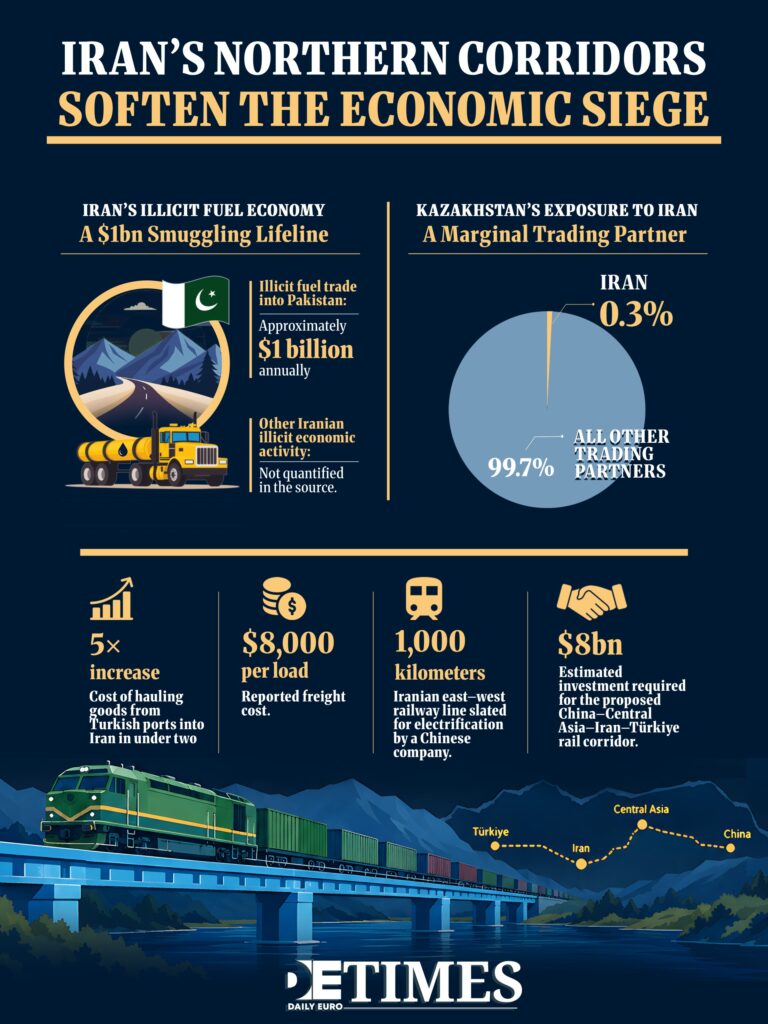
The price of hauling goods from Turkish ports into Iran has jumped more than fivefold in under two months, to about $8,000 a load, according to Iranian media. Treasury Secretary Scott Bessent reads the surge as proof of progress, declaring, “Now we have an absolute isolation campaign and it’s working.”
Washington launched Operation Economic Outcast in August, six months after America and Israel began their war on Iran, and targeted digital assets, technology, gold, aviation and shipping. It has since pressed Ankara and Islamabad to seal Iran’s frontiers.
Rising freight rates and nervous bankers will certainly bruise Tehran. Central Asian ambition probably guarantee a trickle of commerce no sanctions list can fully extinguish.
Neighbours Under Pressure
The blockade of land routes needs neighbours willing to absorb losses, so Washington has started with the financial pipes those neighbours use. Treasury sanctioned 17 vessels last week, declaring Iran’s remaining shadow fleet neutralised.
It had already targeted Türkiye-based Golden Global Bank in September and, this month, suppliers in Türkiye, Indonesia and Hong Kong serving Iran’s automotive and rail sectors.
Islamabad holds the least comfortable seat at the table. After mediating a ceasefire in June, it designated six road corridors linking Karachi, Port Qasim and Gwadar to the Gabd and Taftan crossings into Iran.
Those corridors cross Balochistan, home to a long-running insurgency, and Pakistan’s long-held ambition to become a transit hub makes overnight dismantling unlikely. Its value as a go-between with Tehran probably buys room to haggle over the pace of compliance.
Smugglers Fill the Gaps
Where governments hesitate, border economies fill the vacuum. Smugglers known as soukhtbar have long carried subsidised Iranian fuel into Pakistan from Sistan and Balochistan, and researchers estimate the trade involves thousands of vehicles and about $1 billion a year.
Such networks have survived years of interdiction, and the freight surge Bessent celebrates widens margins for every driver willing to risk a checkpoint.
Central Asia Plays Its Own Hand
Smugglers cannot carry the volumes Tehran needs, so the northern railways take on greater importance. Railway chiefs from China, Kazakhstan, Uzbekistan, Turkmenistan, Iran and Türkiye agreed last year to develop a shared corridor needing roughly $8 billion of investment.
A Chinese company is set to electrify 1,000 kilometres of Iran’s east-west line, tripling freight capacity.
Enthusiasm in the capitals themselves looks thinner. Kazakhstan froze several joint projects with Iran in April, and Iran accounts for roughly 0.3% of its foreign trade turnover, mostly in wheat and barley.
Countries with little to gain from Tehran and much to lose in Washington will probably honour the letter of sanctions and tolerate whatever border guards miss.
Pressure Without a Destination
Weighing frontiers, smugglers and cautious capitals together, Economic Outcast looks like attrition. Iranian trade officials concede overland routes lack the capacity to replace the southern ports.
Dubai’s former role as a financial gateway has no easy successor in Türkiye, Pakistan or Afghanistan, and Bessent credits the United Arab Emirates and Oman as partners in the pressure. Freight rates, financing and shortages will therefore bite hard, and ordinary Iranians will bear a considerable share of the damage.
Nonetheless, bruising a government rarely extracts concessions from it, and heavy-handed pressure may threaten Tehran’s political survival without producing any.
Treasury could spare Central Asian transport infrastructure from secondary sanctions, since hounding neighbours risks pushing them towards Beijing and Moscow. What is likely to see is a poorer, slower Iran still trading at ruinous prices through every back door its neighbours leave ajar.
Keep up with Daily Euro Times for more updates
Read also:
Steppe in Line: The Eurasian Century in Central Asia
EU Looks to the Silk Road: First EU-Central Asia Summit
Oil and Water: A Secondary Theatre of War