

Researchers at Chalmers University of Technology in Sweden recently unveiled a closed-loop laboratory. Artificial intelligence forms hypotheses, designs experiments and interprets the results on brewer’s yeast with minimal human input.
Ievgeniia Tiukova, a postdoctoral researcher at Chalmers and an author of the study, says “Rather than serving solely as decision supporting tools, the AI scientist actively generates new scientific knowledge”. Public research councils in Sweden and the United Kingdom helped finance the work.
Taxpayers therefore pay for discoveries. Privately owned datacentres increasingly process them. The most capable models belong to American technology groups, and scientific value gathers wherever their servers stand.
Europe needs compute, open data and publication rights of its own. Employment reform leaves the servers in foreign hands.
Mathematics Joins the Harvest
Mathematics offers a second example. In May, OpenAI, the American developer of ChatGPT, announced that its reasoning model had disproved a 1946 conjecture by Paul Erdős, the Hungarian mathematician.
The model refuted a conjectured bound but did not prove its new construction optimal. Outside mathematicians supplied the scrutiny. Thomas Bloom, who curates the Erdős problems website, was among them.
Bloom had judged the firm’s earlier claim harshly. Last year a former OpenAI executive said GPT-5 had solved ten Erdős problems, and the model had in fact retrieved existing literature. Bloom called that post “a dramatic misrepresentation”.
The episode points to a business model. Systems indexing decades of public scholarship can resell it to the institutions that produced it. Public universities carry the verification work, and the announcement lifts the valuation of the firm.
As OpenAI reportedly claims hundreds of solutions, independent mathematicians would need to confirm such a tally.
Announcements of this kind justify datacentre spending. Chamath Palihapitiya, a venture capitalist and founder of Social Capital, has reportedly called software intellectual property “effectively worthless”, while US president Donald Trump speaks of “super intelligence”.
Cheap reasoning turns server owners into toll collectors of knowledge. Europe’s researchers risk paying rent on their own findings.
A British Remedy With Missing Pieces
London reacted with labour-market reform. Andy Burnham promised legislation at the Innovation Nation Summit in Manchester.“I can confirm that we will legislate to make sure that non-compete clauses will no longer be a barrier to hiring for our most promising startups and scaling firms,” said the British prime minister.
The law firm Gibson Dunn notes the government has so far stopped short of an outright ban. ElevenLabs and Synthesia, two artificial intelligence startups, had campaigned for relief, and their founders will welcome it.
Freer mobility lets British researchers change employers. It does nothing for ownership of the servers they use afterwards. Any laboratory without its own compute stays a tenant under any contract.
Gigafactories and the Ownership Question
Brussels holds the stronger lever.
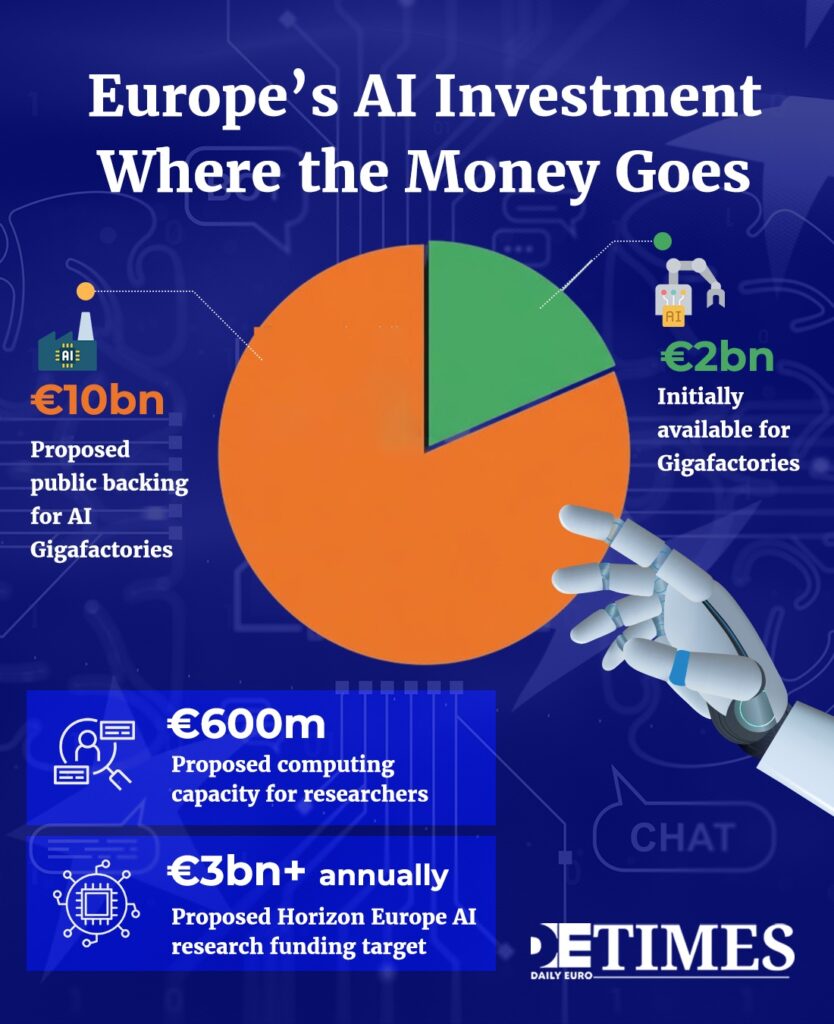
The EU recently invited bids for up to seven AI Gigafactories backed by €10 billion in public funds. Only €2 billion is available at present. The remainder awaits approval in the next budget.
The AI in Science Strategy seeks €600 million in computing power for researchers. It also proposes doubling Horizon Europe’s annual AI funding to over €3 billion. These budgets look modest beside the ambitions of private datacentre owners.
Conditions could turn public funding into leverage. Taxpayer-financed Gigafactories should offer open access to researchers and open publication of results. The European Organization for Nuclear Research already works this way in particle physics.
Europe would then own the machines doing its science. Its researchers could build systems on public data without asking a foreign landlord for permission.
Brussels cannot outspend American capital, so openness may be its only credible edge.
Keep up with Daily Euro Times for more updates
Read also:
France: The Budget Strain Behind Raging School Protests
Saudi Arabia Pays Cultural Businesses to Adopt AI
Data Centre Silence: Europe’s Secret Sauce?

