

The Maldives has signed a commercial terms agreement with Abu Dhabi-based Eagle Hills for a major waterfront development at Ras Malé, placing Gulf capital at the centre of one of the country’s most ambitious urban expansion projects.
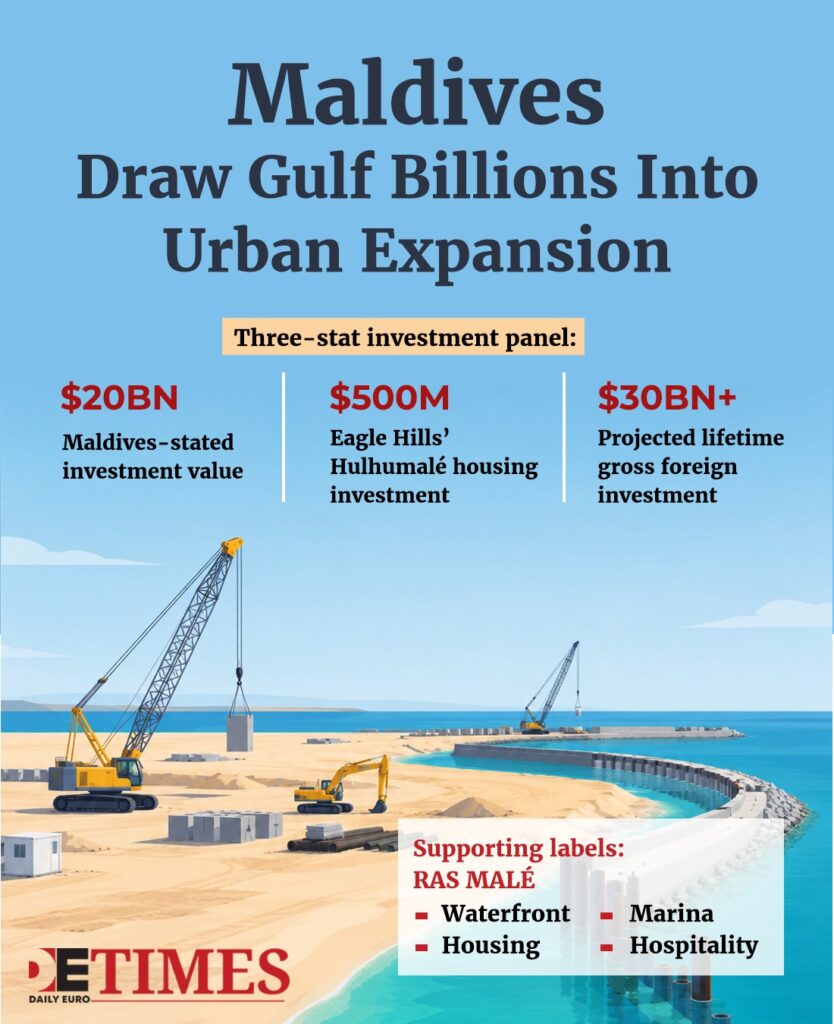
Infrastructure Minister Abdulla Muththalib signed the deal with Eagle Hills chairman Mohamed Alabbar, and the development, planned on existing reclaimed land, will combine hospitality, residential, marina, commercial, educational and healthcare facilities. Maldivian authorities have described the programme as a $20 billion investment, while some Eagle Hills materials place the scale nearer $12 billion, a difference that appears to reflect different ways of counting the same overall programme.
Detailed commercial terms have not yet been published. The deal arrives at a notable moment for Gulf developers: Dubai and Abu Dhabi property firms accumulated substantial capital reserves during a five-year property boom, while recent conflict affecting the Strait of Hormuz and wider Middle Eastern tensions have cooled demand at home and pushed some builders to look further afield.
The Maldives, in other words, is not the only reason this deal exists; it is also where Gulf capital is choosing to go next.
More Than a Resort
The development differs from the Maldives’ traditional resort model. Rather than separating tourists from residential life on self-contained islands, the Ras Malé project is being presented as an integrated waterfront district combining hotels, branded residences, shops, restaurants, leisure facilities, schools, healthcare and public spaces.
Eagle Hills says properties will be offered through leasehold arrangements of up to 99 years.
The company also projects more than $30 billion in gross foreign investment over the project’s lifetime, over a million additional visitors a year and more than 54,000 direct and indirect jobs, though these remain developer projections rather than realised outcomes.
The ambition is therefore much larger than adding another luxury destination to the map. It is meant to create a new urban-commercial centre capable of attracting residents and longer-stay visitors alongside conventional tourists, extending stays that have traditionally lasted a week into months at a time.
Housing Sits at the Centre
Housing remains one of the most politically important parts of the wider programme. The government has repeatedly identified overcrowding and high housing costs in Greater Malé as major national problems, and Ras Malé itself was launched in 2023 as a long-term attempt to relieve that pressure by creating an entirely new city on reclaimed land.
Official plans cover around 1,009 hectares at Fushi Dhiggaru Lagoon.
Earlier this year, applications opened for 15,000 land plots in Ras Malé under the government’s Housing for All programme, and President Mohamed Muizzu wants a majority of citizens to gain access to housing through state-backed schemes by around mid-2028.
The Eagle Hills agreement adds another layer: Finance Minister Hassan Zareer said the developer will also build 5,000 housing units worth around $500 million in Hulhumalé, separate from the waterfront development itself, with construction expected to begin in early 2027. That distinction carries weight, since the wider deal links two different housing challenges: a new city at Ras Malé, and immediate supply elsewhere in the capital region.
Luxury and Affordability Meet
This is where the project turns more politically interesting. Ras Malé was promoted heavily as a solution to domestic housing shortages, while the Eagle Hills development includes premium residences, international hotels, a marina and other high-end waterfront facilities aimed partly at foreign buyers and visitors.
Those ambitions do not automatically conflict.
Luxury development can generate jobs, tax revenue and infrastructure that help finance wider urban expansion, and foreign investment can reduce the burden on public finances. But the balance carries real weight: if Ras Malé ends up primarily a prestige destination while ordinary Maldivians keep struggling with housing costs, the project will face a legitimacy problem even if the economic numbers look impressive.
The government therefore has to make both sides work at once, attracting international capital while ensuring reclaimed land still addresses the pressures that justified the city in the first place.
Existing Land Limits New Dredging
Environmental concerns remain unavoidable. Large-scale reclamation projects alter lagoons and marine habitats, and the Maldives is particularly exposed to rising seas, coastal erosion and ecological damage.
Eagle Hills says its project will stay within land that has already been reclaimed, meaning no additional dredging will be required for the waterfront development itself, and the company has also said independent marine monitoring will take place during construction.
The government says the project must comply with national environmental standards, though that does not remove the wider environmental questions surrounding Ras Malé. The city itself exists because of massive reclamation at Fushi Dhiggaru Lagoon, and infrastructure on reclaimed land still has to cope with drainage, coastal protection, energy demand and long-term sea-level risk.
The waterfront project therefore avoids one additional layer of dredging while remaining part of a much larger environmental experiment.
Gulf Capital Moves Further In
The agreement also reflects the growing role of Gulf investment in the Maldives. Eagle Hills has expanded across the Middle East, Africa and Europe through large mixed-use developments, including a $2.5 billion waterfront and marina project in Albania and a $1.2 billion development on Sharjah’s Maryam Island.
For the Maldives, that model offers access to capital at a scale domestic financing could struggle to provide. Muththalib has said the project is intended to bring foreign money through the Maldivian banking system, create employment, generate state revenue and expand housing opportunities, while Alabbar has framed it as a way to extend the Maldives beyond short resort stays.
Much still depends on the detailed agreement that follows, including how much Eagle Hills will directly invest, the financing structure of individual phases and the division between domestic housing and premium property.
For now, Ras Malé is being asked to perform several roles simultaneously: relieve pressure on Greater Malé, create thousands of homes, attract Gulf capital and grow into a genuinely new urban centre. The project could help make that possible, or it could expose the central tension in the entire experiment: a city built partly to solve a housing shortage is now also being marketed as a global waterfront destination, and success will depend less on how spectacular the marina looks than on whether both versions of Ras Malé can exist together.
Keep up with Daily Euro Times for more updates
Read also:
Germany Finds a Steady Partner in Abu Dhabi
Germany Joins France in the Gulf’s Widening Orbit
UAE Capital Backs Germany’s Technology Pivot