
Thousands of Taliban supporters recently poured into central Kabul, waving flags and celebrating five years since the last American aircraft left the capital.
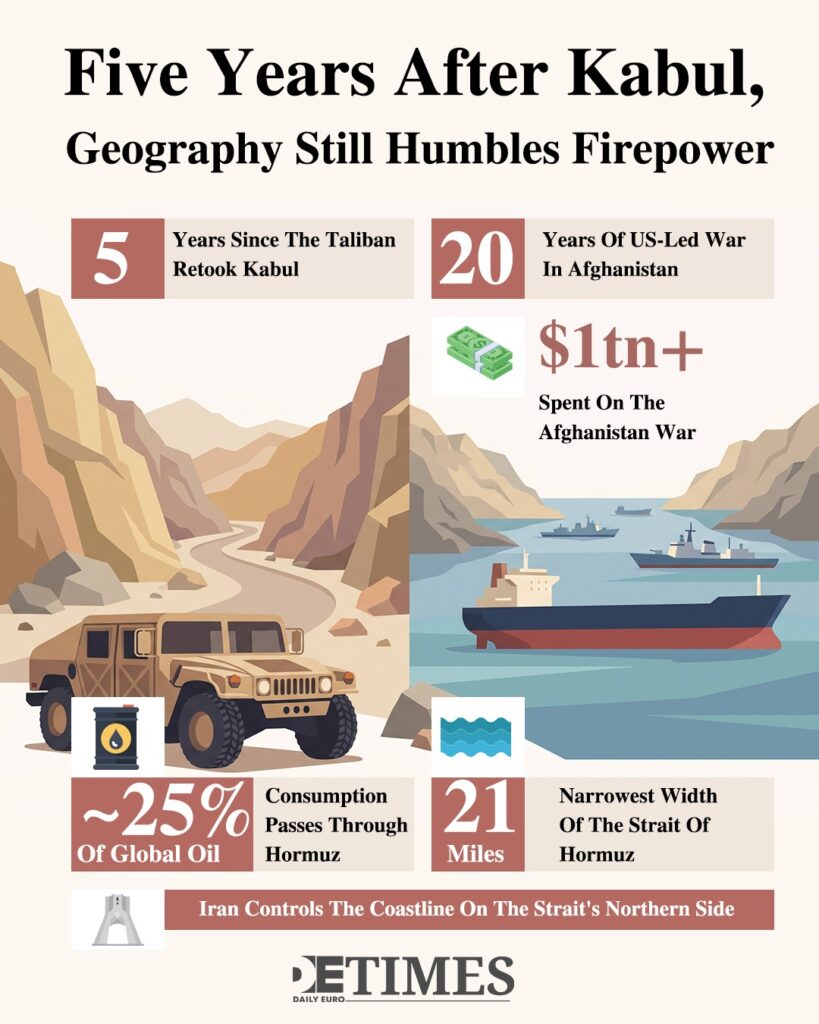
The celebrations closed a two-decade war that killed thousands of Americans and consumed more than a trillion dollars, without producing a government able to stand on its own.
Five years later, the Taliban administration remains internationally isolated, with Russia standing alone as a country willing to recognise it formally. None of this isolation has removed the Taliban from power.
The single force that outlasted American soldiers, drones and satellites was the mountainous ground itself. A comparable geography now works against Washington in the Gulf.
Kabul and Hormuz Share One Recurring Obstacle
Afghanistan’s ridges once absorbed American patrols the way Vietnam’s jungle absorbed an earlier generation of soldiers, turning superior firepower into a repeated stalemate. Iran holds something equally hard to conquer, control of a narrow sea lane carrying a quarter of the world’s oil.
The current Iran war began after American and Israeli strikes killed Iran’s Supreme Leader and other senior officials in February, an assault meant to break Tehran’s command structure at once. Instead of collapsing, Iran’s government answered by squeezing the Strait of Hormuz, a manoeuvre that needs no army stationed abroad and no territory held far from home.
The Strait as a Modern Mountain Pass
The Islamic Revolutionary Guard Corps has spent months treating the strait as its own checkpoint, warning vessels away from unauthorised routes and firing on ships it suspects of breaching them.
President Trump has claimed the waterway is now under American control after a minesweeping operation; shipping data maritime trackers have gathered still points to subdued traffic and rerouted tankers.
Iran’s deputy foreign minister answered Trump’s suggestion of declaring the strait American territory with a short reply, saying the strait “has been Iranian, is Iranian, and will remain Iranian.”
The exchange displayed geography’s edge over firepower along a coastline no navy can fully police.
Gulf States Chart Their Own Course
Neighbouring Gulf governments have responded with pragmatism, choosing engagement over confrontation.
A missile barrage on Najran recently pushed Riyadh toward Ankara and Islamabad for a defence pact, meaning regional partners increasingly manage their own protection.
Abu Dhabi has weathered direct attacks on its shipping with composure. It keeps positioning itself as a hub for trade and diplomacy, even as tankers linked to its state oil company drew fire in the strait.
Doha, too, has become an unlikely custodian of the war’s loose ends, reportedly holding Iranian military pilots shot down early in the conflict.
This does not mean Gulf states are drawn into the fight on Washington’s terms. Their governments are hedging instead, building relationships that outlast any single American administration.
Old Alliances Draw New Fault Lines
A renewed Mediterranean bases arrangement between Moscow and Damascus, paired with an unproven Iraqi claim of Ukrainian involvement, hints at a Middle East drawn deeper into a distant European war.
But these developments do not change the underlying geometry of the fight. Oil still passes through one narrow channel, and Iran still occupies the ground beside it.
What Terrain Cannot Change
Kabul’s mountains never surrendered to occupation, and Hormuz’s shipping lane seems no closer to surrendering to a blockade fleet. Washington commands immense naval and air power, ample enough to damage Iranian infrastructure repeatedly, as strikes through July already proved.
What such power cannot do, on present evidence, is convert bombing runs into control of a coastline Iran can close at will.
A negotiated settlement looks like the safer route, since geography rewards the side that can simply wait. Iran’s economy has suffered under sanctions and years of expense, still its position along the strait gives it bargaining room no army could buy.
Kabul’s anniversary perhaps offers one lasting takeaway. American power keeps meeting ground no strategy has fully mastered.
Keep up with Daily Euro Times for more updates
Read also:
Hormuz Battle Tests European Energy Nerves
Pacifists Buy Missiles: Bern and Tokyo After Hormuz
How Germany’s Taliban Pact Built a Recruiting Ground