
Syria and Russia signed a memorandum of understanding on Sunday, settling the future of the Tartus naval base and the Khmeimim air base after eighteen months of negotiation. Russia leaned on the two facilities to prop up Bashar al-Assad, whose government collapsed under a rebel offensive roughly two years ago, ending the Syrian war.
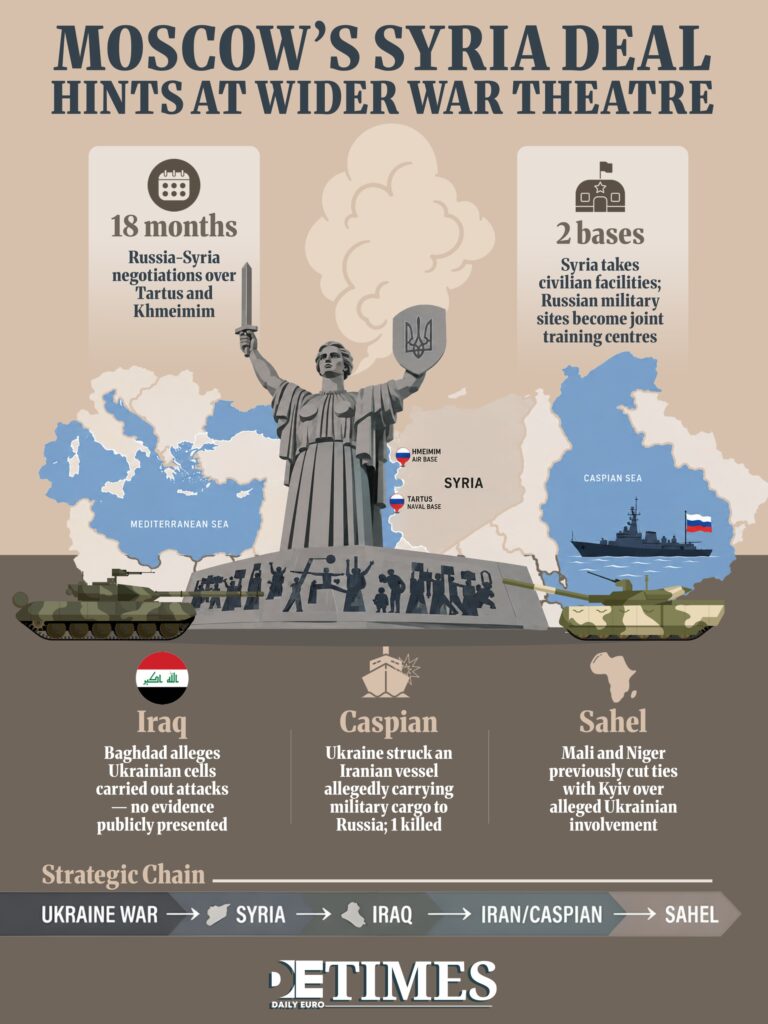
President Ahmed al-Sharaa has visited Moscow twice since taking power, even as Damascus keeps pressing for Assad’s extradition from Russian soil. Under the new terms, Syria takes over civilian facilities at each site, and the remaining military installations become joint training centres inside three months.
A rival claim out of Baghdad now stands alongside Moscow’s Mediterranean gains. Iraq’s national security adviser says Ukrainian cells have carried out bombings on Iraqi soil, an accusation Kyiv calls groundless.
The Baghdad claim followed Ukraine’s own push into Middle Eastern waters, where its forces struck an Iranian vessel supplying Russia’s war machine weeks earlier. Read together, the two threads point to a Syria-Iraq corridor drawn into a rivalry that has already reached Africa’s Sahel.
A Coastline Changes Hands
The Mediterranean agreement caps a negotiation opened not long after Assad’s fall. Damascus takes control of Khmeimim airport and the commercial berth at Tartus port, folding each into civilian administration. Russia’s remaining installations turn into joint training and qualification centres, under arrangements the two governments describe as preserving mutual interests. Syria’s foreign ministry called the shift “a reorganizing of the Russian presence” along the coast, a phrase that reads like diplomatic cover for a narrower footprint.
Russia has yet to comment publicly on the memorandum, though its bases stayed operational throughout the talks. The deal narrows Moscow’s hold over its only two official military bases outside the former Soviet Union, turning sole command into a shared arrangement. Al-Sharaa’s government has pressed the point that Syrian sovereignty over its own territory is not open to negotiation.
Tha’t framing turns a basing deal into proof Syria’s new authorities can extract terms from a patron that once answered to nobody inside the country.
Uncorroborated Claim From Baghdad
Iraq’s turn in this contest opened weeks before the Syrian memorandum, in late July. Qasim al-Aboudi, Iraq’s national security adviser, told Dijlah television an intelligence unit had concluded there was Ukrainian interference inside Iraq. He said security forces arrested a small number of groups responsible for attacks on government facilities, without naming a single target.
Ukraine’s foreign ministry dismissed the claim as groundless and noted al-Aboudi had offered no evidence to support it. Al-Aboudi himself later acknowledged the investigation remained open before blame could fall on either side.
Commentators in Baghdad have linked the accusation to two separate pressures on Iraq’s government, pressure over persistent attacks by armed factions and pressure from Iran-aligned circles rattled by Ukraine’s growing reach into the region. Al-Aboudi and his predecessor both hold close bonds with the Badr Organisation, an armed faction aligned with Tehran.
A Caspian Prelude
The Baghdad allegation followed a maritime clash that had already strained relations between Kyiv and Tehran. Ukraine struck an Iranian cargo vessel in the Caspian Sea in late July, killing one sailor and wounding several more. Kyiv said the ship carried military cargo bound for Russia, part of a supply line Tehran has run for Moscow since the war opened.
Iran’s foreign minister warned the strike could not go unanswered, and Ukraine’s foreign minister urged Tehran to end its support for Russia instead of escalating further. The exchange left Tehran-aligned officials primed to view any accusation involving Kyiv with readymade suspicion.
Iraq’s security establishment keeps close bonds with Iran-backed factions, and its own intelligence services operate inside a country still recovering from decades of foreign interference, real and alleged alike.
Echoes From the Sahel
None of this counts as the first stretch of the Middle East or Africa pulled into the Ukraine war’s reach.
Mali severed relations with Kyiv in 2024 after a Ukrainian intelligence spokesman all but claimed credit for a rebel ambush that killed dozens of Wagner fighters. Niger did the same within days, and Senegal summoned Ukraine’s ambassador over similar accusations. Russia has since recalibrated its posture, building presence in Sudan and along the Red Sea after losing ground in Mali’s own contest. The Sahel record offers a template that needs no formal declaration from Moscow or Kyiv before a new theatre opens.
A Claim Baghdad Cannot Prove
Baghdad’s own government has responded to its adviser’s claim with caution, insisting Iraq wants to stay clear of regional and international conflicts. Whether Ukrainian operatives ever set foot in Iraq stays unconfirmed, and Iraqi officials have offered no evidence outside their own account.
Russia already holds firmer legal footing on Syria’s coast after Sunday’s memorandum. Kyiv’s intelligence services keep operating wherever Moscow holds interests, in Mali, along the Caspian Sea, and now perhaps in Iraq. Baghdad’s next step rests on whether it can produce proof, something it has not managed so far in a rivalry that keeps finding new ground to occupy.
Keep up with Daily Euro Times for more updates
Read also:
Double Bind: Struggle in Syria Between
Iran and Ukraine’s Wars Are Converging
Syria: Latest Visit Hints at Russia’s Return to Syria

