
This year, the foreign minister of the Democratic Republic of Congo delivered a blunt message to Europe’s most powerful football clubs: stop taking Rwanda’s blood money.
The Minister called on Arsenal, Bayern Munich, and Paris Saint-Germain to sever their sponsorship ties with Rwanda’s tourism board. The moral high ground, however, proved fleeting. Within months, the DRC signed its own deals with AC Milan and AS Monaco.
Both countries now compete for influence on European football pitches while, far from the floodlights, armed groups backed by Rwanda seize territory in eastern Congo, displacing a quarter-million people in a devastating conflict.
The Soft Power Playbook
Rwanda pioneered this strategy.
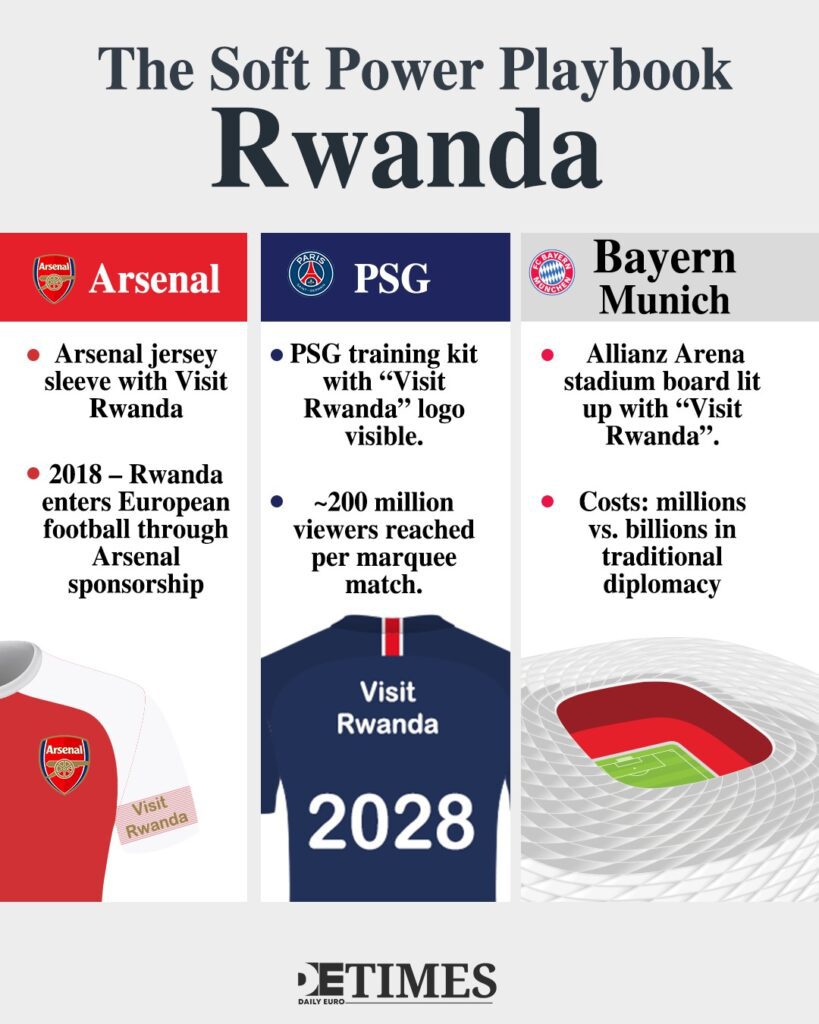
Beginning in 2018, the small East African nation began plastering “Visit Rwanda” across European football’s most prestigious stages. The slogan appeared on Arsenal’s sleeves, PSG’s training kits, and Bayern Munich’s stadium boards: they all advertised a country many Europeans would be hard-pressed to find on a map. For a nation smaller than Belgium, it was an audacious bet on visibility.
The strategy works because it exploits a fundamental truth about the modern economy; a government minister’s speech reaches diplomats and policy experts yet a football sponsorship reaches an estimated 200 million viewers during a single marquee match.
For a fraction of what many countries spend on traditional diplomacy, Rwanda gained a level of global brand recognition that embassy receptions could never deliver.
Congo’s Counter-Play
Kinshasa could not let that challenge go unanswered.
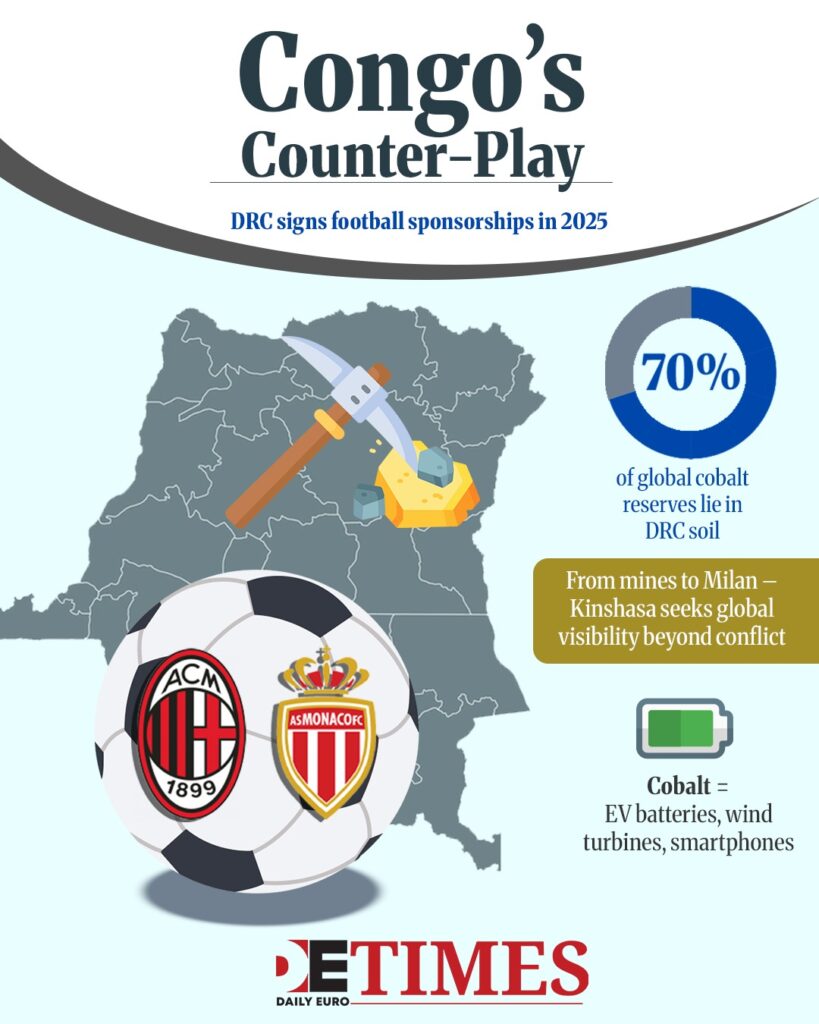
In July, the DRC announced its own partnerships with AC Milan and AS Monaco, framing them as an investment in national branding. The country that produces most of the world’s cobalt, officials argued, deserved to be known for more than conflict. A fair point, yet the timing of the deals tells a different story.
Both countries understand something European policymakers are only beginning to grasp: the minerals that power Europe’s green transition come from their soil. Rwanda has become a crucial partner in E.U. supply chains for rare earth elements. Congo sits on 70 percent of global cobalt reserves, essential for every electric car battery and wind turbine. Football sponsorships may cost millions, but mineral extraction rights are worth billions.
Blood and Goals
Strip away the marketing gloss, and a grimmer picture emerges.
While Rwanda courts European football fans, United Nations investigators have repeatedly documented its material support for the M23 rebels who now control mineral-rich territories in eastern Congo. The Security Council unanimously condemned M23’s latest offensive in February. With each U.N. report, Rwanda’s denials grow thinner.
Europe’s Role: Supply Chains
The calculus is as simple as it is brutal. M23 controls mines that generate millions in illicit revenue. Rwanda processes and exports minerals extracted from territories its proxies control.
European companies then purchase these materials through ostensibly legitimate supply chains. Some of those profits, in turn, fund the very football sponsorships that burnish Rwanda’s international image. Congo’s own mineral wealth, meanwhile, flows through similar channels to finance its own European football deals.
Europe’s Moral Hazard
European clubs have become unwitting, and at times willing, participants in Africa’s resource wars.
When Arsenal’s players take the field with "Visit Rwanda" on their jerseys, they are advertising a country that U.N. experts say is fueling a bloody conflict. When AC Milan promotes Congo’s tourism potential, it is effectively whitewashing a government that profits from the same mineral extraction driving regional instability.
This contradiction is not lost on European fans. Earlier this year, Bayern Munich supporters protested their club’s Rwanda partnership, displaying banners highlighting human rights violations. The club ultimately pulled out of renewal negotiations. Other clubs, however, continue to cash the checks.
The Real Game
Neither Rwanda nor Congo invented this playbook.
States have long used sports to launder their reputations and project soft power. What is different now are the stakes. The minerals these countries control are not just valuable – they are indispensable to Europe’s climate goals and digital future. Every electric vehicle, wind turbine, and smartphone depends on materials extracted from their soil.
Football partnerships give both countries something traditional diplomacy cannot: direct access to European public opinion. When millions of fans see “Visit Rwanda” during a match, they are not thinking about mineral extraction or proxy wars. They are thinking about safaris and mountain gorillas. That impression is worth more than a dozen ambassadors’ speeches.
Playing by New Rules
It is time for European football authorities and governments to reckon with their role in this system. Clubs that accept sponsorship money from countries waging proxy wars become complicit in those conflicts. Leagues that profit from mineral wealth while ignoring its human cost perpetuate the very injustices they claim to oppose through their social responsibility initiatives.
The solution is not to ban African sponsorships, which would be both paternalistic and counterproductive. Instead, European institutions should demand radical transparency about funding sources and impose meaningful consequences for human rights violations. When countries use football partnerships to obscure atrocities, the beautiful game becomes an ugly charade.
Rwanda and Congo will continue their soft power competition through European football while their citizens pay the price for the resource wars at home. The question is whether European clubs will keep playing along, or finally begin to ask where the money comes from. In a sport that claims to unite the world, that distinction matters more than any trophy.
Keep up with Daily Euro Times for more updates!
Read also:
Size Doesn’t Matter: Luxembourg and Rwanda Win Big
Bukavu Falls to M23 in Eastern Congo
Chaos in the Congo: The Fall of Goma

