

Nigel Farage’s Reform UK has seen a significant rise in support in recent months, particularly on immigration policy. Despite having only four seats in the House of Commons, the party has been able to capitalise on widespread public dissatisfaction with the government’s handling of immigration.
National polls show that the party’s position on immigration resonates with a significant proportion of the electorate, making it a serious player in British politics.
Reform UK Immigration Policy
The party is proposing a tough approach to illegal migration.
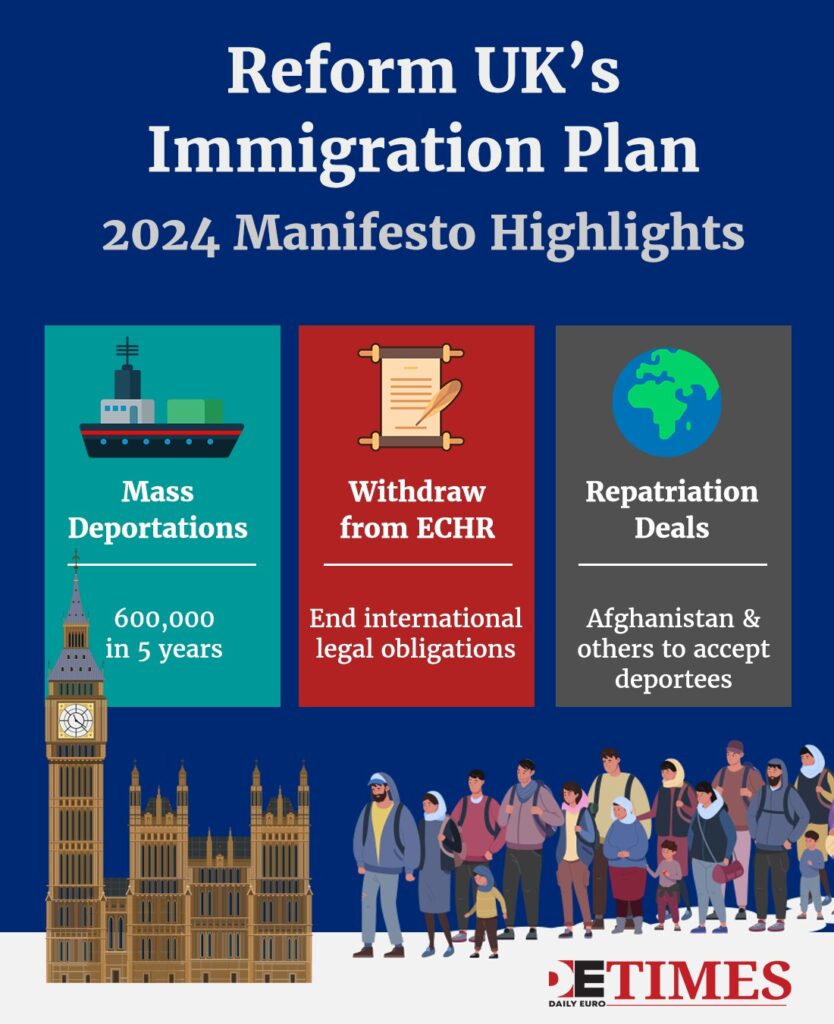
Their 2024 manifesto, Our Contract With You, envisages the deportation of up to 600,000 refugees in the first five years of government. While such measures may be attractive to voters who favour strict border controls, the practical and ethical issues associated with carrying out mass deportations are significant.
Policymakers must consider international law, bilateral agreements, and the potential social impact of such policies to ensure that their implementation does not exacerbate humanitarian crises for those seeking persecution or in fact damage the UK’s reputation globally as a place of refuge and multiculturalism.
Key Measures Include:
- Mass Deportations: immediate detention and deportation of people arriving in the UK illegally, particularly by boat. The party argues that this approach will serve as a strong deterrent to illegal entry and reduce the perceived pressure on public services.
- Withdrawal from International Agreements: Plans to withdraw from the European Convention on Human Rights to make deportations easier. Reform UK claims that such a move would allow the government to act more decisively without being constrained by international legal obligations.
- Repatriation Agreements: negotiations with countries such as Afghanistan to take in deportees. These agreements are intended to ensure that deported individuals have a country willing to accept them, although critics question the feasibility and ethical implications of such deals.
These measures are hotly debated, with critics questioning their feasibility and potential impact on human rights.
Public Opinion and Support
Polls show that immigration has become a major issue for voters.
Many see illegal migration as a serious problem, with up to 1.3 million people potentially in the country without legal status. Reform UK's tough stance has attracted significant support, particularly from disillusioned traditional party voters on the right and left.
Such trends reflect a broader shift in the electorate towards security-oriented policies, where perceived control over borders increasingly influences voting behavior. While addressing illegal migration is important, policy solutions must balance enforcement with humanitarian obligations to avoid social and international repercussions.
Observing how parties communicate these positions will likely determine their credibility and long-term public support over headline-making matters.
Political Implications and Strategy
Reform UK’s rise to prominence is forcing traditional parties to reconsider their positions on immigration.
The Labour leader has proposed introducing digital identification to tackle irregular migration. However, analysts say this may not be enough to counter Reform UK’s populist appeal. The party’s local election victories show that immigration is becoming a key factor in electoral success.
The rise in support for Reform UK reflects a wider trend: popular dissatisfaction with the traditional political parties and their approach to immigration. As the next general election approaches, the party’s ability to retain and expand its support base will depend on how its immigration policy and overall vision for the country are perceived.
Immigration remains a key factor shaping UK politics.
Read the Latest Articles on DET!
Relations in the Rear View For Now: The U.S.-India Diplomatic Crisis
Social Capital Lives On: The Story of Germany and Russia
A New Wave of Bioethics: The Frontiers of Genetic Engineering

