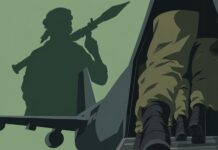

On 29 April, a paid attacker stabbed two men in London, leaving both seriously injured, one a dual US-British citizen. A few weeks later, prosecutors in New York named the organiser as Mohammad Baqer Saad Dawood Al-Saadi, a 32-year-old Iraqi commander of Kataeb Hezbollah (KH), who ran more than 18 attacks across European cities under a front group called Harakat Ashab al Yamin al Islamia (HAYI), financing them with cryptocurrency and using hired local criminals to carry them out.
The Federal Bureau of Investigation arrested Al-Saadi in Turkey and flew him to Manhattan in a Foreign Transfer of Custody operation. FBI Director Kash Patel described it as “the latest success in this administration’s historic work to bring terrorists to justice.”
It is the second such operation in quick succession, following the earlier rendition of Venezuelan president Nicolás Maduro, and from each one the Trump administration has taken the lesson that it should press harder. That reading is now driving plans toward a second Operation Epic Fury, which analysts have described as including a possible strike on Kharg Island, Iran’s dominant oil export hub, and a special-forces mission to extract enriched uranium stockpiles.
European Streets, American Prosecution
The Al-Saadi arrest lands in European capitals as belated confirmation of what cities like London and Amsterdam had been living with for months. Prosecutors detailed paid criminal networks in London, Amsterdam, Rotterdam, and Brussels, with Al-Saadi hiring locally and directing operations remotely from Iraq.
A 2024 British parliamentary intelligence review had documented at least 15 Iranian proxy attempts to kill or kidnap people in the United Kingdom since 2022, and British intelligence had been monitoring HAYI before the mask came off.
The revelation that the group was a KH front all along puts Keir Starmer’s government in an uncomfortable spot, hosting victims of a war whose opening strikes arrived entirely outside European decision-making.
The arrest has put the question of an appropriate response squarely before Starmer and counterparts in The Hague, Brussels, and Berlin.
One foreign policy research institution described Europe’s overall response to the Iran conflict as unusually fragmented, with governments scrambling to react to a conflict they had neither anticipated nor prepared for, and in which they had little direct leverage.
An Arrest Built on Kittleson’s Detention
Al-Saadi’s removal from circulation traces back to journalist Shelly Kittleson. The U.S. State Department posted a $10 million reward for KH secretary general Ahmad al-Hamidawi in mid-April, a direct response to the group’s detention of Kittleson from a Baghdad street corner in March.
KH released Kittleson after a week in captivity, on condition she leave Iraq immediately.
All told, the reward and Al-Saadi’s arrest arriving shortly after together reinforced Washington’s reading that posted bounties and covert extractions produce results. Tactical confidence built on operations of this kind tends to crowd out the strategic thinking a durable outcome requires.
Iran’s Uranium Outlasts Each Military Option
The fact is, extracting enriched uranium from fortified bunkers and arresting a militia commander in Istanbul sit on entirely different scales of risk and reversibility. “You just can’t bomb knowledge away,” Harvard professor Matthew Bunn told military researchers.
Iran holds an estimated 12 tonnes of uranium enriched to varying degrees, with reinforced tunnels near Isfahan housing much of it, and US Energy Secretary Chris Wright confirmed that a portion sits weeks from weapons-grade purity.
Defence analysts at the Foundation for Defense of Democracies assessed that seizing Kharg Island would likely trigger mass Iranian counter-attacks on already-stretched US forces, with the net effect of dragging the conflict out considerably longer.
The Opening Europe Keeps Missing
On Monday, Donald Trump announced he had called off a strike on Iran planned for Tuesday, after Qatar’s Emir Tamim bin Hamad Al Thani, Saudi Arabia’s Crown Prince Mohammed bin Salman Al Saud, and the United Arab Emirates’ President Mohamed bin Zayed Al Nahyan asked Trump to hold off, stating that serious negotiations were under way and that, in their opinion, a deal would be reached.
Trump confirmed he had instructed the military to “be prepared to go forward with a full, large scale assault of Iran, on a moment’s notice,” pending the outcome of negotiations. The Gulf leaders proved, in one afternoon, that direct engagement with Washington produces measurable results.
Europe is the single largest trading bloc in the world, the continent whose streets bore the brunt of Al-Saadi’s network, and a net importer of the energy supplies now disrupted. Its standing in ceasefire negotiations arguably exceeds what its current silence suggests.
The question is whether European governments will go on absorbing the consequences of a war whose opening was entirely of others’ making, or whether the narrow window of ceasefire talks offers a chance to press, collectively and with real economic weight, for the verifiable nuclear agreement that makes all subsequent military options redundant.
Keep up with Daily Euro Times for more updates
Read also:
Islamabad: Recycling the Failed Iran Nuke Deal?
Iran Crisis Puts Ireland on the Sharp End
EU Targets Stablecoins as Iran Forces Digital Tolls