

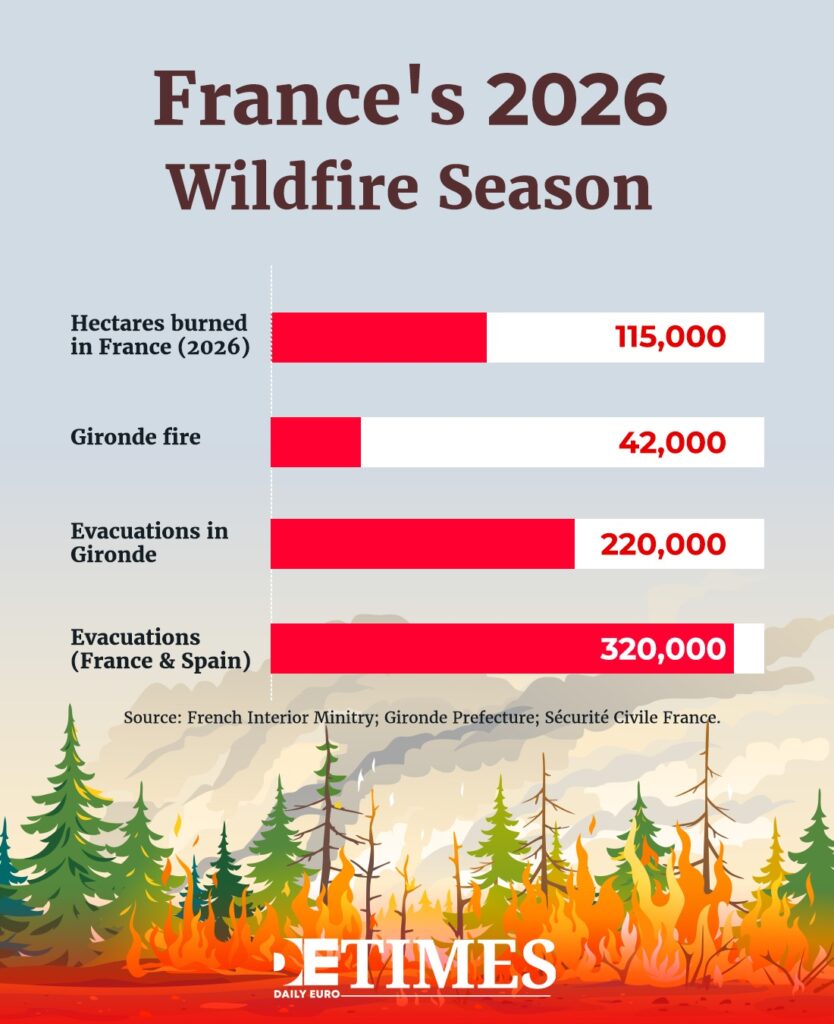
Wildfires in southwestern France have advanced to within roughly 15 kilometres of the Bordeaux metropolitan area, forcing what authorities have described as the largest peacetime evacuation in France since the Second World War. In Gironde alone, 220,000 people have been evacuated, with 320,000 displaced across France and Spain combined.
The main blaze, which started on Tuesday, had burned approximately 42,000 hectares by Sunday morning, an area four times the size of Paris and seven times the area of Manhattan, much of it forests and scrubland made tinder-dry by successive heatwaves. More than 2,500 firefighters, 1,500 soldiers and 1,200 police officers are deployed, supported by 18 aerial firefighting assets. Eighty-four firefighters have been injured.
Bordeaux’s mayor said the city itself, home to 270,000 residents within its boundaries and roughly one million in its metropolitan area, is not directly threatened. But communities surrounding the city have been ordered to evacuate, and Le Porge, a commune to the west with 3,500 residents, has been devastated. Sixty kilometres of the A63 motorway south towards Spain has been closed, SNCF has halted trains for approximately 100 kilometres south of Bordeaux, and the Gironde prefecture has banned summer camps and Scout activities across the department, citing “exceptional circumstances.”
Bordeaux is Not Just Another Fire Zone
The danger to Bordeaux gives the crisis unusual economic and symbolic weight. Gironde is closely associated with wine production, Atlantic tourism and some of France’s most valuable landscapes. Wine grower Theo Hernandez, speaking from the fire zone, described farmers delivering water in tanks to fire crews so that firefighters could maintain their battle without interruption. Even where flames do not directly reach vineyards or urban districts, smoke, evacuations and transport disruption can damage tourism during the peak summer season.
The threat also challenges the old assumption that extreme wildfire disasters belong mainly to Mediterranean France. The Gironde experienced severe fires in 2022, but the proximity of the latest blaze to a major European city makes the risk harder to treat as a peripheral rural problem. Interior Minister Laurent Nunez said on Sunday that 115,000 hectares had burned across France so far in 2026, “far more than anything we have seen in the past.”
Several Conditions Aligned
The intensity of the fires reflects a dangerous sequence of weather conditions. An unusually wet winter encouraged grass and vegetation to grow abundantly. Repeated heatwaves and very low rainfall then dried that growth into fuel. The Gironde’s nearly one million hectares of bracken and fern proved as combustible as the native pine trees.
Once ignited, flames spread from grasses into roots and woodland, where they became extremely hard to extinguish. Meteorologists recorded a pyrocumulonimbus, a fire-generated thunderstorm capable of producing lightning that starts new blazes, for the first time ever in France. July temperatures across affected parts of western Europe have averaged almost 6°C above historical norms, and another temperature rise is forecast for midweek.
France is not facing the emergency alone. Spain has also evacuated tens of thousands of residents as fires burn near Madrid, Ávila, Toledo and Valencia. European partners including Italy, Greece, Turkey and Portugal have provided aircraft, troops or other assistance.
An A400M military cargo aircraft has been converted for water bombing, a measure that reflects the sheer scale of resources now required. Pope Leo, at his Sunday Angelus, said he expressed “solidarity” with those affected and “invite[d] everyone to pray for those affected and for the work of the rescue workers.”
The Crisis is European
This is precisely the sort of emergency for which European solidarity is necessary. No national firefighting service can maintain unlimited aircraft, crews and equipment for simultaneous extreme events across the continent. The scale of the Gironde fire alone, with tens of thousands of people sheltering in makeshift facilities in exhibition centres and sports halls across southwestern France, illustrates what happens when a climate event outpaces ordinary national response capacity.
European solidarity mechanisms have already been activated, and the cross-border mutual assistance between France and Spain reflects years of building those frameworks. But the political pressure to go further, towards permanent shared firefighting capacity, a larger European Civil Protection Pool and faster procurement of heavy aerial assets, will intensify every year that fire seasons like this one arrive earlier and burn harder.
Adaptation Can No Longer Wait
Climate change does not ignite every fire, and human activity remains a major source of ignition. But hotter conditions, drought and extended fire seasons make individual outbreaks more likely to become uncontrollable disasters. Europe has spent years debating emissions targets, but the Bordeaux emergency illustrates the equally urgent need for adaptation: managed forests, wider firebreaks, resilient transport networks, stronger evacuation planning and larger shared firefighting capacity.
Bordeaux may avoid the worst. Yet the image of flames moving towards one of France’s major cities already marks a new stage in Europe’s climate reality. Wildfire is no longer only a threat at the continent’s edges. It is approaching its urban and economic centres, and the gap between the scale of the danger and the scale of the preparation is closing faster than policy has managed to follow.
Keep up with Daily Euro Times for more updates
Read also:
Singapore: A Fire to be Put Out
France, Germany Seek Software Success After Jet Failure
Green Pledges, Crude Gains: France’s Energy Schism