
An Algerian military convoy reportedly entered Arlit, the uranium hub of northern Niger, last week, in Algeria’s first ground deployment abroad since the 1973 Arab-Israeli war. Parliament had approved the mission last month. President Abdelmadjid Tebboune ordered the deployment after Niger’s military government asked for help, insisting Algiers is “not sending our soldiers to wage war in Niger”.
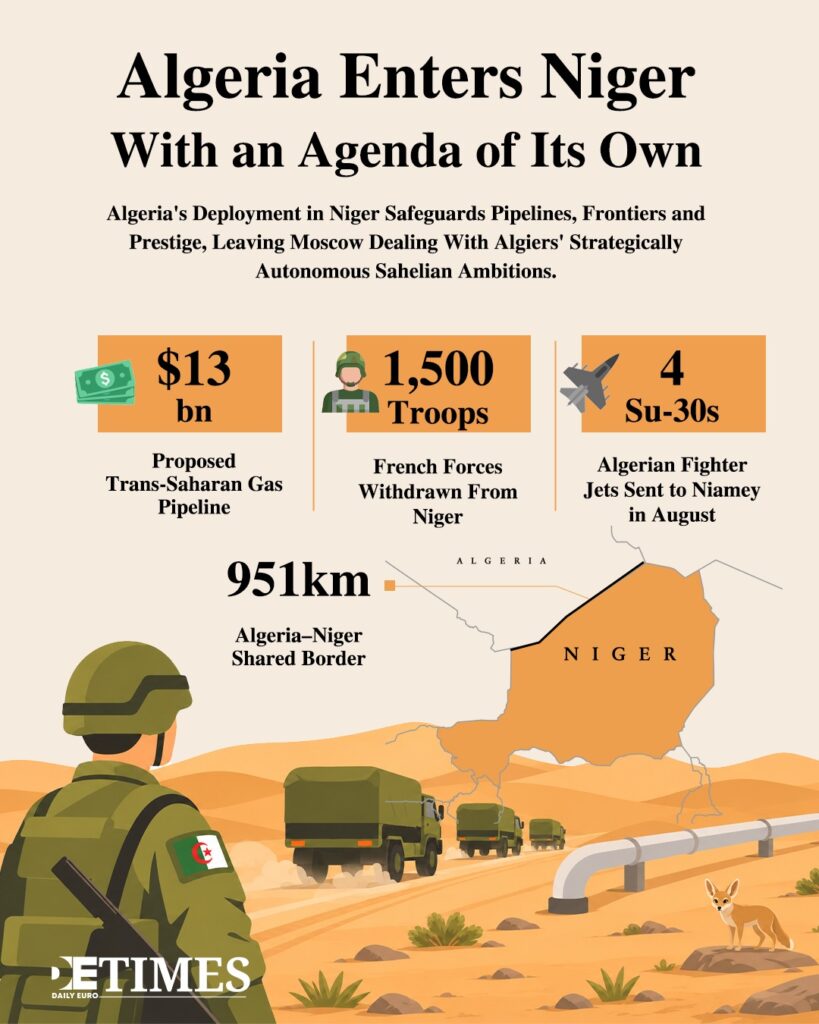
Relations had thawed in February with the return of ambassadors, and Algiers had already sent four Su-30 fighter jets to Niamey in August after a mutiny.
The mission serves Algeria’s frontier and gas interests above all, regional capitals are filling the room Western armies vacated, and Russia probably finds Algiers pursuing an agenda of its own.
Border, Gas and Prestige
Algeria shares a 951-kilometre frontier with Niger, and a collapse in Niamey would push armed groups and desperate migrants northwards. Foreign Minister Ahmed Attaf told legislators “Niger’s security is part of Algeria’s security”. Such words would have sounded improbable last year, after Niger recalled its ambassador over Mali’s accusation Algeria had downed a drone.
Arlit itself hosts the uranium mine Niger took from France’s Orano last year, a reminder of how much Niamey’s resources attract outside attention.
Algeria’s state energy firm holds interests in Niger and takes part in the proposed Trans-Saharan Gas Pipeline. The $13 billion scheme would carry Nigerian gas through Niger towards Algeria and onward to Europe, and its northern stretch crosses a region where armed groups and illicit trafficking thrive.
Lawmakers named Madama, a former French military hub near the Libyan border, as the base, and its position could give Algiers an observation post over the wider Sahara.
A published assessment warns a guarded gas facility does not necessarily secure the roads leading to it, an evaluation which fits a mission centred on energy assets and transport routes.
Regional Powers Fill the Western Void
Those motives gain force in a Sahel Western armies have abandoned. France pulled roughly 1,500 troops out of Niger nearly three years ago, and Washington gave up its Agadez drone base two years ago.
Niamey turned to Russia’s Africa Corps for protection. In August, Russia’s ambassador in Niamey credited Africa Corps with defeating the mutineers, and Algiers answered with jets of its own.
As Algiers and Rabat court the Alliance of Sahel States (AES), which groups Mali, Burkina Faso and Niger, some observers read the Algerian display as a message to Morocco.
Paris has reportedly restored security cooperation with Algiers after months of frost, which says a good deal about who holds leverage.
Supporters invoke the African Union principle of African solutions to African problems. Niger has also grown closer to Morocco, so competition for Niamey’s attention is likely to intensify.
Russia’s Foothold and Algeria’s Calculations
Algeria buys the bulk of its weaponry from Russia, and the Su-30 jets sent to Niamey came from Russian factories. Overlapping interests explain the convergence, but public evidence points to no joint command.
Niamey gains leverage by courting several patrons.
Africa Corps looks stretched after losing Kidal in April, and Foreign Minister Sergei Lavrov nevertheless promised the AES an open-ended military commitment in July.
In Niger, the Russians play a lighter supervisory role than in Mali, which leaves room for heavier equipment from Algiers.
Algeria fields what some rankings call the second most powerful army in Africa, and it offers border knowledge and pipeline investment, assets a lean Russian presence lacks.
Algiers has long refused foreign bases on its doorstep and once voiced alarm over Wagner mercenaries in Mali. Algerian commentator Akram Kharief wrote of a broader ambition to hold “strategic depth south of the Sahara”. Such ambition leaves little room for a junior role, and Moscow may find Algiers competing for favour in Niamey.
Keep up with Daily Euro Times for more updates
Read also:
Niger Airport Attack and France’s Aerial Footprint
As Algeria and Mali Clash, France Finds New Opening
Can Libya’s Energy Promise Outdrill Its Divisions?