

Explosive drones tore through diesel tanks at Zawiya, Libya’s largest working refinery, in mid-August, prompting the National Oil Corporation to warn it might halt operations. A car bomb had already killed the Libyan National Army’s intelligence chief in Benghazi, an assassination that unsettled a fragile American-brokered plan to reunite the country’s rival governments.
Europe’s search for gas away from Russia has turned this divided state into an improbable candidate for stable supply. The gap between Brussels’s hopes and conditions on the ground could hardly be wider.
Libya does not currently earn the label its geology invites. The income now flowing toward it, though, may become the strongest tool its rivals have ever held for building something like a functioning country.
A Refinery Under Militia Rule
The Zawiya facility stands at the centre of Libya’s oil economy, holding the country’s biggest refinery, an export terminal and a power plant serving a quarter of a million residents.
Local commanders treat the site less as shared infrastructure and more as a source of income, profiting from smuggling and protection rackets tied to its black-market trade.
Prime Minister Abdul Hamid Dbeibah denounced the strikes as a grave offence and vowed to find those responsible, though no faction has claimed them. The killing in Benghazi carries similar consequences for the eastern side.
Observers of the country warn it could delay or unravel a reunification effort resting on senior officers answering to a single chain of command.
Molecules Europe Still Needs
Brussels has legislated its way out of Russian gas, banning new liquefied natural gas contracts from next year and pipeline imports the year after. Russia’s share of the bloc’s gas imports has fallen from around 40% in 2021 to roughly 6% for pipeline supply now.
Norway, Qatari cargoes and American LNG have filled most of the difference. Officials in Brussels still hope North Africa can fill more of the gap.
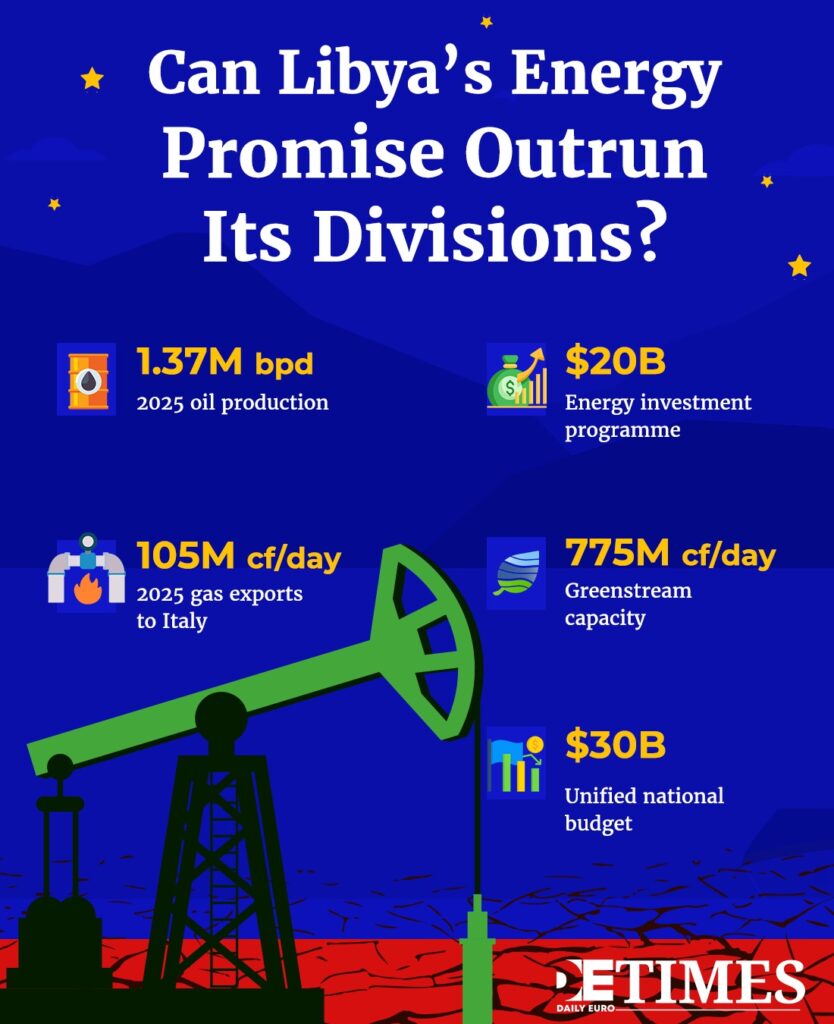
Libya’s oil output has genuinely recovered. Production reached an average of 1.375 million barrels a day last year, the highest in over a decade, and a $20 billion investment programme now funds further growth.
Gas output lags far behind. Deliveries through the Greenstream pipeline to Sicily averaged only 105 million cubic feet a day in 2025, a small fraction of its 775 million cubic feet capacity. Domestic power shortages leave little gas spare for export. Algeria alone now supplies close to a fifth of the bloc’s pipeline gas; Libya’s share barely registers.
The price of getting supply security wrong touches European taxpayers directly. Commission President Ursula von der Leyen said the bloc spent an extra €25 billion on oil and gas during the opening weeks of the summer’s Hormuz crisis. A Libya capable of dependable exports would ease the risk considerably. A Libya where rival militias still hold the ground cannot offer it.
Libyan officials are already framing the country as part of the answer. Speaking on a panel at the Offshore Northern Seas conference in Stavanger, Norway, on Wednesday, Oil and Gas Minister Khalifa Abdel Sadig said Libya believes it can help Europe offset the energy supply losses tied to the closure of the Strait of Hormuz.
“There’s no doubt that we are going through very challenging times when it comes to energy security,” he told the panel, adding that Libya could become a “key player in providing energy security solutions” for the European Union.
The pitch runs straight into the same contradiction the rest of this piece describes. Smuggling still drains value from Libya’s oil and gas sector, and attacks on facilities like Zawiya raise doubts about whether a country still working through more than a decade of unrest can guarantee anything close to reliable supply.
Washington’s Wager on Unity
Energy revenue already looks capable of building political convergence in Libya. In April, the two governments agreed a unified national budget worth roughly $30 billion, the first since 2013.
American envoy Massad Boulos has pressed the case further, encouraging companies including Chevron and ConocoPhillips to invest and presenting reunification as the condition for larger returns.
The convergence extended to the battlefield too. April also brought the first joint training between the rival camps’ soldiers in over a decade, a modest but genuine sign of change.
An oil sector generating tens of billions of dollars a year gives factions more reason to cooperate over its management than any diplomatic communiqué has managed in fifteen years.
Keep up with Daily Euro Times for more updates
Read also:
Libya Twin Attacks Strain a Fragile Unity Push
Gaddafi Assassination Opens a Road for Haftar in Libya
Libya’s Aviation Struggle: How Rival Factions Block a Unified National Airline