

Croatian police arrested Volodymyr Zhuravlov days ago on the set of Snake Island, a Hollywood production reconstructing the pipeline sabotage he stands accused of committing. Doug Liman directs the film, and Sean Penn and Adrien Brody carry its leading roles.
Zhuravlov had been advising the crew on diving technique as officers in Pula intervened, ending a production that had unknowingly cast its own consultant as a defendant.
Nord Stream 1 and Nord Stream 2 once carried Russian gas beneath the Baltic Sea toward Germany, until three of their four pipes ruptured in explosions four years ago.
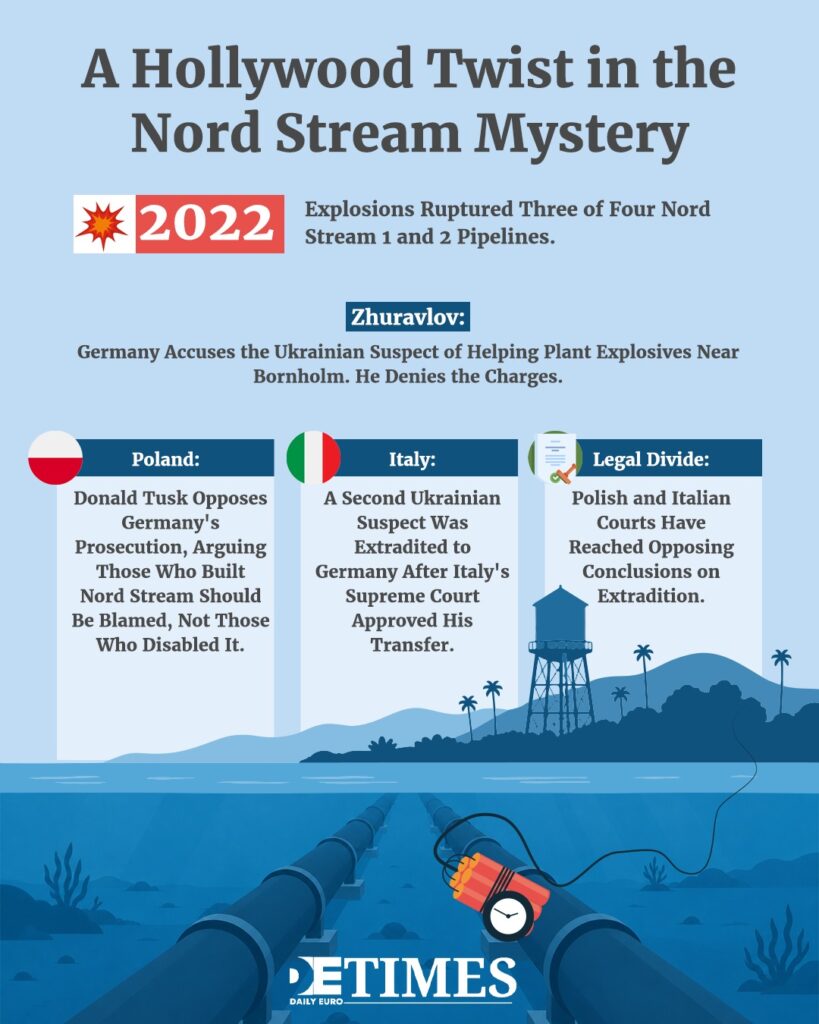
German federal prosecutors accuse Zhuravlov of joining a diving team that fixed explosives near the Danish island of Bornholm, a charge he denies. Poland has already handled the accusation once, and Warsaw’s answer complicates Berlin’s pursuit of him for a second time.
Poland’s government keeps insisting that Germany abandon the prosecution altogether. Prime Minister Donald Tusk restated his position days ago, saying “those who built this pipeline should be ashamed, not those who disabled it.”
A Diver Turned Film Consultant
Zhuravlov’s presence on set says less about the sabotage than about how a clandestine wartime chapter has become raw material for entertainment.
Production crews had been filming in Zagreb for weeks, and Croatian broadcasters reported extras dressed as Ukrainian soldiers outside a downtown hotel days before police intervened. Zhuravlov worked as a technical adviser, guiding actors and set designers toward authenticity.
Nothing in the reporting connects his consultancy to the 2022 attack, and the coincidence, however cinematic, amounts to publicity alone.
German prosecutors have offered no sign that his film work overlapped with the alleged crime, and the arrest appears timed to his travel schedule alone.
Warsaw’s Long Opposition to the Pipeline
Poland’s defence of Zhuravlov did not begin with the Croatian arrest. Warsaw opposed Nord Stream from its inception, viewing the pipeline as a route for Russia to bypass Poland and Ukraine, binding Germany ever closer to Gazprom’s supply.
A Warsaw court ruled on the matter last year, freeing Zhuravlov after finding that German jurisdiction did not extend to an act in international waters during a defensive war.
Nord Stream mattered to Warsaw well before the sabotage, since the project promised Russia a route around Poland’s territory and a firmer hold over German energy policy.
Russian oil revenue still bankrolls the war Moscow wages in Ukraine, and Nord Stream once offered Gazprom a similar lever over Berlin’s choices.
Warsaw’s courts, weighing the sabotage inside Poland’s own history with the pipeline, have treated the divers as participants in Ukraine’s defence.
Sovereignty Explains Warsaw’s Legal Stance
German prosecutors can request a suspect’s transfer, but a Polish judge, insulated from the cabinet, decides whether the transfer proceeds. Tusk himself said last year that the courts alone would rule on Zhuravlov’s fate, a position he has repeated ever since the Croatian arrest revived the case.
Berlin has not accused Warsaw of obstruction, and its foreign ministry made clear last year that it would accept the Polish court’s decision without challenge.
The restraint says something too, showing the two capitals still operate inside the same legal order even as they disagree about outcomes.
Divergent Paths in Italy and Croatia
Zhuravlov is not the only diver caught in this pursuit. Italy handled a similar case differently. Italian police detained Serhii Kuznetsov, a former Ukrainian army officer accused of coordinating the operation, in an Italian village last year.
Italy’s Supreme Court then cleared his transfer despite an earlier block, and Italy extradited him to Germany months later. He now awaits proceedings in Karlsruhe as Zhuravlov remains free.
The divergence turns on how national courts read the conflict, since Polish and Italian judges reached opposite conclusions from comparable facts.
Croatia must now decide which precedent to follow, and its ruling will settle whether Germany secures a defendant or loses a third case to Polish-style reasoning.
Keep up with Daily Euro Times for more updates
Read also:
Europe’s Power Mix is Finally Turning Green
Power Bills So High: The Search for Answers
Rotterdam Blast Tests Europe’s Infrastructure Nerves