

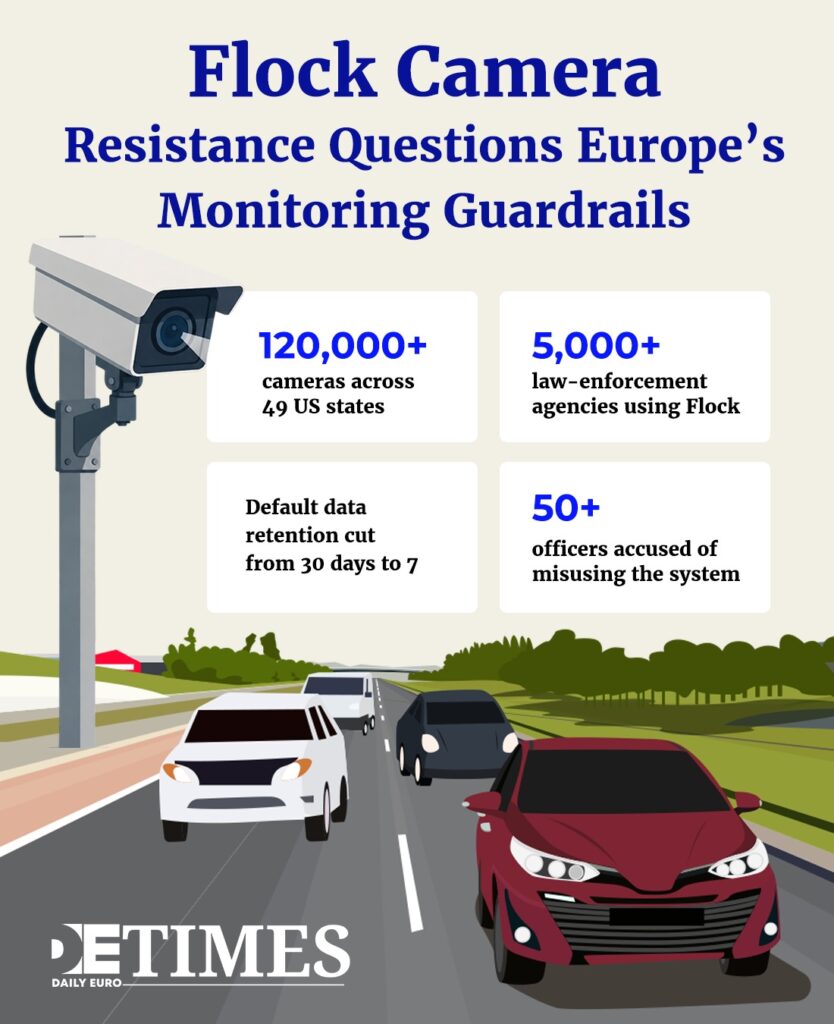
Flock Safety’s roadside cameras have become one of America’s most contested policing tools, used by more than 5,000 law-enforcement agencies and thousands of private communities. The wider network now includes more than 120,000 cameras across 49 states, and police credit the system with recovering stolen vehicles and locating missing people.
Critics describe the same infrastructure as a searchable record of ordinary people’s movements, and cameras are now being cut down, shot at and vandalised across the country. So far there is no confirmed deployment of Flock cameras by a UK police force, though Britain already runs extensive automatic numberplate recognition of its own.
Scale Explains America’s Backlash
A single licence-plate camera is not especially revolutionary, since police have used numberplate readers for years. Flock changes the equation by linking thousands of inexpensive cameras through one cloud database, so an investigator can search for a vehicle and see where it appeared across jurisdictions.
The system can also search by colour, model and other features rather than the plate alone. That network effect is what makes it effective, and also what worries privacy campaigners most.
A tool built to find a stolen car can just as easily reveal where a citizen works, since one photograph counts less than a linked history of thousands. The Washington Post reported this month that at least 50 officers have been accused of misusing Flock to spy on wives, girlfriends and former partners.
In one case, a police chief searched for an ex-partner and her teenage daughter roughly 600 times. A Louisiana deputy was fired this week for tracking a former fiancee’s plate several thousand times over several years.
Sabotage Meets Corporate Reform
That scale helps explain the theatrical backlash. People have cut cameras from poles, spray-painted their lenses and damaged their solar panels in incidents recorded across dozens of states this year.
Police have even used Flock’s own network, in an almost circular twist, to investigate people accused of destroying Flock cameras. Online campaigns have embraced a kind of anti-surveillance folklore, offering fake alibis for vandals and proposing costumes designed to confuse the cameras.
Destroying cameras remains criminal vandalism regardless of the politics behind it, but the popularity of these campaigns underscores how fast surveillance can lose legitimacy once oversight fails. Flock has responded with mandatory audits for abnormal searches, mandatory case numbers for every search, and a cut in default retention from 30 days to seven.
Civil liberties groups welcomed the shorter retention window but argue the other changes still leave too much authority inside police departments.
Europe Would Face Stronger Legal Barriers
A Flock-style system would enter a very different legal environment in Europe, where licence plates and vehicle movements count as personal data once they identify someone. GDPR principles require a lawful purpose, proportionality, limits on retention and restrictions on reuse.
Britain’s Information Commissioner already places automatic numberplate recognition alongside CCTV and facial recognition within the same data-protection rules. That does not make extensive surveillance impossible, since European governments already run large camera networks of their own.
It does mean the friction between local police databases and a privately run, cross-border network would likely be sharper than in America. Regulators would probably ask questions before deployment that many American cities only asked afterwards, including who owns the data and how long it is kept.
Those questions do not guarantee responsible use, but they change the starting point considerably. A network built without judicial oversight from the outset is far harder to rein in later.
Europe Can Learn Before It Copies
The unease extends beyond Flock. In Buenos Aires this month, activists dressed as Gandalf gathered outside the home of Peter Thiel, co-founder of the surveillance-software firm Palantir, whose name plays on Tolkien’s seeing stones.
The comparison is imperfect, since Palantir sells data-analysis software rather than physical sensors, but the anxiety is similar. Democratic institutions can quietly hand extraordinary informational power to private companies whose systems few citizens understand.
There are legitimate reasons European police might want Flock-like technology: it could spot a kidnapped child’s car or track a stolen vehicle across borders. Rejecting it outright would ignore that benefit.
But the American experience suggests that safeguards should exist before deployment, not after scandal, requiring case numbers, automatic flags for unusual activity and judicial authorisation for cross-border searches. Elected governments, not technology vendors, should decide what any such system becomes.
Flock cameras may never cover European roads under the Flock name, and Europe already has enough automated plate readers of its own that the brand is beside the point. America’s experience is a warning to Europe, not a technology to copy.
Its infrastructure expanded because each camera looked reasonable on its own, and its meaning changed only once thousands formed a network that remembers where everyone has been. Europe still has the chance to decide where that line sits, before somebody else draws it in software.
Keep up with Daily Euro Times for more updates
Read also:
Economic Diplomacy: Establishing Safety Zones in Ukraine and Lebanon
French AI Surveillance: Composing for Algorithms or Audiences?
British Safety Laws: Chat Control to Crowd Control