

Keir Starmer’s voice broke as he embraced his wife, Victoria Starmer, outside 10 Downing Street on Monday. He had just confirmed he would resign as leader of the Labour Party and as the United Kingdom’s leader.
Two years earlier, Labour had swept to power with a landslide majority, ending fourteen years of Conservative Party rule. Local elections last month delivered Labour one of its weakest results in decades, as Nigel Farage’s Reform UK gained heavily in councils once considered safely Labour.
Starmer’s resignation lays bare something more consequential than the identity of his successor. Each new occupant of Downing Street now inherits a narrower room to manoeuvre abroad, an observation that holds regardless of personal popularity.
Burnham’s Rapid Ascent to Downing Street
The narrowing of options begins with the succession itself, which has advanced faster than almost anyone expected.
Andy Burnham, the former mayor of Greater Manchester, returned to Parliament last week after winning the Makerfield by-election decisively, defeating Reform UK’s candidate by a wide margin.
Wes Streeting, a former health secretary and one of the few potential rivals, said he would back Burnham rather than mount a bid of his own. Nominations for the Labour leadership open on 9 July and close as Parliament rises for the summer recess a week later.
Should no rival step forward, Burnham could lead Britain within weeks; a contested race would delay the handover until September.
Decade Of Revolving Leaders
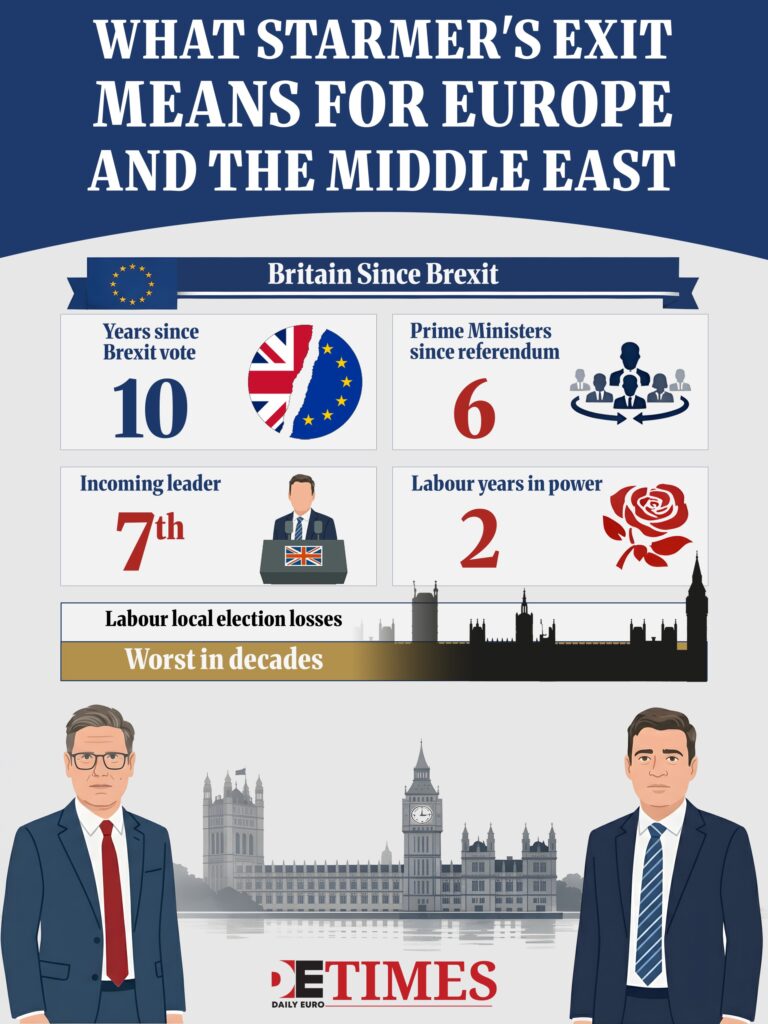
Burnham’s likely installation completes a cycle stretching back a decade. Tomorrow brings ten years since Britons voted to leave the European Union, a choice that has overhauled Westminster ever since.
Since that referendum, Britain has cycled through David Cameron, Theresa May, Boris Johnson, Liz Truss, Rishi Sunak and Starmer, with a seventh leader now due to take over. The cycle’s recurrence rests chiefly on Britain’s underlying economic heft, since governments answer first to wages, borrowing rates and energy bills.
Brussels Reassesses a Cautious Reset
Burnham’s economic inheritance also dictates how Europe treats him, since diplomacy increasingly tracks credibility rather than warmth.
Starmer had spent recent months rebuilding bonds with Brussels, scheduling a summit meant to formalise closer co-operation on trade, security and youth mobility.
European Commission President Ursula von der Leyen credited Starmer with building “a true reset built on trust” after his resignation speech. The EC nonetheless postponed the planned summit pending certainty on his successor.
Norway’s Prime Minister, Jonas Gahr Støre, separately praised the security co-operation forged between the two countries over Ukraine, hinting the reset runs wider than the European Union itself.
Burnham now carries that goodwill into office without having built it himself.
A Harder Calculation in the Gulf
Europe’s caution finds an echo in the Middle East, where Starmer’s juggling of interests drew pressure from several directions at once.
As the United States and Israel struck Iran in February, Starmer initially denied British involvement, then granted Washington the use of British bases for what his government described as defensive strikes.
That reversal frayed terms with President Donald Trump, and the wider partnership between the two governments deteriorated through the spring.
Gulf states, including the United Arab Emirates, voiced frustration that Britain had been slower than other allies to grant access, even as they avoided open confrontation with London.
The UAE has since taken steps to accelerate its own arms procurement, evidence that Gulf governments increasingly hedge against dependence on any single Western partner.
What Burnham Must Prove Now
Burnham therefore takes office answering to two audiences that have already drawn their own conclusions about Britain.
Europe will judge him on whether the Brussels reset survives a change of personnel, since institutions there have grown wary of promises tied to one leader.
The Gulf will judge him chiefly on consistency, having observed Starmer’s positions pivot under pressure from Washington.
Burnham’s likeliest route to credibility, in Europe and the Middle East alike, lies in treating foreign policy as an exercise in continuity, proof that Britain’s commitments survive its own revolving door.
Keep up with Daily Euro Times for more updates
Read also:
Starmer to China: Growth Now, Alliances Later
Britain’s New Empire of Arms: Keir Starmer’s Missile Diplomacy in India
Gulf Tour Commences for British Prime Minister Starmer