

A seven-car crash near Babberich in the Netherlands killed a 66-year-old man earlier this year. Investigators linked the pile-up to traffic queued at a nearby German border checkpoint. Hubert Bruls, mayor of Nijmegen and chair of the regional safety board, called the deaths “extremely tragic” and demanded Germany end the checks.
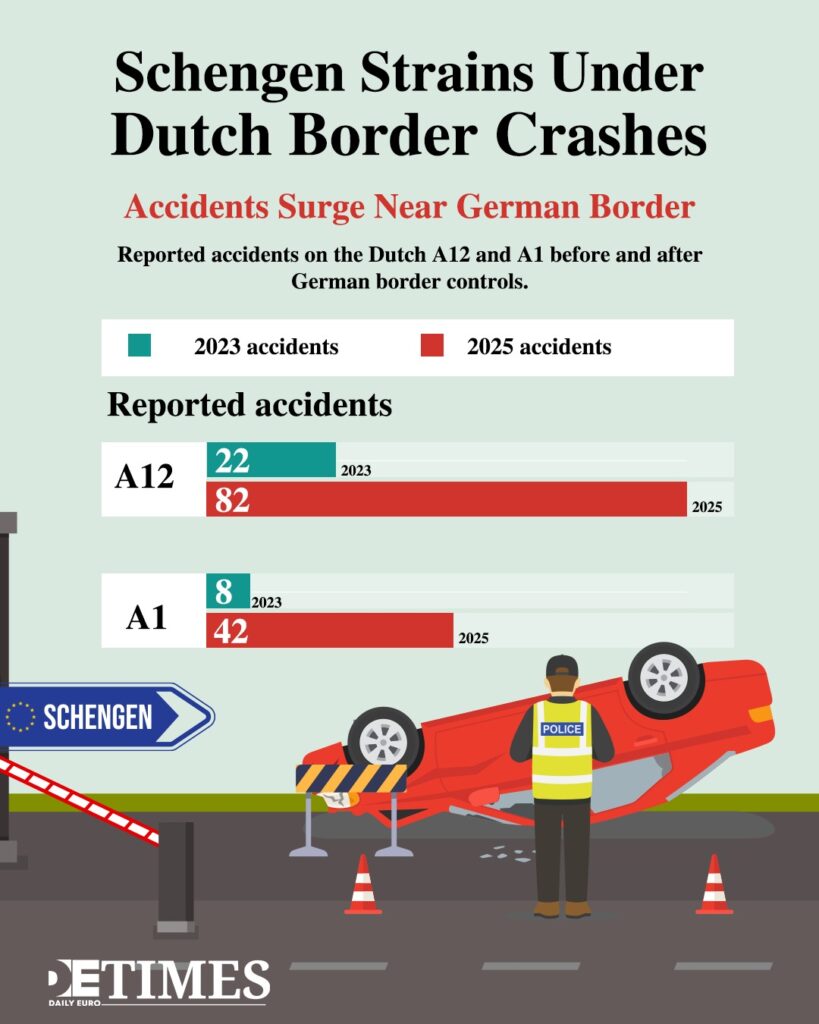
Data requested from Rijkswaterstaat, the Dutch infrastructure authority, confirms accidents on highways leading toward the German border have risen 250% since Berlin introduced the controls in September 2024.
The dispute between Dutch border towns and Berlin no longer looks like a local grievance. It reads as an early tremor in a larger question about Europe’s passport-free travel.
The Toll On Dutch Roads
Rijkswaterstaat’s data, obtained by the Dutch newspaper De Telegraaf, put last year’s accident count on the A12 at 82, against 22 in 2023, the final full year before the checks began. The A1 climbed similarly, reaching forty-two collisions last year against eight in 2023.
Officials attribute the rise to drivers who meet unexpected queues at checkpoints and cannot brake quickly enough. Four people have died in border-area collisions since the controls started, and at least ten more have suffered serious injuries.
Mayor Mark Boumans of Doetinchem and acting Zevenaar mayor Aad van Oosten have joined Bruls in pressing the Dutch government to raise the concern directly with Berlin.
Germany defends the checks as necessary against irregular migration and cross-border crime, and cites over 150 arrests of suspected smugglers along the frontier. Bruls disputes whether those arrests justify the toll, contending many of those detained would likely have been caught through ordinary policing anyway.
A court in Koblenz has already sided with opponents of the checks on a narrower legal point. It ruled Germany’s border checks breach the Schengen Agreement’s guarantee of free movement between member states.
Berlin has persisted with the controls all the same, extending them into the final quarter of the year alongside similar measures now in place in Austria, Denmark, France, Poland, and Sweden.
A Wider Schengen Emergency
Germany’s checkpoints exist inside a larger unravelling which erupted in Ceuta in recent days. Over 60,000 migrants crossed into the Spanish enclave from Morocco in late July, overwhelming reception centres and killing dozens during the crossing.
Italy responded by suspending Schengen’s free-movement guarantee with Spain for air and sea travellers – a decision Rome says will hold into mid-August. Foreign Minister Antonio Tajani described the move as a defence of European borders. Prime Minister Giorgia Meloni’s government also answers to a newer anti-migration party which has gained ground on immigration.
Madrid rejects the Italian rationale entirely, noting migrants who entered Ceuta without authorisation have no legal route into the broader Schengen area regardless of Italy’s checks. Prime Minister Pedro Sánchez wrote online respect for European treaties and the facts is not optional, a rebuke directed squarely at Rome.
Spain has now threatened restrictions on travellers from Italy unless Rome lifts its own controls. It escalates a dispute between two governments positioned on opposite ends of Europe’s political spectrum. France, a full Schengen member itself, reimposed checks on its border with Spain within days of the Ceuta crossings, citing concern migrants who might travel onward into French territory.
A Union of Borders
Eleven Schengen countries currently maintain some form of internal border control, a count which would have looked extraordinary a decade ago. Checkpoints stayed confined mostly to brief, health-related emergencies. Each government insists its measures remain temporary and narrowly targeted.
The accidents piling up on Dutch motorways and the ultimatums passing between Madrid and Rome describe one underlying weakness. Any member state can suspend free movement on its own judgement, with little European oversight.
Brussels has so far answered with consultation instead of enforcement, urging coordinated action even as individual capitals set their own timelines.
Keep up with Daily Euro Times for more updates
Read also:
A New Schengen Gulf Style as EU Puts Up Barriers
Schengen: Freedom of Movement No More?
How Disinformation and Panic Overwhelmed Ceuta