

A mortar shell struck a neighbour’s house in Mogadishu’s Hawlwadag district last week. The incident opened a small window onto two days of heavy fighting between government forces and opposition-affiliated militias in the Somali capital.
Hassan Sheikh Mohamud’s presidential term expired 15 May. Parliament had approved constitutional amendments prolonging both the presidential and parliamentary terms by one year, and Hassan Sheikh Mohamud signed them in March.
The opposition, including former President Sheikh Sharif Sheikh Ahmed and former Prime Minister Hassan Ali Khaire, called the prolongation unlawful and organised protests.
Somalia held no one-person-one-vote election between the 1969 coup and the present day. Civil conflict has defined the country since Mohamed Siad Barre’s government fell in 1991.
The fighting that erupted around the homes of Sharif Sheikh Ahmed and Hassan Ali Khaire is the direct product of accumulated institutional breakdown. Each Somali election cycle since the federal government’s founding in 2012 has adhered to the identical routine, producing expiring terms, deadlocked negotiations, street fighting and a delayed deal.
The present crisis replicates that routine and lays bare the federal state’s most fragile claim, a pretence of governance over a country it cannot fully hold together.
The Sudan Comparison and Limits
Defence Minister Ahmed Moallim Fiqi publicly branded the opposition fighters the “Somali wing” of Sudan’s Rapid Support Forces. The RSF are a paramilitary group that has been fighting Sudan’s army since 2023. The analogy betrays as much about the government’s anxieties as its messaging.
Sudan’s war grew from two roughly symmetrical armed institutions with state resources, established command structures and competing foreign backers. Somalia’s opposition fighters are mainly clan-based and fragmented, with no unified command and no revenues like those of Sudan’s warring parties.
The more immediate threat comes under a different name. Al-Shabaab reclaimed vast territory in central Somalia through 2025, capitalising on political divisions that monopolised the government’s attention.
Government forces directing their weapons at opposition compounds in Mogadishu cannot simultaneously hold the front lines south of the capital. Political disunity has long been Al-Shabaab’s most enduring strategic asset, and the June clashes handed the group a further dividend.
Prosecution Shrinks Already Narrow Space
The federal government’s stated intention to prosecute Sharif Sheikh Ahmed and Hassan Ali Khaire converts an electoral stand-off into an existential clash. The information ministry accused both men of endangering civilians by deploying militias into residential areas.
Hassan Ali Khaire alleged that the government turned anti-tank weapons and drones, supplied by international partners to fight Al-Shabaab, on civilian neighbourhoods instead. No independent body has fully verified either side’s claims.
The structural consequences need no further evidence. Opposition leaders who believe arrest awaits them have no rational incentive to negotiate through institutional channels.
United Nations Secretary-General António Guterres, the African Union and East African bloc members all called for restraint and dialogue. Heavy artillery fire persisted as such appeals reached Mogadishu.
The United States embassy described the violence as “reckless,” calling on all leaders to resolve differences through peaceful means.
The Message Reaching the Periphery
Every armed skirmish in Mogadishu carries reverberations the federal government cannot control.
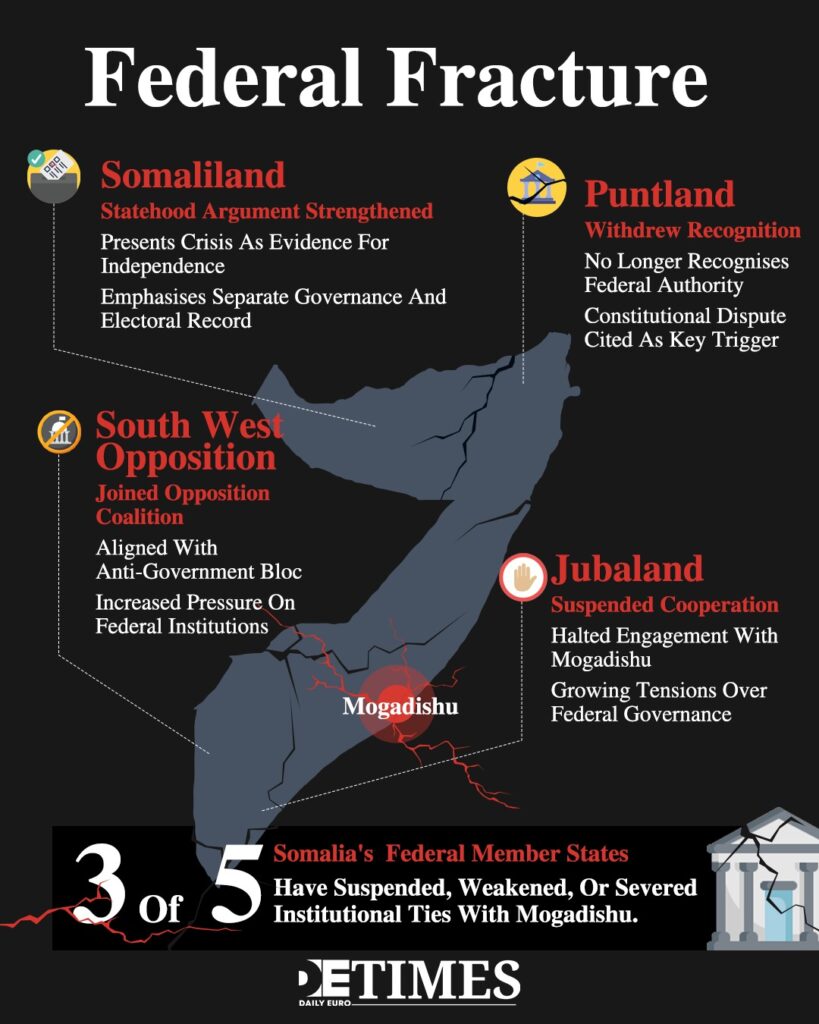
Puntland withdrew its recognition of the federal government in 2024, citing the constitutional amendments. Jubaland, which had already weathered a federal arrest warrant against President Ahmed Madobe, suspended co-operation around the same period.
Both states then joined the ousted South West State administration to form the Somali Future Council, an opposition coalition based in Nairobi.
Three of Somalia’s five federal member states have now severed or suspended institutional links with the federal government over the constitutional crisis.
Somaliland occupies a position that the Mogadishu crisis only reinforces. Somaliland’s foreign minister has outlined a statehood claim grounded in long-standing sovereignty and an independent electoral record.
Keep up with Daily Euro Times for more updates
Read also:
Troubled Waters: Return of Piracy and Somalia’s Governance
Türkiye’s Oil Grab in Somalia: A New Era of Exploitation?
Triangular Diplomacy: Djibouti, the Houthis, and Somalia

