
Last week, the National Assembly’s law committee approved a constitutional bill granting Corsica new powers to adapt some French laws to local conditions.
The full chamber deliberates on the text from 16 June, with a vote expected on 23 June, before the bill proceeds to the Senate later in the year. Should both chambers agree on a common version, three-fifths of French lawmakers assembled in Congress at Versailles must then ratify it.
Three years ago, another prisoner in an Arles jail fatally attacked Corsican nationalist Yvan Colonna. The assault triggered weeks of unrest on the island and pushed the government to reopen a political file it had long preferred to leave closed.
Two years of what became known as the Beauvau Process ended last year after Paris and Corsican elected officials reached a foundational agreement, pledging “an autonomous Corsica within the republic.”
The bill would add a constitutional article recognising Corsica as a long-standing, linguistic, and cultural community and give the island powers to adapt French laws to local needs.
The text does not define which areas Corsica could regulate. A separate law, once the constitutional reform passes parliament, would settle the respective specific competences, and the committee’s approval advances a process that had repeatedly ground to a halt.
A Deal Without Binding Legal Force
The Beauvau Process produced a political commitment with no binding legal force. Benjamin Morel, a public law lecturer at Paris-Pantheon-Assas University, described the bill’s scope as “one of the major difficulties.”
The text does not specify in which areas Corsica’s authorities would hold new powers. Morel noted that the island’s room for manoeuvre under such a framework remained opaque.
The French government’s top advisory body, the Conseil d’État, warned last year that the draft opened the door to near-general legislative powers for the island. “A complete transfer of powers in virtually any area is potentially possible,” the Conseil d’État cautioned.
The government rejected that recommendation, judging its commitment to the Beauvau agreement with Corsican representatives as the greater imperative.
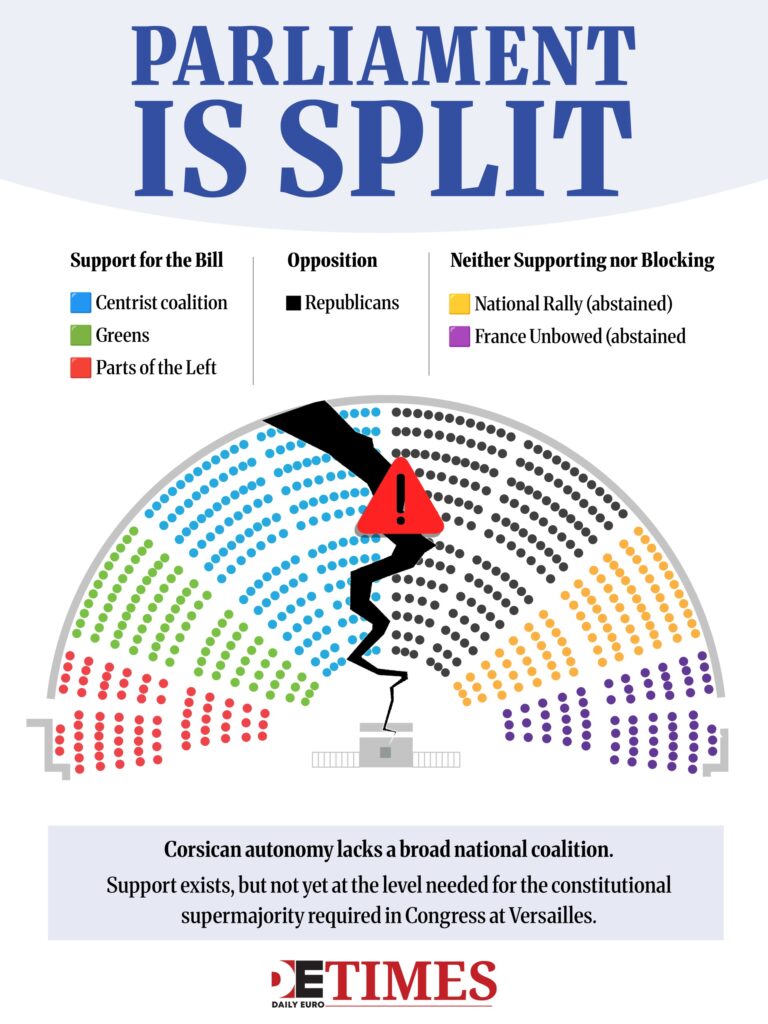
The committee proceedings confirmed the divisions within the National Assembly. Centrist lawmakers, parts of the left, and the Greens backed the text. The conservative Republicans opposed it outright; the National Rally and France Unbowed each abstained.
The Demands Paris Has Not Met
The bill’s deliberate vagueness proves consequential because Corsica’s most concrete political demands remain absent from the text. Corsican nationalist movements have long called for co-official status for the Corsican language, recognition of the Corsican people as a distinct political community, and a residency statute.
The statute would limit property acquisition by buyers from outside the island.
Holiday homes owned by mainland French and foreign buyers account for roughly 40% of all Corsican real estate. Local families have endured sustained pricing pressure in the housing market for decades.
Nazione, the pro-independence party, rejected the Beauvau agreement as falling short of such demands. The party stated the bill recognised neither the rights of the Corsican people, co-official status for the Corsican language, nor a residency statute.
Gilles Simeoni, president of the Corsican executive and the lead autonomist negotiator, pressed allied parliamentary groups to advocate for genuine legislative autonomy and acknowledged “resistance” within the French parliament.
A Supermajority in a Fractured Parliament
The Senate’s own reservations compound the obstacles ahead. Gérard Larcher, the Senate’s president, expressed concern about the transfer of legislative powers to the island. Larcher also voiced fears that constitutionalising Corsican autonomy could encourage Breton and Basque regions to press similar claims.
The bill is up against a Senate chamber that is more conservative than the National Assembly and has traditionally defended the republic’s principle of legal uniformity.
France’s broader political instability adds a further element of risk. The country has cycled through several governments since last year’s snap elections, and the fragmented parliament has found it hard to build stable majorities.
A constitutional reform needing a three-fifths supermajority in Congress demands cross-party consensus that French politics has had trouble sustaining. Several European governments observing regions of their own press for greater powers will be evaluating the outcome carefully.
A Consequential Threshold With Unsettled Passage
The committee vote stands as the furthest that any French parliament has brought Corsica’s claim to constitutional autonomy in more than fifty years of nationalist campaigning.
The island’s governing coalition, in place since 2015, can point to a process that the unrest of three years ago helped accelerate. The fractured parliament will now decide whether that process delivers genuine legislative powers or a diluted symbolic recognition.
The most credible expectation is a bill that reaches Versailles with its scope greatly narrowed by the Senate. A constitutional recognition of Corsica as a distinct community within the republic would still be monumental for a state built on legal uniformity.
Whether such a reform can produce laws that change daily life on the île de Beauté is the question the parliamentary process has still to answer.
Keep up with Daily Euro Times for more updates
Read also:
Words Have Meaning: EU Language Politics Blocks Defence Budget
Europe’s AI Factories: Strategic Autonomy or Public Bubble?
French Antifa and the Federal Drift of European Politics

