
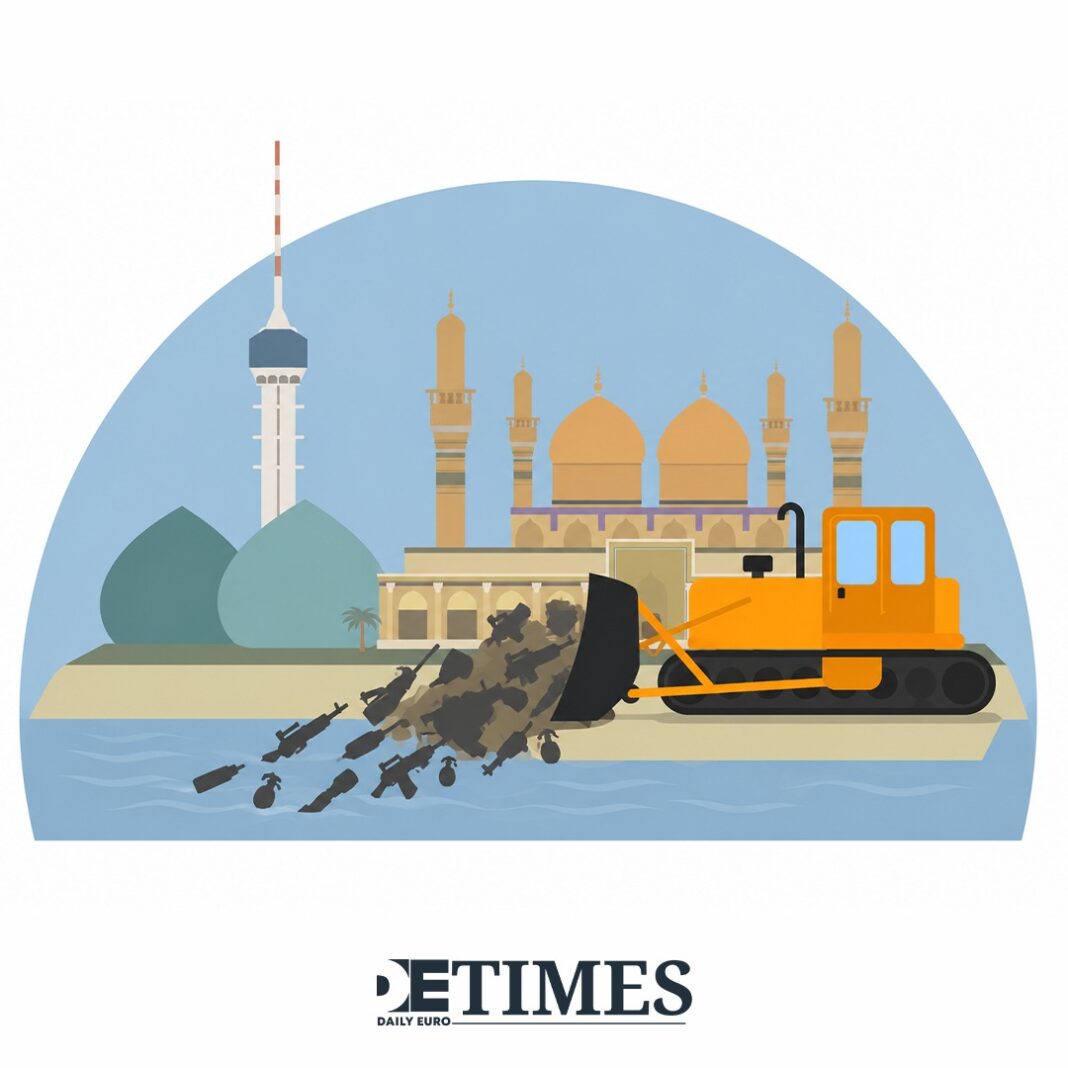
In Samarra, members of the armed faction Saraya al-Salam gathered at their headquarters for a ceremony marking the start of handing their weapons over to Iraqi state forces, early last month. The cleric Moqtada al-Sadr had ordered the move himself, a gesture that Baghdad’s new government has since tried to turn into a national rule rather than a single faction’s choice.
This week, government spokesman Haidar al-Aboudi announced that every armed group has been given until 30 September to surrender its weapons, the same date the international coalition formally winds down its anti-ISIS mission.
Iraq’s government wants the world to read a withdrawing coalition and a disarming militia network as one and the same achievement, proof that the state finally stands on its own.
Deadline Built On Earlier Pledges
The September date followed a string of pledges made through the spring. Asaib Ahl al-Haq and the Imam Ali Brigades, two of the most armed factions inside the Popular Mobilisation Forces, formed committees to inventory their fighters, weapons and equipment ahead of a handover to the armed forces command.
Prime Minister Ali al-Zaidi, a forty-year-old banker sworn in only weeks before, made a state monopoly on weapons the centrepiece of his programme, and Washington has tied defence cooperation directly to that goal.
The PMF were built in 2014 to fight the Islamic State group and remain funded through Iraq’s own budget at $3.5 billion a year, despite decades of loyalty running to individual commanders rather than the army.
Where the Coordination Framework Splits
A history of divided loyalty now produces an open rift inside the very bloc that brought Mr al-Zaidi to power. Kataib Hezbollah and Harakat al-Nujaba, the most heavily armed and most Tehran-aligned of the factions, rejected the disarmament plan outright, insisting that no faction should give up arms while foreign troops remain on Iraqi soil.
A source close to that camp told reporters the September date amounts to Washington pressuring Baghdad while keeping its own intelligence presence intact.
Asaib Ahl al-Haq and Saraya al-Salam, by contrast, present their compliance as proof of loyalty to the state rather than to any foreign patron.
The contrast between these two camps shows a coalition no longer agreeing on what sovereignty actually requires of it.
Tehran’s Stake in Baghdad’s Arsenal
That disagreement traces back further than any single deadline, to Iran’s own calculation about what these factions are for.
One Iraqi analyst argued that Tehran values the armed groups both as a religious inheritance tied to clerical authority and as a force it can call upon at will.
Research from the Arab Center in Washington notes that genuine integration into a unified chain of command is only one of several outcomes, alongside partial integration that leaves commanders politically powerful while militarily intact.
A third, thinner outcome would see heavy weapons surrendered while smaller arms and loyalty networks stay exactly where they are.
Iraq’s own capacity to tell these outcomes apart, let alone enforce the most demanding one, remains the unresolved part of the plan.
Vacuum the Coalition’s Exit Could Open
Layered onto the uncertainty sits the coalition’s own departure, which carries risks separate from the disarmament question itself.
Researchers tracking ISIS remnants have found that militia activity has served as a counterweight limiting the group’s room to operate in Kirkuk and the Anbar desert, a counterweight Baghdad now plans to dismantle on the same calendar as the coalition’s exit.
Removing two restraints on the same date, the foreign troops and the local militias together, asks Iraq’s regular forces to fill a gap neither was built to fill alone.
What September Will Actually Decide
None of this denies that real movement has happened, only that movement and resolution are not the same thing. Mr al-Zaidi has paired the disarmament push with a corruption crackdown that has already produced dozens of arrests among senior officials, a signal that state authority is being rebuilt on more than one front.
However, the test in September will not be whether ceremonies are held in Samarra or committees are formed in Baghdad. It will be whether Kataib Hezbollah and Harakat al-Nujaba give up the very weapons Tehran considers its own to lend, and whether Baghdad has any real means of compelling them if they refuse.
Keep up with Daily Euro Times for more updates
Read also:
Somalia Electoral Crisis Worsens the Federal Fracture
Congo: Rebel Resurgence Disrupts India’s Africa Plans
Foreign Capital Flows into Damascus Despite Insecurity

