
The Democratic Republic of Congo filed a case at the International Court of Justice on 26 June accusing Rwanda of responsibility for decades of abuses in the east, including massacres, displacement and support for armed groups. This is the third time Kinshasa has sought ICJ action against Kigali: a first case was dropped in 2001 and a second dismissed in 2006 for lack of jurisdiction.
The move turns a long-running regional accusation into a formal legal strategy, and the humanitarian evidence behind it is serious. More than 7.8 million people are internally displaced in eastern Congo, UNICEF reported 35,000 cases of sexual violence against children in the first nine months of 2025 alone, and M23 captured Goma and Bukavu in January 2025.
But the case also reopens an uncomfortable history. Eastern Congo’s wars did not begin with a single act of external aggression. They grew out of the aftershocks of the 1994 genocide, the flight of Hutu génocidaires into Congo, the militarisation of refugee camps, the rise of Banyamulenge insecurity and decades of political manipulation by Kinshasa itself.
Any attempt to tell the story as Congo innocent and Rwanda guilty is morally and historically incomplete.
Rwanda Has a Case to Answer
That does not mean Rwanda should escape legal scrutiny.
Kigali has consistently denied backing M23, yet UN experts and Western governments have largely sided with Congo, finding substantial evidence of Rwandan support. The ICJ precedent already exists: in 2022 the court ordered Uganda to pay $325 million in reparations for its role in the Congo wars, a judgment Kampala is paying in instalments through 2027. That template is what Kinshasa is now applying to Kigali: establish state responsibility for proxy warfare, then pursue reparations measured in the hundreds of millions.
Rwanda has consistently presented its interventions as defensive and tied to the continued threat posed by FDLR forces across the border. That logic was once easier to treat as partially credible given the raw post-genocide context. Thirty years on, it is increasingly hard to separate from strategic opportunism and regional dominance.
The ICJ case says Kinshasa wants the conflict treated as a matter of legal responsibility, not merely a messy regional war. That is a serious escalation in diplomatic terms.
But Congo’s Record is Not Clean
Any honest account has to say what many official framings avoid.
Congolese governments and local power structures have also helped produce the Tutsi question rather than resolving it. Anti-Tutsi rhetoric has surfaced repeatedly in national politics, and Banyamulenge and other Congolese Tutsi communities have often been treated as suspect populations whose belonging can be questioned whenever crisis deepens. Rwanda’s justifications, however self-serving, have always fed on real insecurity amongst Tutsi communities in eastern Congo that Kinshasa has done little to address and at times actively deepened.
This is what makes the conflict so difficult to flatten into courtroom morality. Congo can be right to accuse Rwanda and still be implicated in the conditions that made Tutsi identity so combustible in the first place. The vicious loop runs in both directions: Rwanda exploits Tutsi vulnerability for regional influence, whilst Congo’s political class uses anti-Rwandan and sometimes anti-Tutsi rhetoric to mobilise nationalist legitimacy.
The Hague Cannot Solve the Whole History
Courts can allocate responsibility for specific violations.
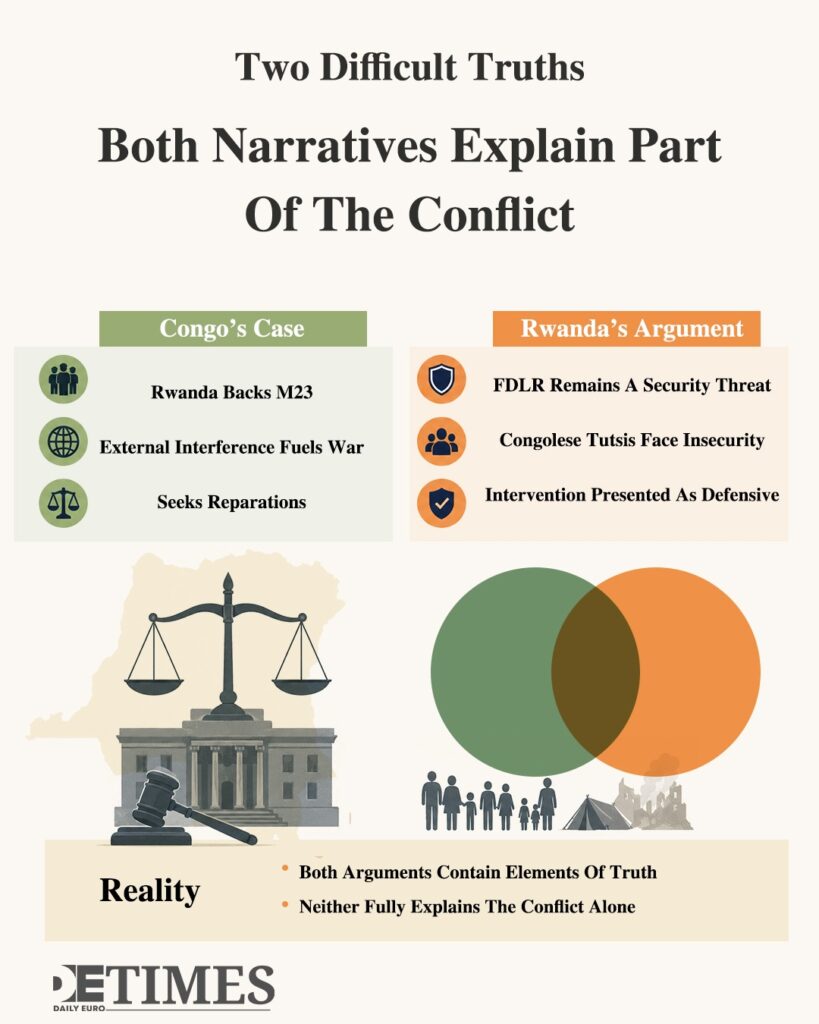
They cannot easily resolve a regional memory war stretching back to genocide, refugee militarisation and cycles of rebellion. The legal route may clarify part of the truth, but it will not dissolve the underlying politics. The real danger is that each side uses the case to harden its own innocence: Kinshasa points to Rwanda’s interference and says the matter is settled; Kigali points to Congo’s anti-Tutsi record and calls the case hypocritical. Both arguments contain pieces of truth. Neither is the whole truth.
Congo’s case against Rwanda may expose one long thread of violence. It also reopens another — the long failure of the Congolese state and society to resolve the place of Tutsis within the nation itself. The ICJ can name responsibility. It cannot, on its own, untie a conflict built on three decades of fear, memory and manipulation.
Keep up with Daily Euro Times for more updates
Read also:
No Peace on the Horizon Despite M23 Ceasefire in Eastern Congo
Uganda: A Safe Haven for Asylum or M23?
Musical Chairs: Rwanda Quits ECCAS’ in Africa’s Latest Party Trick

