

Earlier this month, Frontex director Hans Leijtens ordered staff to stop accepting new applications to the European Union Reintegration Programme, citing spending the budget could no longer fully cover. Frontex, the European Border and Coast Guard Agency, has coordinated returns for years and has offered reintegration aid to returnees since 2022.
The decision hit Frontex, whose annual budget stands at about €1.2 billion, after registrations for the programme had surged in the first half of the year. Such paralysis is the predictable product of a returns policy that multiplies Frontex’s duties and leaves them unfunded. Brussels has probably overwhelmed the Warsaw-based body with enforcement zeal.
A Hardline Law Without a Budget
The pressure on Frontex’s accounts has a legislative origin. In June, the European Parliament and the Council agreed a Regulation establishing a Common European System for Returns.
Forced return becomes the default where a person refuses to cooperate, absconds to another member state or poses a security risk. The law also lengthens detention periods and permits return hubs in third countries willing to host people awaiting removal.
Further expansion looms. Magnus Brunner, the European Commissioner for Internal Affairs and Migration, has already announced that the European Commission will propose a stronger Frontex role on returns in autumn.
Since January, Frontex has deployed 109 return specialists across 15 member states, up from 95 a year earlier. Every new duty widens the gap between mandate and funding, and the gap has begun to swallow the aid meant for returnees.
Reintegration Aid Becomes the Casualty
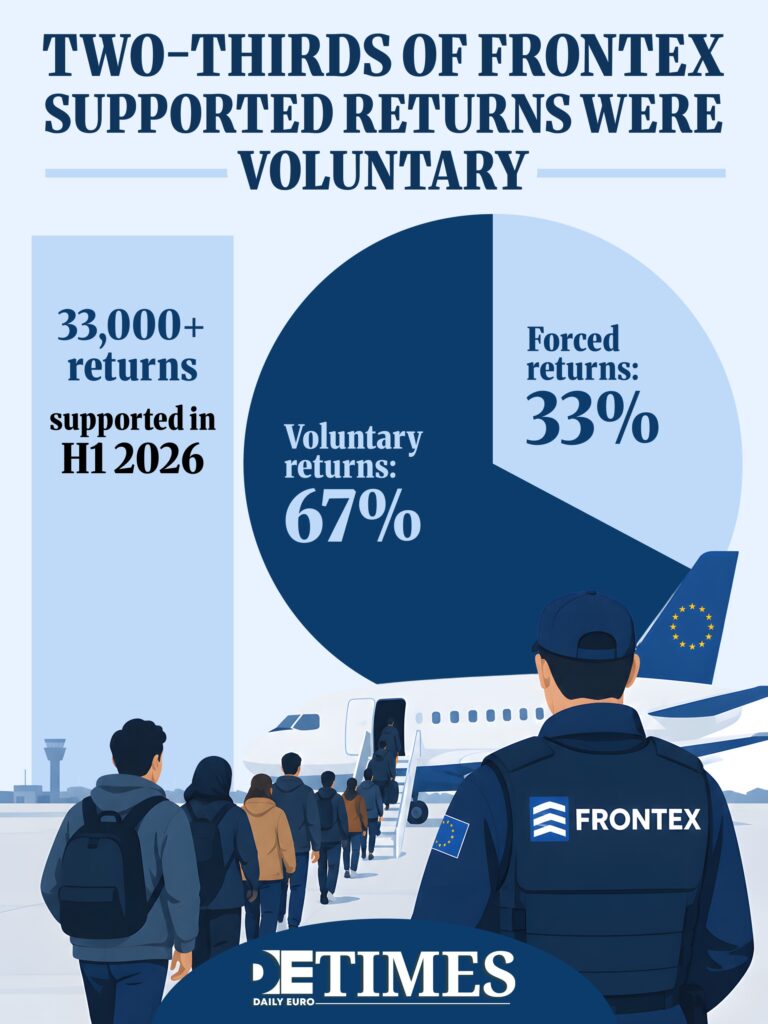
Within a widening gap, the modest sweetener of the returns system went first. Frontex supported more than 33,000 returns in the first half of the year, around two-thirds of them voluntary.
Registrations for reintegration help climbed to around 14,000, up from around 8,000 a year before, an increase of 75%. Total returns rose by roughly 10% over the same period, so the demand for aftercare outpaced the departures it accompanies.
Each package of training, micro-grants or psychological support looks modest beside an escorted charter flight. Rising registrations point to genuine demand for a dignified exit, and a freeze penalises the people most willing to leave. Would-be returnees in the pipeline must endure an open-ended wait.
The effect of reintegration aid on onward movement remains contested. Researchers have recorded growing scepticism about its capacity to deter onward migration, and monitoring of such programmes has long been patchy. Thin evidence calls for rigorous evaluation, which a sudden freeze would probably make harder.
Falling Arrivals Weaken the Rationale
Border data adds another puzzle. Irregular crossings into the EU fell by 40% in the first four months of the year, to 28,500, according to preliminary Frontex data. Shrinking inflows weaken the case for treating returns as an emergency that justifies open-ended spending.
Political demands on Frontex nonetheless keep multiplying. Spain’s People’s Party spokesperson Borja Sémper recently pledged that a government led by his party would deploy Frontex in the Atlantic to secure returns to Morocco. Each such pledge adds duties to an agency that has already frozen a programme.
Frontex spokesperson Chris Borowski has conceded that a more ambitious returns policy cannot work without adequate funding. Leijtens has also warned that officers on standby for sudden crises can’t be reassigned to other tasks.
The candour is welcome, but Brussels seems to have ignored it. Expanding the mandate before settling the budget invites the breakdown Frontex has recently suffered.
Keep up with Daily Euro Times for more updates
Read also:
How Disinformation and Panic Overwhelmed Ceuta
A New Schengen Gulf Style as EU Puts Up Barriers
Schengen: Freedom of Movement No More?