

Last month, 5,000 Norwegian Home Guard soldiers rehearsed the defence of Oslo’s airport during Øvelse Hovedstad, their annual military defense exercise. Two idle soldiers found rented Deepal cars storing video of their movements and of codes keyed in at military gates. Changan, a Chinese carmaker, owns the brand. Trade anxiety drives Europe’s reaction, with security language providing the cover.
The rental firm says it obeys Norwegian and European law. Reporting so far offers no evidence that Chinese authorities obtained any recording. The weakness is nonetheless real, since cars with cameras record whoever sits near them.
Governments Bar Cars From Military Sites
Norway’s discovery joins restrictions already imposed elsewhere.
Poland’s army banned Chinese-made vehicles from high-security installations in February. Foreign cars may still enter if owners disable recording functions. Israel’s military ordered officers to hand back about 700 Chinese cars last year, and Britain’s Special Boat Service excluded them from its Poole base.
Turkish defence firms including Aselsan, Roketsan and Havelsan bar foreign electric cars from their campuses. An aerospace engine maker’s chief says foreign cars carry devices “that can map the entire area and we are not the ones controlling them”. Turkish-built models stay welcome because the firms control their software.
Beijing denies using electric cars for espionage. Governments imposing bans have so far presented no solid proof of malicious activity. Disabling cameras on military premises takes an afternoon of engineering, and a 350,000-car ceiling answers a different problem.
Hybrid Ceiling Protects European Factories
The size of the proposed ceiling points to industrial motives.
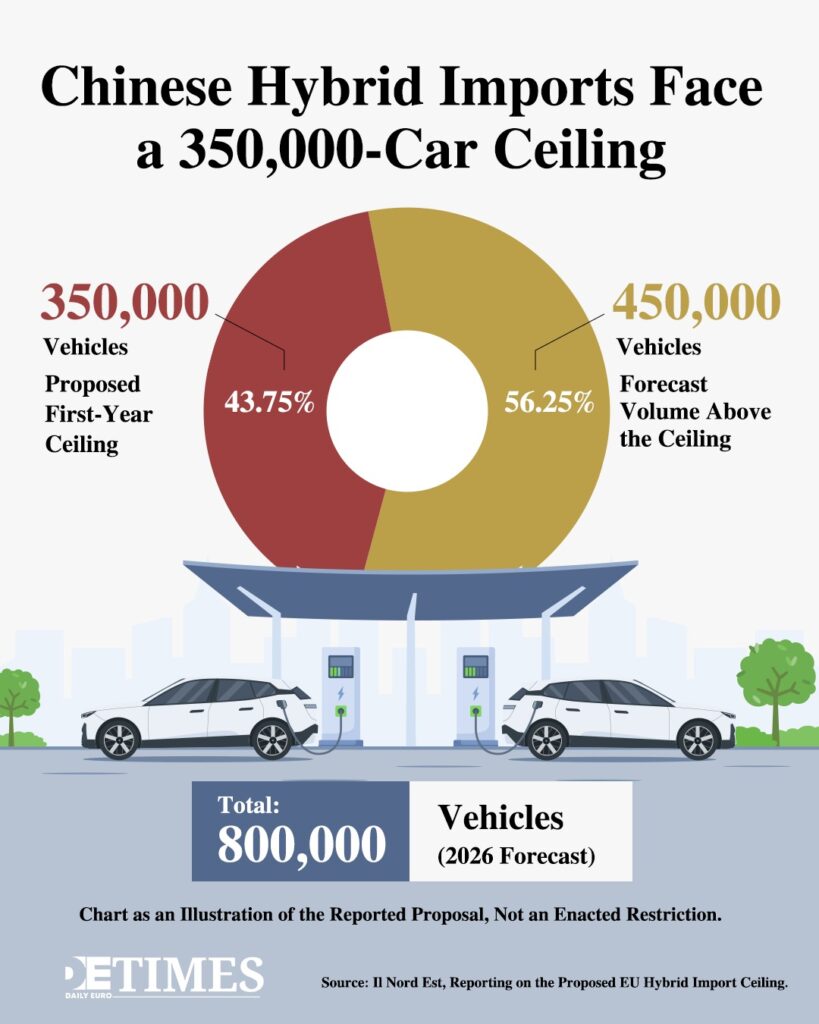
Reports say Brussels will cap hybrid imports at 350,000 vehicles in the first year. The ceiling sits well under the roughly 800,000 vehicles on the 2026 forecast. It would rise 6% a year across four years and cover every hybrid, wherever built, to respect World Trade Organisation rules.
Chinese makers turned to hybrids after Europe imposed extra tariffs on battery electric cars two years ago. Hybrids pay a flat 10% duty. Monthly shipments swelled to 50,000 in July after starting at only 3,800 when the tariffs began.
Brussels first asked Beijing to hold Chinese hybrids near 15% of its market, where they hold over a third. The European Commission also cites an annual trade deficit with China near €360 billion.
Beijing Negotiates and Builds Abroad
As trade policy invites trade responses, Beijing’s reply has been commercial.
Beijing rejected voluntary export limits hours before the European trade commissioner’s visit. After two days of talks, the two sides struck an understanding on hybrid trade under World Trade Organisation rules. Details remain unpublished. They also agreed to keep discussing minimum prices for electric vehicles.
Production abroad offers Chinese makers a way around quotas. Changan is talking to European manufacturers about local assembly. Stellantis plans small electric cars in Italy with Leapmotor. And a Ford and Geely venture in Spain expects its first vehicles in 2028.
Chinese factories need foreign buyers, since August exports jumped 65.3% year on year and domestic sales of new energy vehicles fell 4.6%.
Electric Adoption Risks Higher Prices
Buyers feel the consequences before local plants open. Cheap hybrids tempt Europeans who still hesitate over full electrics.
A ceiling that cuts expected volumes by over half will probably lift prices and thin the choice. Slower hybrid uptake may also delay the later switch to battery models.
Earlier tariffs on battery electric cars produced limited results, since Chinese sales in Europe nearly doubled between two years ago and last year. Quotas may leak the same way as makers localise production.
Lower duties on Chinese battery cars could pull hybrid buyers towards full electrics.
Audit Software and Welcome Local Factories
The price talks offer a workable template. Governments should certify vehicle software, disable recording near sensitive sites and publish audit findings. Such steps protect soldiers at lower expense than any quota.
Quotas will probably push Chinese makers towards European assembly within a few years. Local plants could restore price competition and lift electric uptake again.
Brussels may then demand data localisation and technology sharing in return for access. Beijing’s answer to such demands remains uncertain, and drivers will pay in the interim.
Keep up with Daily Euro Times for more updates
Read also:
Renault Goes Leaner: Drones and Electric Cars
German Manufacturers Stalled EU Climate Progress
Maritime EVs: Europe’s Maritime Industry Must Work Together Now