

Reform UK’s social media machine spluttered last week. Posts from the party’s top brass, among them deputy leader Richard Tice, drew barely any traction, with reposts stuck below triple digits and some posts missing 10,000 views. For a party whose fortunes ride on online buzz, the silence stung.
Ukraine’s drones explained the mood, or so the internet decided.
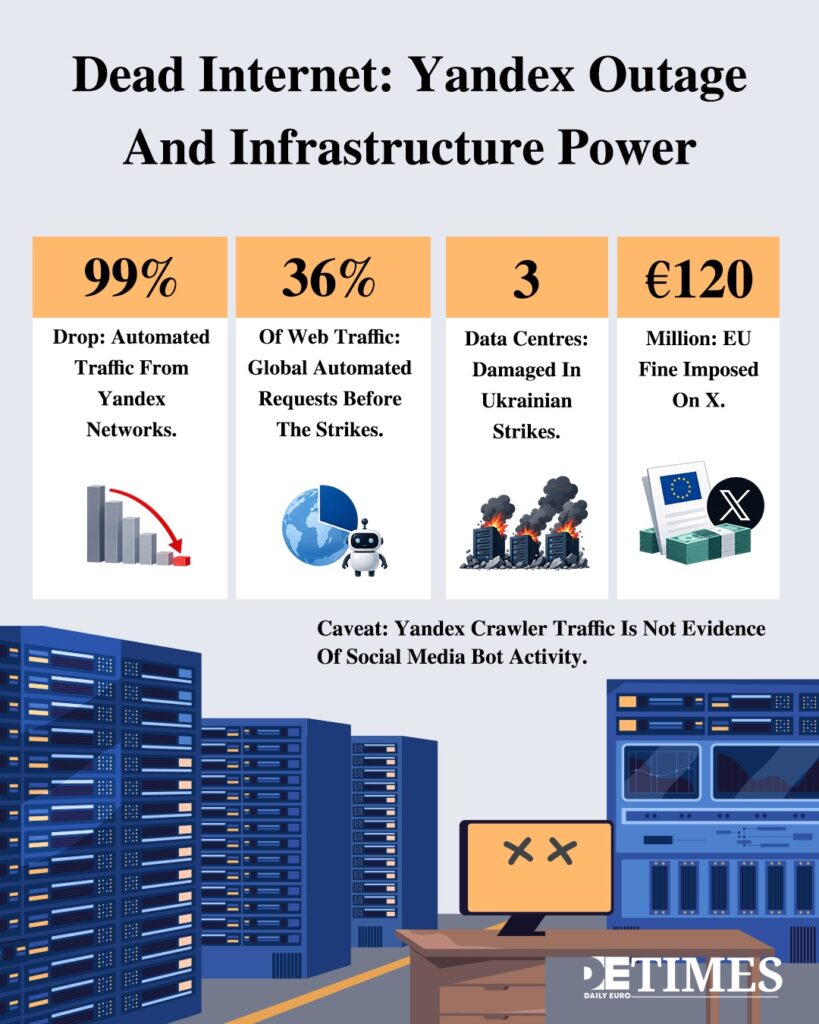
Over four days, they damaged three Yandex data centres, paralysing search, taxi and payment services for tens of millions of Russians. Cloudflare’s charts recorded automated traffic from the company’s networks collapsing by as much as 99%. The Kremlin’s bot farms had finally fallen silent. Volodymyr Zelenskyy endorsed the verdict at the Warsaw Security Forum, telling delegates his strikes had left social platforms feeling less hateful.
The verdict felt too tidy, and it soon wobbled. Some of Europe’s online political chatter comes from machines, and the companies running the platforms have no interest in counting how much.
Crawlers Migrated, Narratives Survived
The theory leaned on a basic mix-up, and researchers said so within hours. Cloudflare’s charts measured automated requests leaving Yandex’s own networks, chiefly search crawlers indexing the web, and social media accounts never featured in the data. Feeds felt cleaner, where they did at all, for reasons nobody established.
Cloudflare’s own analysis cut deeper. Malicious automation on the company’s cloud service migrated to other Russian hosting providers within hours, keeping the same digital fingerprints. One gambling operation’s traffic dropped to zero on Yandex and popped up elsewhere, unchanged. Before the strikes, automated requests made up roughly 36% of global web traffic. Server buildings stay put, and malicious software relocates.
So the bot war goes on. Track a bot by its internet address, and the trail dies as soon as its owners switch providers. Bombing server farms is satisfying, television-friendly work. Following bots between hosting companies is dull, and it is the only thing which works. The platforms holding the data on how accounts behave rarely share it, which suits them.
Dead Internet, Right-wing Origins
The irony cuts against its inventors. The Dead Internet theory, a belief in a web conversation made mostly of fabricated voices, first circulated among right-wing and conspiracy circles years ago. Its early prophets insisted shadowy elites manufactured consensus online.
Its audience then saw its own engagement thin, which felt personal. One widely shared post stamped the Reform UK logo beside a chart containing no Reform UK data. Enthusiasts had mistaken a search crawler’s downtime for the sound of their opponents switching off. A theory invented to explain phantom crowds ended up explaining the crowd around the theory.
Billionaire Plumbing and Convenient Blame
Infrastructure decides whose voice carries online, and Ukraine felt it firsthand. Overnight restrictions slowed the country’s Starlink terminals on the battlefield, disrupting drone missions amid nightly Russian missile attacks.
Musk wrote “Starshield systems are owned and controlled by the US government”, adding “Any limits on speed or usage are decided by the US military and ultimately POTUS”. The mogul offered his company as a bystander, and plenty of observers found the coincidence curious.
A pinch of salt belongs here, since the same man owns X, the arena where bot claims rage and rightwing causes once boomed. Users spent days posting provocations and clocking the silence. Few paused to ask why a private company profits from keeping its engagement composition unverifiable.
Poland’s foreign minister demanded to know if Musk played politics with his products again. France went further. Jean-Noël Barrot, the foreign minister, accused Musk of “online harassment” of European leaders, warning about foreign interference ahead of France’s presidential election.
Brussels has already fined X €120 million under the Digital Services Act for opaque data practices and a deceptive verification system. The mogul denounced the penalty as “the tyranny of an unelected bureaucracy oppressing the European people”. In his vocabulary, accountability belongs to somebody else.
Keep up with Daily Euro Times for more updates
Read also:
Poland’s Fight Against TikTok Bots and Washington’s Normfare
A Jury Found Social Media Guilty of Addiction
Truth Social or X? Vice President Musk’s Latest