
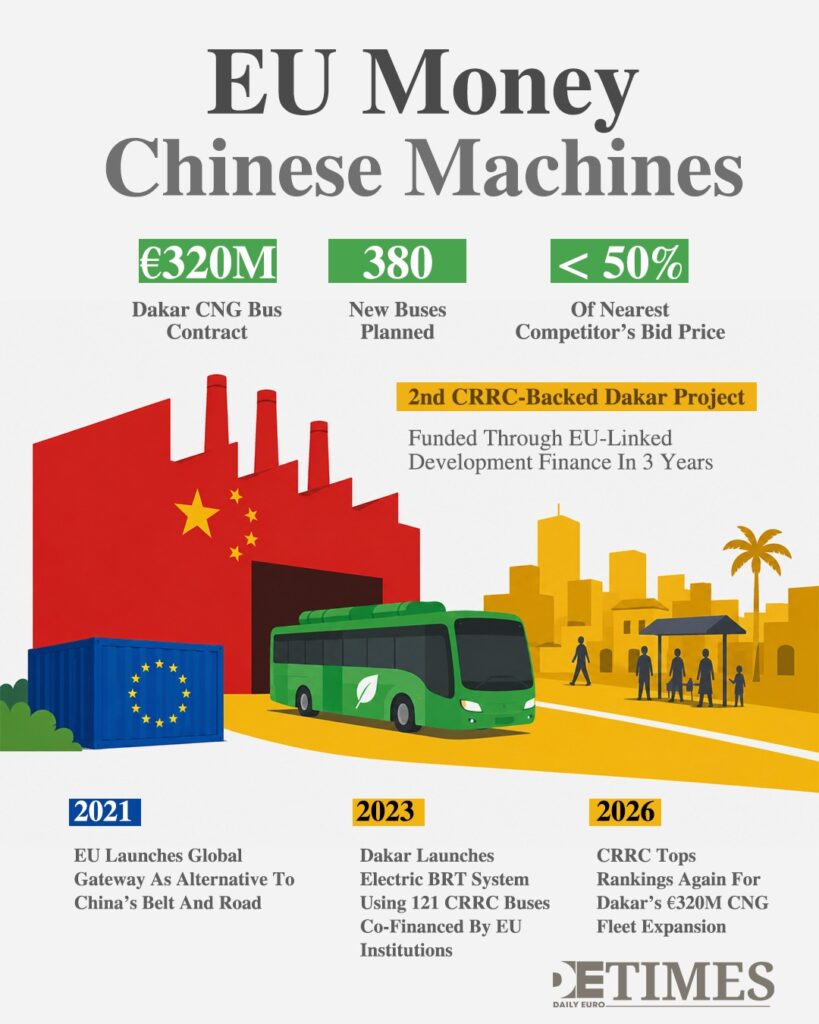
A few weeks ago, a document obtained by the media placed CRRC, the Chinese state rail and transit giant, at the top of both the technical and financial rankings for a €320 million contract to put 380 compressed natural gas buses on the streets of Dakar. It did so by bidding at less than half the price of its nearest competitor. The financing came from the European Investment Bank, the European Commission, France’s development agency, and Germany’s KfW.
The response from Brussels was critical. A Danish MEP was “appalled”, and the director of the European International Contractors association called for more “patriotism” from European financiers.
Strip away the good-governance language, the complaint is not a principled position. It is a protection racket dressed in development rhetoric.
A History Brussels Prefers to Forget
The Dakar CNG bus deal is not an anomaly. In late 2023, Dakar inaugurated a fully electric Bus Rapid Transit network running on 121 articulated CRRC buses, co-financed by the European Investment Bank and Global Gateway funds. European capital built the road infrastructure while China delivered the vehicles.
This is now the second time in three years that the EU’s flagship African development programme has funded Chinese hardware in the same city. At some point, repetition becomes policy.
The Global Gateway was launched in 2021 as the EU’s strategic answer to China’s Belt and Road Initiative. The project pledged to mobilise up to €300 billion by 2027, with half earmarked for Africa. It positioned itself as a values-driven, governance-heavy alternative to Chinese infrastructure finance.
European Commission President Ursula von der Leyen declared at the Global Gateway Forum last year that exceeding €400 billion ahead of schedule was a realistic prospect. The programme has since funded Chinese infrastructure delivery in the Senegalese capital twice in three years.
The Loophole Wears an Official Name
There is a structural explanation for how this keeps happening, and Brussels built it themselves. The EU’s Foreign Subsidies Regulation can investigate state-backed firms undercutting competitors in tenders on EU territory.
In Lisbon, the Commission used exactly that mechanism, found billions in subsidies behind a CRRC rail bid, and got the company withdrawn.
In Dakar, the regulation has no reach. When EU development funds flow through implementing partners like the European Investment Bank, those partners apply their own procurement rules, and the exclusion dissolves.
Brussels can police Lisbon. In Dakar, it can file press statements.
Dakar’s Calculus is its Own
The harder truth is that Dakar did nothing wrong. Senegal evaluated the bids on their merits and CRRC ranked first.
Dakar is a city of nearly four million people, growing by 40 percent over the coming decade, and getting 380 affordable buses onto its roads is a genuine public priority.
Cape Town-based electromobility researcher Prian Reddy framed the African perspective precisely: many African countries are financially constrained, and utilizing existing resources and supply chains is crucial for the continent to make the leap toward a climate-neutral future.
Former Senegalese President Abdoulaye Wade wrote in the Financial Times nearly two decades ago that China’s approach to African needs was better adapted than Europe’s slow, patronizing post-colonial model. That observation has not aged out of relevance.
At the Global Gateway Forum last year, South African President Cyril Ramaphosa voiced the continental expectation directly: these investments should not replace one dependency with another. Dakar’s procurement decision gives concrete expression to that expectation.
Entitlement Wrapped in Development Language
There is a legitimate grievance buried somewhere in the European reaction, but it is not the one being voiced.
CRRC holds annual turnover of €28 billion, surpassing the combined revenues of Alstom, Bombardier, Hitachi, Kawasaki, and Siemens. A manufacturer of that scale bidding at half the market price raises a real state-subsidy question, one the EU has already proven it can press where its legal mandate holds.
The credible response is to push the European Investment Bank and every other implementing partner to require full subsidy disclosure on every development-funded tender, wherever it falls on the map, and to extend the Foreign Subsidies Regulation’s reach as far as treaty law allows.
What is not credible is the assumption that European firms hold a natural commercial claim on contracts that African cities receive the funding to award.
Global Gateway was sold to the world as a values-driven alternative to Belt and Road, built on open competition and good governance. Dakar ran an open, competitive, merit-based procurement process and awarded the contract accordingly.
If that outcome embarrasses Brussels, the problem is not Dakar’s procurement standards. It is that it proclaims fair competition while quietly assuming it would always win.
Keep up with Daily Euro Times for more updates
Read also:
The Myth of African Art at Venice Biennale
France Out, Africa In: Senegal, ECOWAS, and Sahel Integration
EU Looks to the Silk Road: First EU-Central Asia Summit