

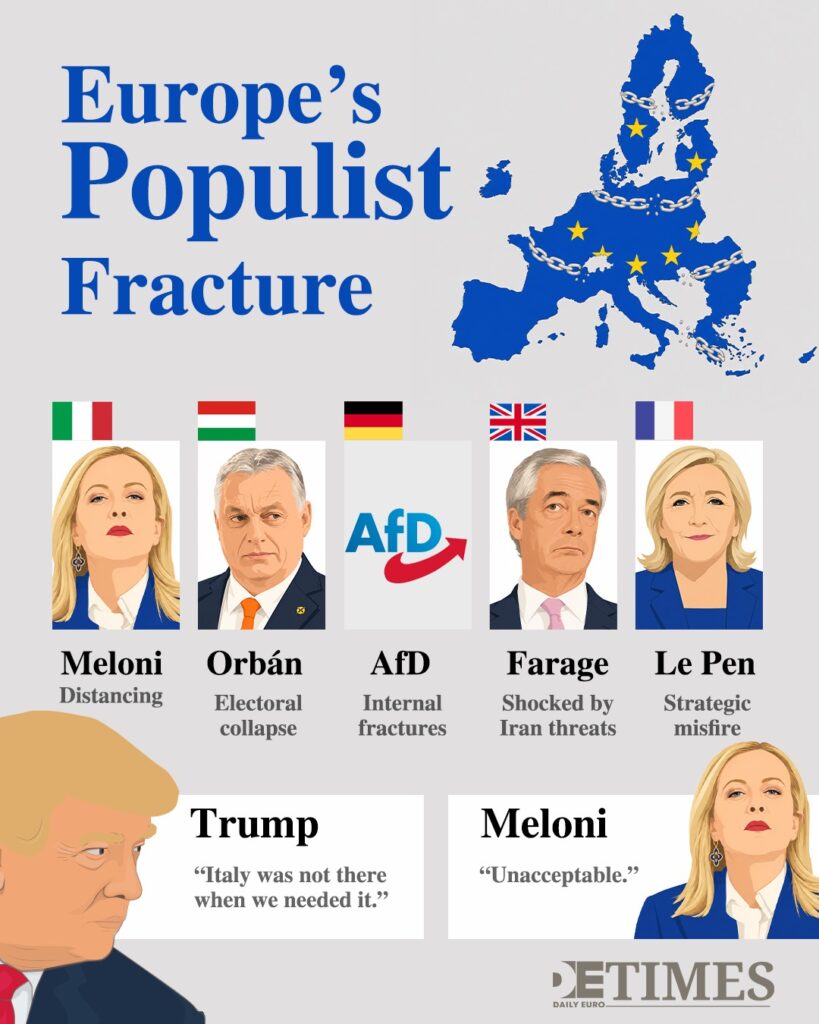
On Saturday, he told Italy’s leading daily, Corriere della Sera, that he was still considering moving U.S. troops off Italian soil because, in his words, “Italy was not there when we needed it”. The remark came barely 24 hours after his own Secretary of State, Marco Rubio, had sat down with Prime Minister Giorgia Meloni in Rome for what both sides called fence-mending meetings.
Just as the Middle East conflagration has fractured Trump’s own MAGA coalition – splitting isolationists from interventionists and prompting even loyalists like Marjorie Taylor Greene and Tucker Carlson to break with the president – so too is the transatlantic populist alliance cracking under the same pressure
A Romance Built on Calculated Convenience
Giorgia Meloni’s connection to Donald Trump was a deliberate choice. Years before her Fratelli d’Italia party swept to power in the 2022 Italian general elections, she had built ties with US and European conservatives to remake her image as a moderate and gain foreign acceptance.
By the time Trump returned to the White House in early 2025, she stood as the sole European Union leader invited to his inauguration. Elon Musk helped arrange this, and Trump called her a “fantastic woman.” JD Vance, after a trilateral meeting in Rome, called her a “bridge” between Washington and Brussels.
Saudi Prince Alwaleed bin Talal, speaking on Europe’s political state last year, praised her pragmatic governance from the middle.
The early diplomatic gains were real: she was the first EU leader to meet Trump after he imposed global trade tariffs.
Italy received the same European tariff treatment as everyone else. Trump’s demand that NATO members raise military spending to 5% of their GDP produced no Italian concession.
Iran, the Pope, and Six Minutes
The Iran war forced decisions that made the alliance impossible to sustain. Italy refused to let US aircraft refuel at a southern Italian military base before striking Iran. Rome also declined to join mine-sweeping operations to reopen the Strait of Hormuz.
On 13 April, Meloni called Trump’s social-media attack on Pope Leo XIV “unacceptable.” The supreme pontiff had repeatedly called for an end to the US intervention in Iran.
The next day, in a six-minute interview with Corriere della Sera, Trump expressed shock: “I’m shocked by her. I thought she was brave, I was wrong.”
Giovanni Orsina, director of the department of Political Science at Luiss University in Rome, said: “Her opposition has always said she was subservient to Trump. Now it has been harder for her opponents to attack her.”
After losing more than 10 points in weekly polls following the referendum, her popularity crawled back to previous levels, according to SWG-La7 political polls.
Rubio in Rome: Institutions Outlast Feuds
The diplomatic fallout brought US Secretary of State Marco Rubio to Rome on 8 May for what observers called “fence-mending meetings.”
The visit came days after Washington announced the withdrawal of 5,000 troops from Germany, raising doubts about the roughly 12,000 US military personnel stationed on Italian soil.
Rubio’s talks with Meloni covered Middle East security, NATO coordination, migration and trade. The administration worked to preserve Italy’s role as one of Washington’s closest partners in southern Europe.
Cabinet minister Adolfo Urso commented: “Italy and the United States are allied countries and maintain their relationship and alliance within international institutions, starting obviously with the Atlantic Alliance.”
From Budapest to Berlin, Populists Recalculate
The European dimension of the Meloni-Trump rupture reached across the continent, from Hungary to Germany and into the United Kingdom.
Viktor Orbán’s landslide loss happened despite full-throated backing from the Trump administration, including an eleventh-hour visit by JD Vance. Trump appeared eager to distance himself: “It wasn’t my election,” he told reporters.
Germany’s Alternative für Deutschland (AfD), which received the most explicit US backing of any European party – including Elon Musk’s declaration that “only the AfD can save Germany” – found itself with internal fractures as the Iran conflict caused pressures to surface.
In a break with most European nationalist parties, the AfD issued a statement saying that “the renewed destabilisation of the Middle East is not in the German interest and must be brought to an end.”
In the United Kingdom, Nigel Farage’s Reform UK party, which had overtaken Labour and the Conservatives to lead in national opinion polls, declared itself “quite shocked” by Trump’s threats against Iran.
In France, Marine Le Pen’s Rassemblement National endorsed Orbán alongside Meloni and Alice Weidel in a video before Hungary’s elections. That endorsement now reads as a mistake for every European politician watching transnational nationalism’s credibility erode.
“There is a growing feeling that these forms of nationalism may not be really the correct answer and certainly Orbán’s defeat has contributed to the idea,” said Giovanni Orsina.
Rome Needs Governance Over Borrowed Glory
For Italy, the 2027 electoral cycle reaches a political environment changed by energy prices, a lost referendum, and a transatlantic rupture.
Roberto D’Alimonte, a professor at the LUISS school of government, predicted a difficult final stretch: “People want to see their gas bills go down, not just see Meloni talk about gas. What matters are the bills you get every month.”
Since the Iran war began, energy prices in some Italian regions rose by more than 50%. Abstract talk of national sovereignty feels thin against the monthly gas bill.
For Fratelli d’Italia and the governing coalition, survival through 2027 demands actual governance. Her distance from Trump may have bought her the credibility that governance requires.
Scholars of European politics now describe her as helping build a “geopolitical quartet” alongside Emmanuel Macron, Friedrich Merz, and Keir Starmer, bound by shared necessity.
Keep up with Daily Euro Times for more updates
Meloni in Manama: The Sakhir Declaration and Gulf Security
A Martyr is Political Capital: Meloni Links Kirk Assassination to Red Brigades
Pope Leo XIV Returns Augustine to Algeria