
Student-led demonstrators recently hurled rocks at a police cordon outside Albania’s Education Ministry, and riot police replied with tear gas and water cannon. Tens of thousands of protesters later set fire to the ministry and a Raiffeisen bank branch, and the unrest spread to universities in Elbasan and Shkodra.
The blaze followed a summer of Flamingo protests against a luxury resort plan on the southern coast. Jared Kushner, the son-in-law of United States President Donald Trump, intended to turn Sazan, a former military base, into a destination worth about 1.4 billion euros. Prime Minister Edi Rama, in office since 2013, won a fourth term last year and refuses to resign.
The obvious question is whether French school blockades inspired Tirana’s students or Albania’s own economy did the work. The evidence favours the second reading, with the European wave offering at most a sympathetic backdrop to a grievance that is thoroughly local.
Flamingos Give Way to Students
The Flamingo campaign never really ended, and it found a new address in the lecture halls. Albanian journalist Arlis Alikaj described the eruption as “the boiling point of months of suppressed grievances”.
Afrim Krasniqi, a researcher at the Institute for Political Studies in Tirana, observed that young people protested peacefully for almost three months. Officials answered with discrediting campaigns and little genuine dialogue. Authorities who treat peaceful petitioners with contempt invite the stone-throwing they later condemn.
Paris Offers Only a Backdrop
Contempt explains the escalation, but the French comparison still deserves a hearing. Wire reports cite weeks of French school blockades over teacher numbers and crumbling buildings as the wider European context for Tirana’s unrest.
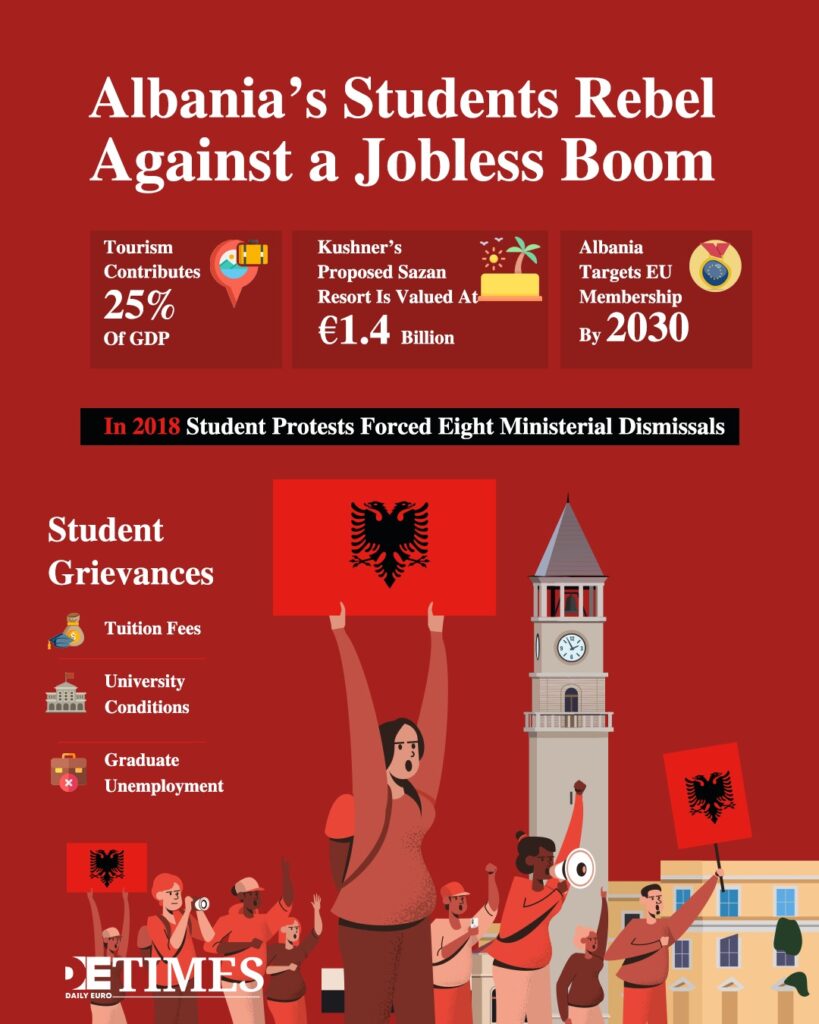
Albanian organisers, however, list university conditions, tuition fees, thin financial support and graduate employment prospects as their motives. Reports so far offer no sign that they took cues from Paris.
Even the loftier slogans stay stubbornly domestic. Protester Luljeta Kola called for “a complete overthrow of the system” in a country she sees as socially unjust.
A Boom That Skipped Graduates
Local anger needs a local cause, and Albania’s celebrated tourism model offers one. Tourism contributes about 25% of gross domestic product, and Rama has courted foreign capital with a zeal visible in every glittering resort plan.
Young Albanians hold an uneven share of that prosperity. Expensive degrees too often lead to precarious jobs or a one-way ticket abroad.
The frustration is old. Eight years ago, a tuition revolt forced Rama to dismiss eight ministers and announce a “Pact for the University”, although several student demands stayed unmet. Unkept promises of that kind rarely vanish, and they accumulate interest.
Rama Digs In as Brussels Waits
The resentment collides with a prime minister who treats resignation as unthinkable. Rama vowed to stay in office, declaring “No one can grab Albania by the throat”, and he accused political opponents of inciting the violence.
His Socialists won last year’s election and need not call another parliamentary vote until 2029. The Democratic Party backs the students and wants a caretaker government before early elections, although many demonstrators reportedly treat opposition leaders as unwelcome allies.
The European Union delegation in Tirana urged a proportionate police response and voiced concern over the violent escalation. Rama hopes to close accession talks in 2027 and join in 2030, an ambition badly served by burning ministries. The EU delegation had already warned that the Kushner project could threaten the membership bid.
Keep up with Daily Euro Times for more updates
Read also:
EU Perception Shift: Albania Gains Ground, Croatia Appears Unsettled
On the Right Track: Albania’s Accession Plan
Croatian Cannot Carry Montenegro’s Accession

