Pedro Sánchez declared on 20 October that Spain will ask the European Union to scrap daylight saving time.
The Spanish Prime Minister made it clear: there is no point any longer. His government plans to bring this proposal to the European Council with a single aim, ending what Madrid calls an outdated ritual.
The announcement comes at a recognizable moment. This weekend, people across Europe will turn clocks back by one hour, knowing that 66 per cent of Spaniards support dropping the time change for good.
Europe Already Voted Against Clock Changes
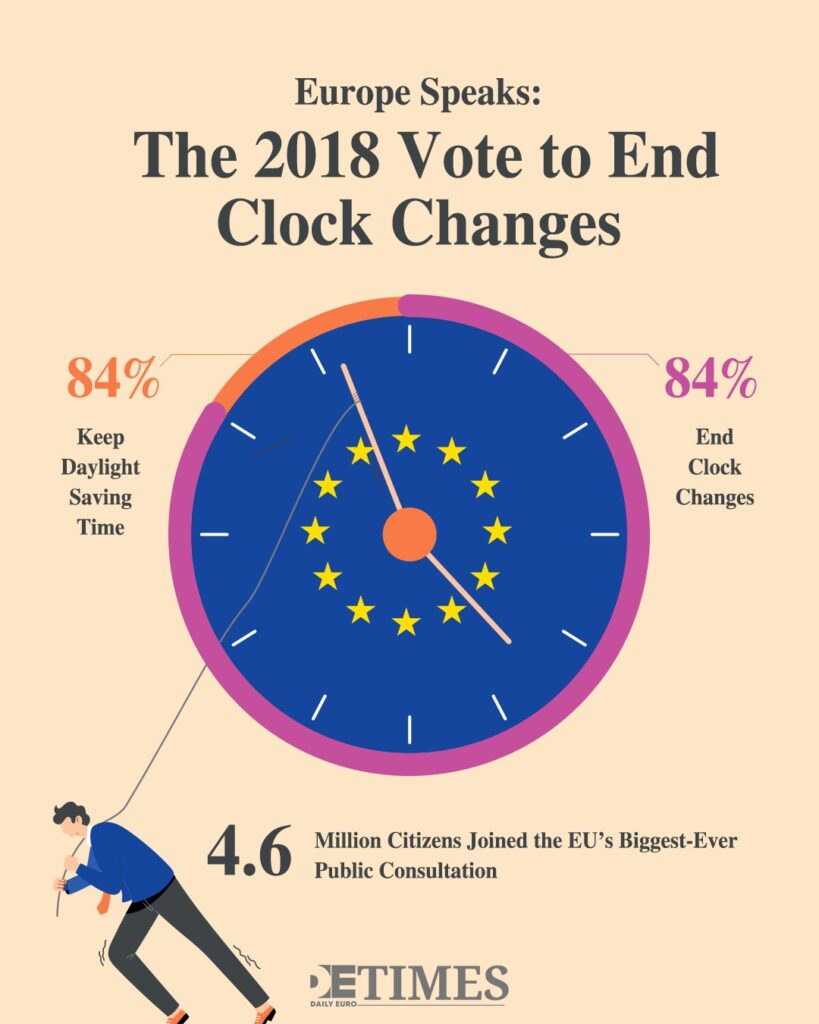
Madrid’s proposal does not break new ground for the EU. Back in 2018, the European Commission launched a public consultation after nearly four million voiced support. Of those who responded, 84 per cent wanted to stop clock changes.
The European Parliament approved an end to time switching in 2019 with a vote of 410 to 192.
From there, the process halted. The proposal ran aground with the Council because member states couldn’t come to consensus. Some wanted summer time to be permanent; others pushed for winter time. Brexit landed. Covid-19 changed everything. The war in Ukraine drew attention elsewhere.
Six years later, twice-yearly time changes persist.
The Original Reasons Have Disappeared
Spain’s government argues that economic progress, technological growth, and updated social habits have made this habit irrelevant. The practice began in Europe in 1980 with the idea that the clock switch would reduce energy use.
That time has passed. Modern lighting, flexible work, and new technology have canceled out the old justifications. Updated studies show very limited potential for energy savings. The German Environment Agency summarized that true energy savings cannot be pinned down because less use in some areas is wiped out by greater use in others.
In spring and autumn, more heating is needed during chilly mornings. The supposed evening electricity savings don’t make up the shortfall.
Health Evidence Builds Against Time Changes
Science now speaks clearly on the health consequences.
Clinical neurophysiologist Óscar Ramon Sans Capdevila remarked that changing clocks disrupts everyone’s rhythm. Studies confirm that it upsets biological clocks, causes extra stress, and leads to short-term health woes.
Sánchez emphasised that science now agrees this practice fails to save energy and instead disrupts people’s natural rhythms twice a year. The evidence about harmful effects grows for both northern and southern parts of Europe.
Data shows drowsy drivers lead to more accidents in the days that follow a clock switch. Sleep loss, irritability, and weaker immune systems follow these disruptions, according to medical experts.
Poland and Finland Back Spain’s Initiative
Spain is not alone in restarting this debate. During a recent EU energy meeting, only two other countries spoke up in support. A Polish diplomat was hopeful that time could be found to analyze the evidence and build a case for ending the practice. A Finnish diplomat echoed Spain’s view, expressing regret that the issue comes up only in October and May.
European Commissioner for Energy Dan Jørgensen restated that Brussels stands in favour of ending clock changes. He promised a new analysis would begin and voiced confidence that action is ahead.
Spain’s Minister of the Presidency Félix Bolaños explained that Spain wants to keep discussions open on details. Madrid aims to build agreement, not insist on keeping either summer or winter time all year round.
Six Years of Democratic Will Ignored
The 2018 polling remains the EU’s most successful consultation.
4.6 million people responded, sometimes representing a significant slice of a nation. Germany saw 3.79 per cent of its population weigh in. Austria’s rate was 2.94 per cent.
Parliament listened. The Commission listened. The Council held back.
Member states asked for a broader impact assessment before moving ahead. Then the pandemic hit and the whole topic faded from view. There is still no date for a decision.
Democracy, voiced by millions, deserves more than endless paperwork. The one-hour clock shift continues because the Council’s position remains unresolved.
Europe Must Choose
Spain comes to the table with a practical fix. Madrid contends that ending daylight saving time would align Europe better with daily routines. The proposal seeks a Europe that works for people and not for clocks.
Teresa Ribera, European Commission vice president and former Spanish government vice president, noted that with no further clock changes, Spain would most likely settle on winter solar time. Other countries would decide based on geography and public preference.
That diversity should not hold up progress. The EU already runs coordinated time changes. It could just as easily coordinate permanent time zones. Places at similar latitudes could align, and neighbours could agree on practical solutions.
Otherwise, Europe risks sticking with a system millions reject, lacking scientific support, and creating clear health challenges every spring and autumn. Energy savings no longer offer a valid reason.
Listen to Citizens Finally
Sánchez argued that valuable policy starts by listening to citizens and to science, then weaving those lessons into law. Six years ago, the EU asked what people wanted. The answer was clear. Science has delivered its conclusion. What the Council still lacks is political resolve.
Madrid plans to press the issue at the next EU Transport, Telecommunications and Energy Council meeting. The government hopes to phase out the practice by 2026, giving countries time to coordinate and adjust travel services.
Two out of three in Spain and five out of six across the EU have said they want this change. If popularity means anything in Europe, the Council should finally act on the will shared in 2018.
Keep up with Daily Euro Times for more updates!
Read also:
Spain Overtakes Japan: Services Economy Writes New Economic History
Spain: Adiós Relaxation, Hello Red Tape
Foreigners Under Fire by Spanish Tax Hikes