
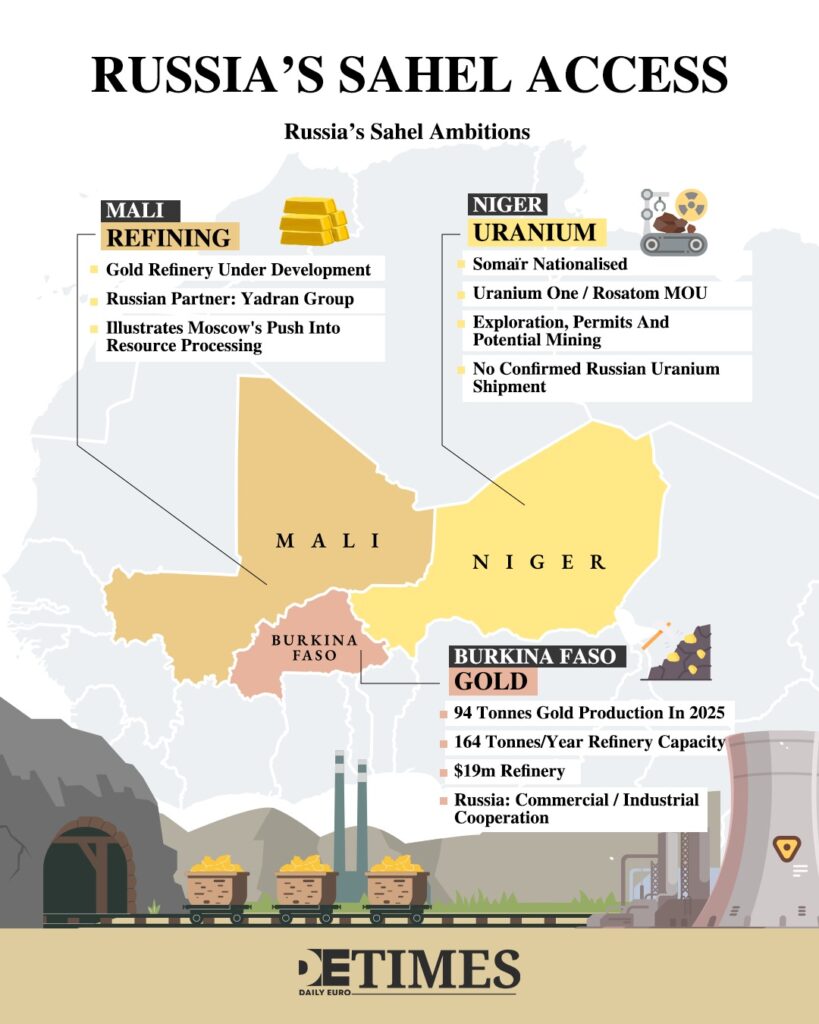
Burkina Faso opened its first gold refinery this week, a $19 million plant with initial capacity of 164 tonnes a year in a country that produced 94 tonnes last year.
The surplus capacity hints at ambitions to refine metal from neighbours. Ibrahim Traoré declared, “Our ambition goes beyond gold,” and Mali is building a refinery of its own with Russia’s Yadran Group.
Such projects widen Moscow’s bargaining table. Russia will gain an edge in uranium and other resource deals across the Alliance of Sahel States (AES), comprising Burkina Faso, Mali and Niger. The edge becomes capability over the West only if Moscow delivers refining capacity, transport and legal certainty.
Moscow Eyes the Unified Market
Pavel Shibilov, Head of International Development at the Russian Export Center, told a Moscow forum last week that the AES market holds great interest for Russia. His enthusiasm is commercial, and it arrives at a convenient hour for exporters seeking new customers.
Chambers of commerce signed a cooperation agreement at the forum, and a Russian turbine maker signed a letter of intent with a Burkinabè partner. Such paperwork is modest, yet it opens doors that Western firms once guarded.
Existing trade is thin, dominated by grain and iron goods, so a unified market gives Russian exporters a chance to build scale from a low base. The REC understands that a regional bloc negotiates better than three separate capitals, and it is courting the bloc accordingly.
Niger Courts New Uranium Buyers
Niger seeks new investors after tightening its grip on the sector. Last year Niamey nationalised Somaïr, the mine Orano had operated for decades, and the International Centre for Settlement of Investment Disputes blocked any sale of the stockpiled uranium. The ruling has not stopped Niamey from shopping for buyers.
The most visible suitor is Rosatom. In December the state-owned Timersoi National Uranium Company signed a memorandum with Uranium One, a Rosatom subsidiary, covering permits, exploration and eventual mining operations.
Rosatom denied any involvement in reported plans to buy 1,000 tonnes of Somaïr’s stock, insisting it builds its own projects with African partners. So far the Russian edge consists of paperwork, with no confirmed shipment.
Where Russian Leverage Meets Limits
Landlocked producers still need ports, and every overland route crosses territory where armed groups contest state authority. A cargo of yellowcake or refined gold headed for Russia faces insurance bills, diversion risks and the long haul through neighbours with their own agendas.
Buyers in Europe and Asia can find uranium in Kazakhstan and Canada, so Niamey’s bargaining power over Paris might prove smaller than the rhetoric implies. Russia, which mines and enriches uranium at home, has little urgent need for Nigerien ore.
Sahel governments understand this well. They court Moscow, Beijing, Ankara and others at once, because economic power is an outcome of history. Decades of one-sided joint ventures explain why Moscow finds open doors in Niamey and Ouagadougou.
Keep up with Daily Euro Times for more updates
Read also:
Sahel Grows Increasingly Hostile Towards Foreign Powers
Sahel’s New Power Broker Speaks Nuclear
US Eyes Mauritania-Israel Deal as New Sahel Foothold

