

Giorgos Mazonakis, one of Greece’s most recognisable singers of the past three decades, died after visiting the private facility known as the “Stem Cell Clinic”. The Hellenic Society of Haematology has since reported that the clinic operated without the oversight ordinarily mandated for procedures involving bone marrow cells.
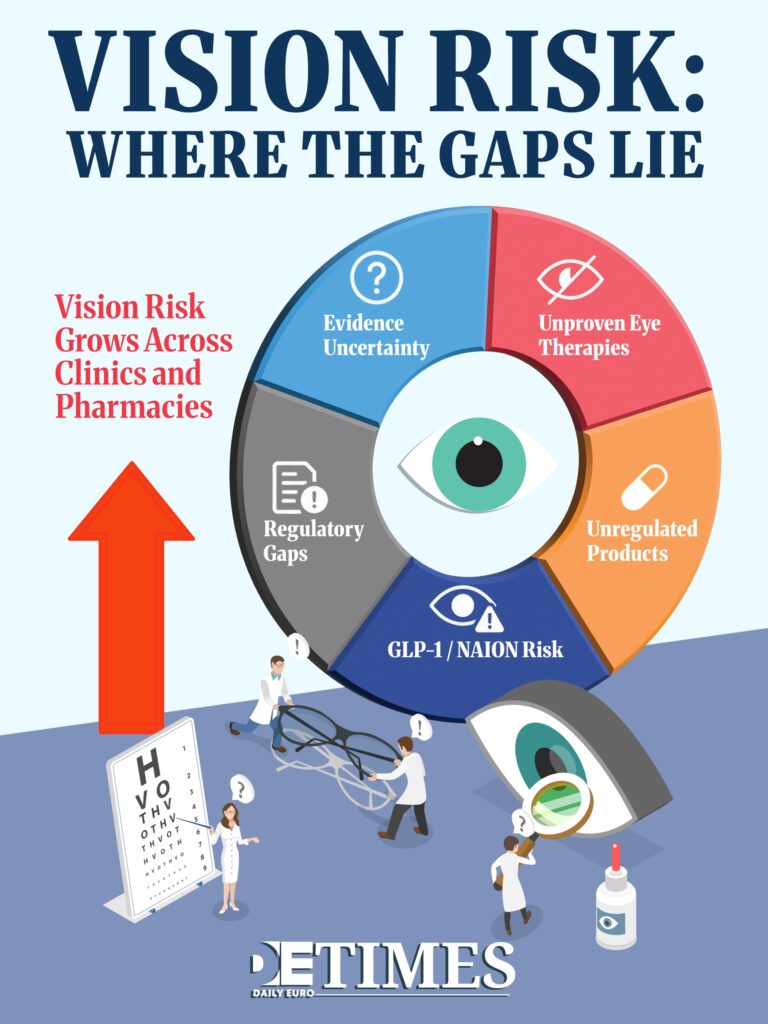
Ophthalmologists watched with particular unease, aware their own patients routinely receive sales pitches for comparably unproven eye interventions.
The Hellenic Ophthalmological Society, or HOS, acted quickly. The society urged patients, in a statement issued days after Mazonakis’s death, to place trust only in ophthalmologists and recognised scientific bodies.
Iridology, “glasses-free” eye exercises and injectable “regenerative” formulas each earned specific rebuke.
Death That Opened Greece’s Oversight Gap
The clinic where Mazonakis received treatment belonged to Greece’s alternative-therapy industry, which regulators have watched grow largely unsupervised. Providers without medical training have advertised interventions Greek hospitals once reserved for haematology units.
The Society of Haematology noted it had petitioned Greek authorities as far back as 2019 over unlicensed cell-therapy clinics, receiving little enforcement in return. Its renewed complaint carries an implicit rebuke of the Greek authorities, content to let the alternative-therapy sector police itself.
The HOS has raised the same alarm about ophthalmology. Its list of targeted practices includes iris-reading diagnostics and cosmetic procedures altering eye colour, each marketed as a certainty no science supports.
The Allure of Miracle Cures
Refractive errors, the HOS explained, arise from the eye’s anatomical structure, and no exercise regime sold online can correct them.
Genuine orthoptic techniques exist, though ophthalmologists should prescribe them only after proper diagnosis, never as a retail product.
Even legitimate pharmacology draws a caveat. Presbyopia eye drops, capable of temporarily sharpening near vision, can produce serious adverse effects in the wrong patient.
Enforcement of this boundary remains thin in Greece. Consumers can buy ophthalmic products online absent any prescription, an omission the HOS specifically condemned.
The Risk in Approved Medicine
The United States has generated the same threat, this time from medicines carrying full regulatory approval.
Novo Nordisk and Eli Lilly are answering hundreds of American lawsuits alleging Ozempic, Wegovy and Mounjaro caused sudden, irreversible vision loss. These belong to a drug class called glucagon-like peptide-1 medicines, or GLP-1 medicines, prescribed widely for diabetes and slimming.
Plaintiffs describe the injury as non-arteritic anterior ischaemic optic neuropathy, or NAION.
Engel, a Maryland snowplough driver prescribed Ozempic for diabetes, woke four months later blind in one eye and lost sight entirely within a year. His account, once an outlier, anchors the federal multidistrict litigation created specifically for NAION claims, which by September oversaw more than two hundred comparable cases.
Greece carries its own stake in the dispute. Off-label demand for Ozempic among people wanting to slim down has grown nationally, with imports reportedly doubling within a year and pharmacies dispensing the drug with loose adherence to prescription rules.
Evidence that Refuses to Settle
Medical opinion still has not converged on one verdict. A Danish-Norwegian cohort found semaglutide users developed NAION more often than patients on a different diabetes drug class. A Harvard Medical School study separately calculated a roughly fourfold relative increase in risk, though the absolute chance stayed low.
A June 2026 review by the American Academy of Ophthalmology reached a gentler conclusion, finding no consistent overall rise across the wider literature. Novo Nordisk and Eli Lilly maintain their own research finds no proven causal link.
Regulators in Britain and Australia have hedged toward caution regardless.
The United Kingdom’s Medicines and Healthcare products Regulatory Agency updated semaglutide labelling in February. Australia issued equivalent warnings in July spanning the entire GLP-1 class, citing reports of comparable optic damage.
American labels carry no equivalent notice, leaving patients in the United States, and by extension Greeks buying the drug informally, without a warning already mandated in Britain and Australia.
Keep up with Daily Euro Times for more updates
Read also:
Britain’s Restaurant Bust Feeds the New Diet Gospel
Hantavirus Panic Revives Pandemic Lies
Europe’s Air Pollution Kills the Poor Twice as Fast