
Egypt and Iran produced a 1-1 draw at Seattle’s Lumen Field last Friday. The result was the least notable event of the evening. Fans in rainbow colours filled sections of the stands. Others gathered outside the stadium to demand that FIFA sever its relationship with Saudi state oil company Aramco.
Seattle’s local World Cup organising committee had designated 26 June as “Pride Match Day” months before the tournament draw placed Iran and Egypt in the Group G finale.
Mehdi Taj, president of the Iran Football Federation, publicly called the branding “an irrational move that supports a certain group.” Egypt’s federation sent a formal letter to FIFA secretary general Mattias Grafström rejecting, “in absolute terms,” any activities connected to the celebration.
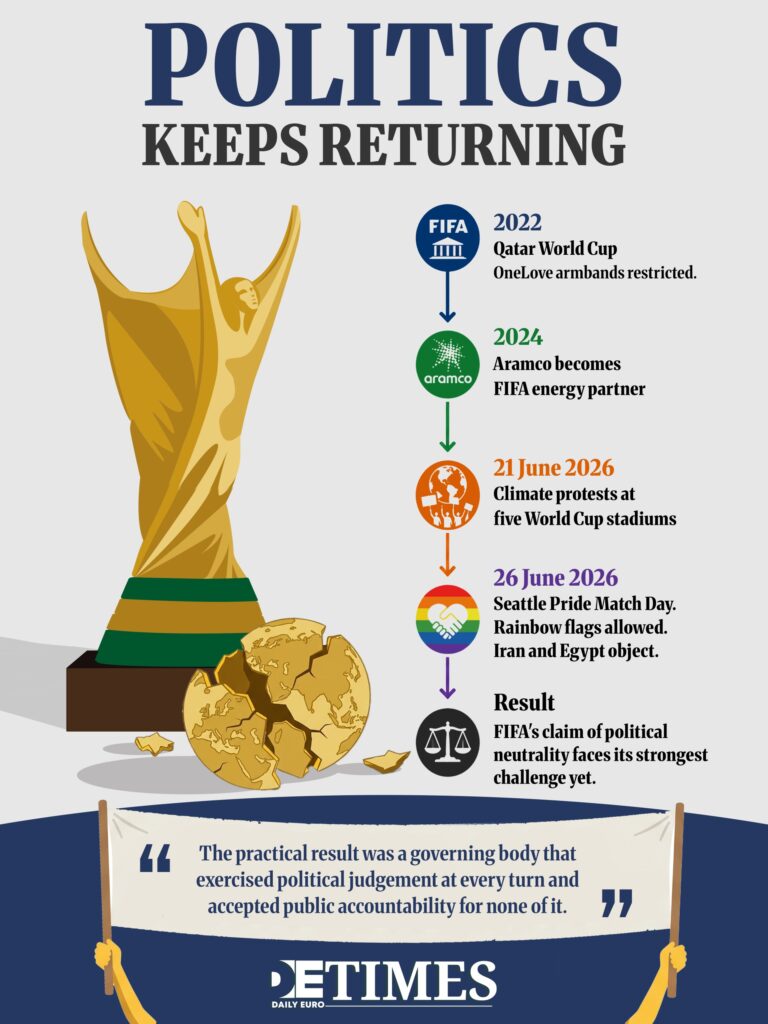
FIFA confirmed it would not prohibit rainbow flags inside Lumen Field. The governing body thereby announced its position on sexual orientation and gender identity rights at the precise fixture it had declared free of politics.
The twin pressures of the Pride designation and the Aramco protests had placed football’s governing body inside a political arena. FIFA had spent years insisting it occupied that arena only as a spectator.
Qatar’s Memory and Seattle’s Reversal
The Seattle episode extended a longer pattern in FIFA’s relationship with political expression. In Qatar four years ago, FIFA threatened to discipline captains who wore the “OneLove” armband, ruling it a political statement. Last Friday in Seattle, FIFA confirmed rainbow flags fell within its own stadium code of conduct as “general statements of human rights.”
FIFA’s president Gianni Infantino had attempted to draw a line in January. “I must clarify that there will be no ‘Pride Match’ at the World Cup,” he told a German publication.
“There will be a FIFA World Cup match in Seattle, and on the same day, events organised by external organisations will be taking place in the city. But that has nothing to do with the match itself.”
The line proved ornamental. Iran’s star forward Mehdi Taremi, asked about rainbow-flag-bearing fans after the game, said: “We respect all of the LGBT people.”
Iran’s presence at the tournament had added its own political charge from the outset. The US-Iran ceasefire process had been fracturing Western diplomatic alliances for months as the group stage unfolded. FIFA had also separately banned the pre-1979 Iranian Lion and Sun flag from all venues, calling it a political symbol. The rainbow flag received the opposite ruling. FIFA drew a political line in both cases.
The Oil Sponsor Outside the Stadium
The second front had opened a week earlier. Climate activists protested outside five World Cup stadiums across the United States on 21 June. Their grievance centred on FIFA’s exclusive energy sponsorship agreement with Saudi Aramco, the world’s largest oil and gas company, and a World Cup expected to be the most polluting in the tournament’s history.
The deal, announced two years ago, made Aramco the exclusive energy sponsor for both the 2026 men’s tournament and the 2027 Women’s World Cup. Saudi Crown Prince Mohammed bin Salman had addressed critics with characteristic directness: “If sportswashing is going to increase my GDP by 1%, then we’ll continue doing sportswashing.”
More than 130 professional women footballers from 27 countries had signed an open letter describing the arrangement as a “middle finger” to players and fans. Male professional players added their voices last year.
An independent study published this month by carbon-accounting firm Greenly estimated the tournament’s total carbon footprint at 7.8 million metric tons of CO2 equivalent, more than double the official emissions figure reported for Qatar 2022.
Travel across the three host countries accounted for 87.8% of that total. The New Weather Institute polled women’s football fans across Australia, Brazil, the UK and the US; 72% wanted FIFA to end the Aramco deal.
Governance Without an Ethics Anchor
The Aramco deal sat in direct proximity to FIFA’s own declared commitments. FIFA had signed the United Nations Sport for Climate Action Framework and pledged a 50% cut in carbon emissions by 2030 and net zero by 2040. The Aramco partnership arrived two years ago, the same year FIFA reaffirmed those pledges.
FIFA’s symbol decisions carried the same institutional implication. FIFA banned the Iranian Lion and Sun flag as a political symbol and permitted the rainbow flag as a statement of human rights. Both rulings followed from the same authority. FIFA offered no explanation of the governing principle that distinguished them.
The practical result was a governing body that exercised political judgement at every turn and accepted public accountability for none of it.
Keep up with Daily Euro Times for more updates
Read also:
Gulf Sports Investments and Regional Security
Akram Afif: Fair Play Needed On and Off the Pitch
Greece’s Olympic Ghosts Haunt a New Generation of Host Nations

