

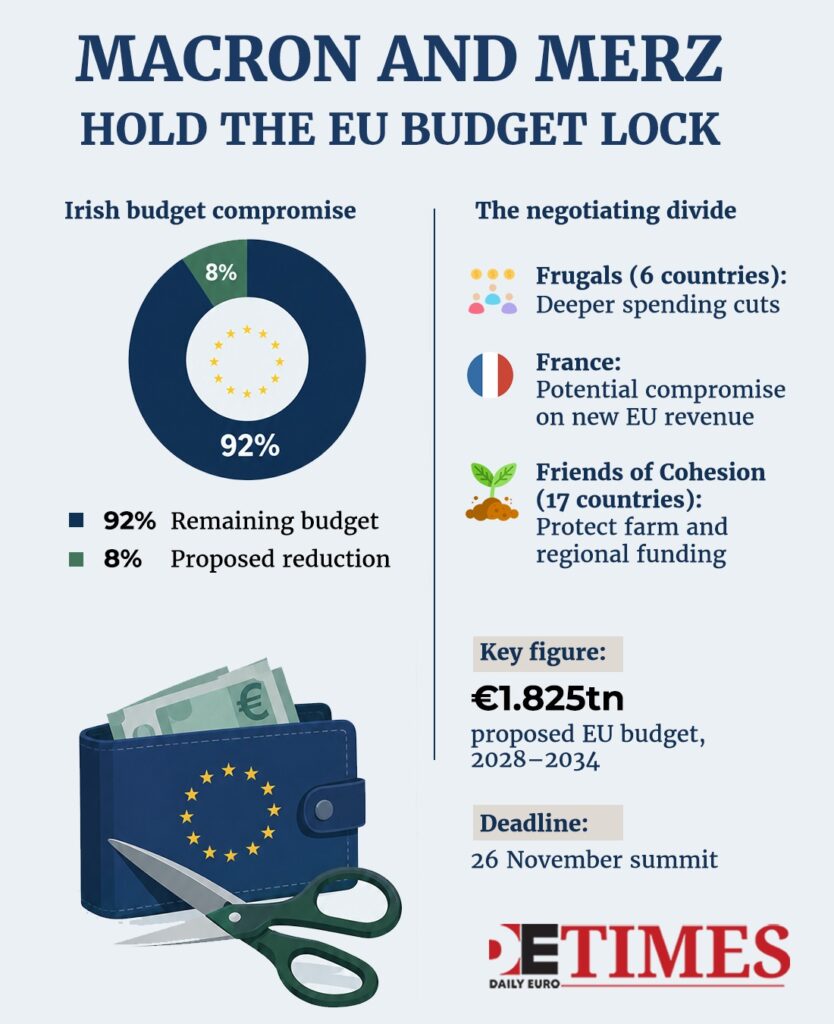
Last week, European Union leaders buried the Irish presidency’s compromise, which proposed trimming the 2028-2034 budget by about 8% and bringing the total down to €1.825 trillion.
The seven-year plan governs farm payments, regional grants and research funds, and the funding simply lapses at the start of 2028 without an agreement. European Council President António Costa has taken over the drafting and has scheduled an extraordinary summit for 26 November.
Little time remains to broker a breakthrough, and diplomatic reporting points to a Franco-German bargain, with the French electoral calendar adding urgency. Berlin would consent to new EU-wide revenue in exchange for Paris accepting tighter spending discipline.
Such a trade remains unconfirmed, but the incentives behind it look unusually strong.
Why Brussels Stands at Stalemate
The wide gap between capitals starts with the size of the bill. The European Commission’s proposal, tabled last year, neared €2 trillion, an amount the wealthiest contributors regard as unaffordable. Irish mediators responded with trims of about 8%, and the result displeased almost everybody.
A bitter irony explains the discontent. The Irish text trimmed competitiveness funding by 13% and global cooperation by 17%, programmes the frugals themselves champion.
Revenue turns these disputes into a fight over who pays. Repaying the pandemic-era joint borrowing adds a further burden, so Costa has placed new own resources, meaning EU-wide revenue streams, at the heart of his plan. Member-state contributions finance most of the budget, and every capital wants them restrained.
What Each Capital Wants
Those revenue questions have split capitals into camps, and the widest division separates six net contributors from seventeen recipients.
Germany, Austria, Denmark, Finland, the Netherlands and Sweden form the frugals, who want several hundred billion more removed, mostly from agriculture and cohesion funds. Chancellor Friedrich Merz declared, “We must significantly reduce the common budget”, and regretted the Irish plan as overly ambitious. Dutch Prime Minister Rob Jetten judged the text inadequate for his country’s priorities of competitiveness, safety and future welfare.
Opposite them, the seventeen-strong Friends of Cohesion, a southern and eastern group convened last week under Giorgia Meloni, reject the cuts. Italy’s prime minister told the Senate, “The date cannot become more important than the content”, a stance that lowers the odds of a rushed signature. Hungary’s Péter Magyar confirmed the group had turned down the latest plans, and the European Parliament, whose approval any budget needs, has warned against cuts that weaken Europe.
Between these camps stands France, the second-largest economy, which has not picked a side. Squeezed between European ambitions and a runaway deficit, Paris holds the swing position.
Why the Election Clock Favours Compromise
France’s hesitation proves decisive, since its electoral calendar sets the real deadline. Costa reportedly alerted leaders to a possible delay until October next year should this year’s target slip, with elections looming in France, Italy, Poland, Finland, Greece and Estonia. Macron warned the room of vanishing political space for a settlement from January.
His anxiety has a name. Marine Le Pen, who leads the polls ahead of next year’s presidential election, has pledged to cap France’s net contribution at €5 billion a year, with the current level around €8 billion. Leaders in Paris and Berlin hold weak domestic hands, so a December deal would probably shelter each of them from an unpredictable spring.
A Franco-German Bargain Gathers Pace
Domestic fragility explains why the two capitals have begun trading concessions elsewhere. Macron and Merz have recently sealed a swap, with Berlin securing extra time for combustion-engine cars in exchange for Paris’s strict Made in Europe rules on subsidies and public contracts.
The auto deal offers a template for the budget, where diplomats reportedly hint at a similar trade. Germany would accept new revenue streams, such as levies on online gambling or financial transactions, in return for stricter spending reviews. A revised carbon border levy might join the package.
Such a package would answer Costa’s priority on own resources and give Berlin a talking point on spending reviews, with Paris pocketing a cherished revenue source. Unanimity still gives every capital a veto, so Italy, Poland and the Friends of Cohesion would need assurances on farm and regional funds.
Keep up with Daily Euro Times for more updates
Read also:
France: The Budget Strain Behind Raging School Protests
France’s Fuel Crisis Collides with the Upcoming Budget
Italy Pushes to Weaken Green Rules in the EU Budget

