
International Monetary Fund Managing Director Kristalina Georgieva paused during a recent appearance on CBS’s Face the Nation to think of Sri Lanka.
The island had spent three years climbing out of its worst economic crisis, cutting fiscal deficits, rebuilding reserves, and working through an IMF restructuring.
When the Middle East war erupted, a third of Sri Lanka’s flights passed through the Gulf. Tourism, a lifeline, now suffers a severe blow.
Georgieva, audibly stirred, said: “My heart goes for Sri Lanka.” Her words evaluate transcontinental shocks.
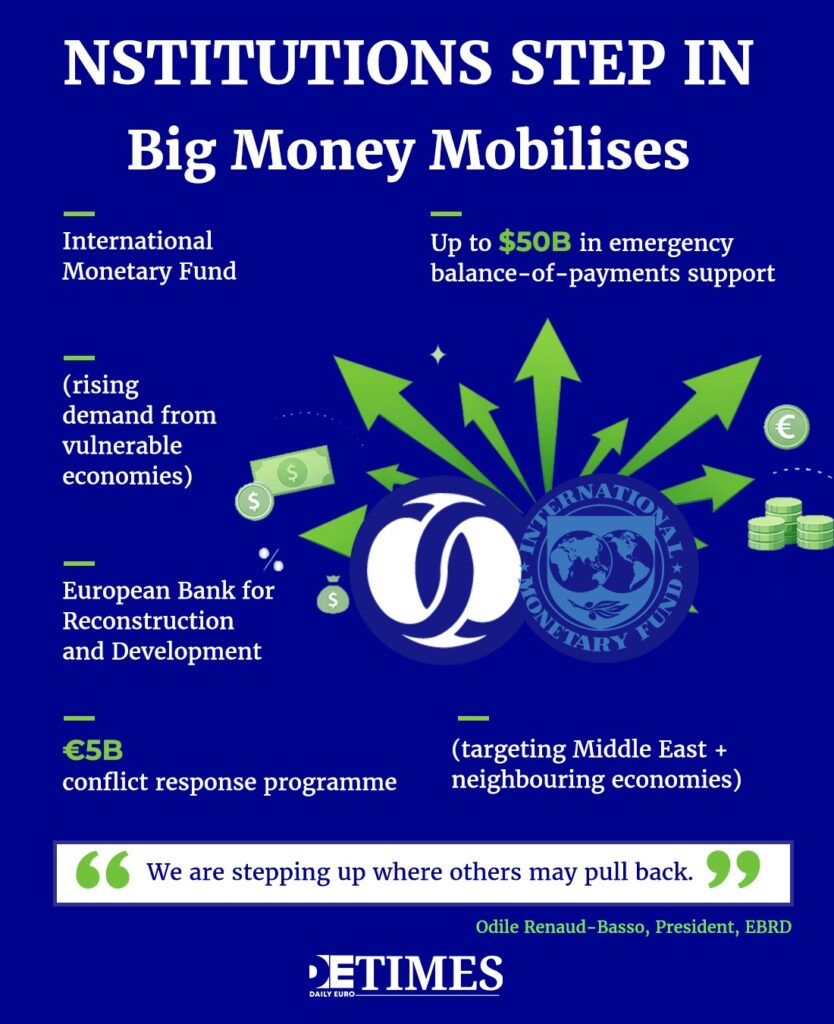
The European Bank for Reconstruction and Development and the IMF act as the two multilateral institutions at the centre of the emergency response.
The war drove Brent crude to a $120 peak. As Qatar’s Ras Laffan liquefied natural gas site, producing nearly 93% of the Gulf’s LNG output, took direct hits on 19 March, the site mandates a multi-year recovery.
Over 80% of the world’s countries import oil, hence the expansive global reach of the financial fallout.
Two Institutions, Many Billions in Play
The EBRD launched a conflict response programme seeking to deploy €5 billion across economies affected by the fighting. Iraq, Jordan, Lebanon, and the West Bank and Gaza serve as primary targets; Egypt, Türkiye, Armenia, and Azerbaijan stand as neighbouring targets.
EBRD President Odile Renaud-Basso declared: “We are stepping up where others may pull back, while maintaining sound banking fundamentals.”
The sequenced recovery support covers liquidity for financial institutions, energy utilities, and businesses.
The EBRD has invested more than €26.5 billion across 489 projects in the southern and eastern Mediterranean since 2012. Such investment provides the bank with a working familiarity with the region it now mobilises at speed.
At the Spring Meetings in Washington, Georgieva projected near-term demand for IMF balance-of-payments support would rise to $50 billion, provided the ceasefire holds. Georgieva says the Fund had received accumulating requests for emergency financing.
Various developing states likely need support. The IMF, the World Bank, and the International Energy Agency formed a co-ordination group to manage data-sharing, targeted policy advice, and financing responses across member states.
The Spread that Economics Predicted
EBRD Chief Economist Beata Javorcik warned that “the conflict shows how quickly geopolitical shocks can ripple through energy markets, supply chains and financial conditions.” Her observation carries immense gravity.
The EBRD’s March 2026 Regional Economic Update projects that oil sustained above $100 a barrel, combined with supply chain disruptions in chemicals and metals, could reduce global growth by at least 0.4 percentage points and push inflation up by more than 1.5 percentage points.
Kenya, Moldova, Mongolia, Senegal, Tunisia, and North Macedonia emerge on the bank’s list of most-exposed distal economies.
Javorcik added that “the effects of the conflict are likely to linger beyond the end of hostilities,” a sentence giving anyone expecting a swift recovery a reason to stop.
Rising energy prices feed into food prices via fertiliser supply chains. The Gulf supplies a large share of the world’s helium, used in everything from semiconductors to medical imaging.
Countries in South Asia and East Africa see compounded costs as their services exports weaken and import bills rise.
Debt Accrues Before the Emergency
The financial response being assembled lands on top of a pre-existing condition. IMF economists documented how many economies already carried record-high debt levels and limited reserves before the war began, leaving little room to absorb new shocks.
Mary Svenstrup, a former senior US Treasury official now with the Centre for Global Development, urged IMF stakeholders to “really rethink how the Fund supports vulnerable countries with the recognition that we’re going to be seeing more global shocks.”
Emergency lending can act as a stabiliser; however, the structural exposure of economies built around imported energy and Gulf remittances need conversations outside of a crisis response.
An institution lending during a war will eventually need a frank exchange with its borrowers about why the same vulnerabilities reproduce themselves, generation after generation.
The Burden Falls on the Powerless
Sub-Saharan African economies and small island states largely fill what Georgieva called the “quadrant of vulnerability”: fiscally constrained oil importers. “Poor, vulnerable countries, whether they’re in Asia or in Sub-Saharan Africa, they’re being hammered dramatically.”
Such economies ended up in such a state via a combination of geography and economic history that produced the dependence; their governments did not choose such dependency.
The IMF and EBRD deserve recognition for mobilising quickly, and Georgieva was right to urge policymakers to “reject go-it-alone actions.” The tougher fact is stipulated survival financing materialises at the worst possible prices.
States whose public finances were already stretched will add more obligations in exchange for surviving an interdependent shock.
The stronger case is for the multilateral system to invest in structural economic resilience across its southern and eastern neighbours, building a durable partnership before the next emergency hits.
Keep up with Daily Euro Times for more updates
Read also:
EU Targets Stablecoins as Iran Forces Digital Tolls
Davos Boss Exit Signals Revamp for a Tired WEF
Lebanon Teeters on Default: Europe Opts Out of Pushing Disarmament