

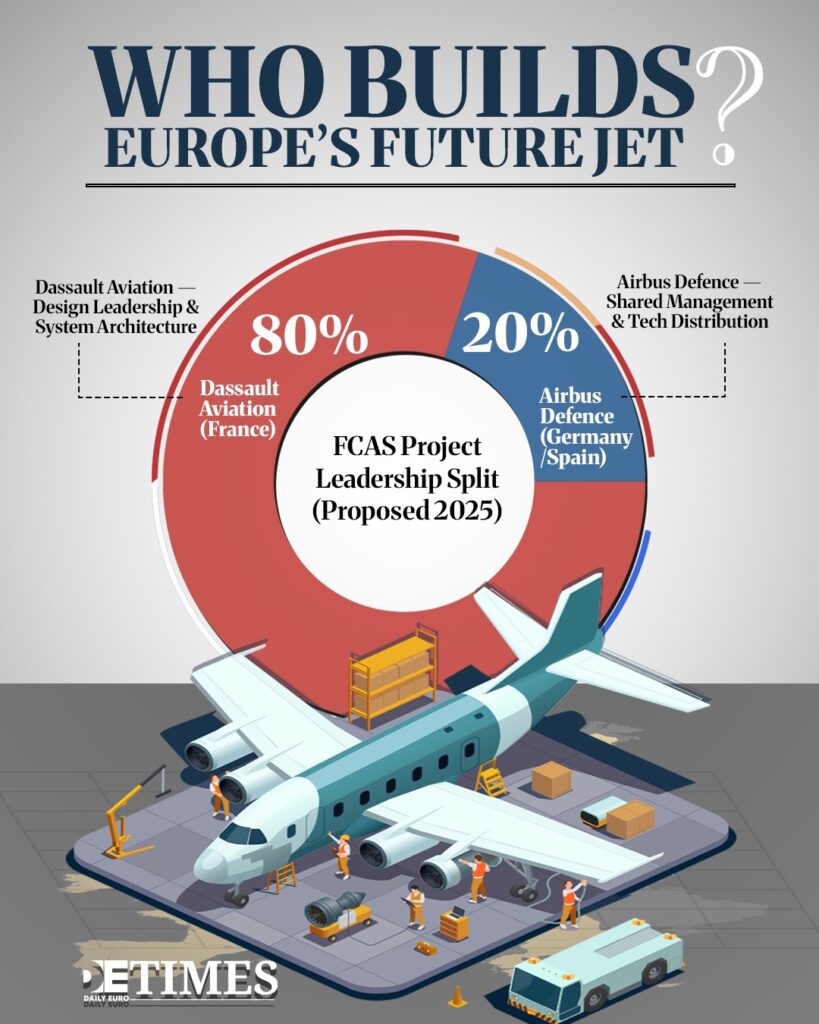
French warplane maker Dassault Aviation demanded an 80% share on Europe’s Future Combat Air System (FCAS) this summer in the latest European scrap over armed fighters.
Germany’s Airbus was stunned by the claim.
Now, the €100 billion program, aiming to replace Rafale and Eurofighter jets by 2045, might collapse. Dassault CEO Eric Trappier even said his company could build the fighter jet alone if necessary.
But Paris lacks the political steadiness to pressure Dassault.
Government Instability Fuels Corporate Stubbornness
Michel Barnier fell after just 91 days as Prime Minister in December 2024, the first government toppled in a no-confidence vote since 1962. Barnier brought decades of Brussels experience and spoke fluent German, earning Berlin’s respect.
His quick departure left France without a strong mediator with Germany. Since then, French governments have struggled just to manage day-to-day affairs.
Dassault takes advantage of this power vacuum. The company only answers to its shareholders and export markets. Government calls for compromise just run into Dassault’s business calculus. No French minister seems to have the authority to force the company to relent.
Workshare Battles Echo Old Conflicts
Dassault claims its deep expertise in warplane production justifies a dominant role.
Trappier told French lawmakers that one leader must choose subcontractors for the project’s next phase. Still, he promised German and Spanish firms would get to participate.
Airbus, on the other hand, supports jobs all over Europe through the Eurofighter production network. This multinational company is built on shared work and authority.
Letting Dassault take over would severely damage Airbus’s military aircraft division.
German lawmaker Christoph Schmid called the French demand the final nail in FCAS’ coffin.
Berlin and Madrid watch Dassault push ahead with little resistance from the French government, as technical advice increasingly becomes official policy.
Farming Protests Set the Tone for Defence Disputes
Last year, French farmers blocked the EU-Mercosur trade deal, flooding Paris with tractor convoys. Brussels had spent 25 years trying to clinch the agreement with Argentina, Brazil, Paraguay, and Uruguay.
President Emmanuel Macron publicly opposed the deal, despite European Commission support. Rural voters threatened chaos on supply chains.
The winter protests showed that domestic interests often overshadow Brussels.
The FCAS situation follows suit. European integration runs into national champions protecting their turf.
Private Companies Control Europe’s Security
Airbus CEO Jean-Brice Dumont warned that FCAS stands no chance without political and industrial agreement by year-end.
Dumont admitted that the current program phase has big hurdles, with no bids yet for the next phase.
Partners worry that the 2045 target is slipping. France could be left without next-generation jets when Rafale F4 retires. Germany has increased its F-35 orders as a fallback.
Each delay fuels arguments to end cooperation between defence companies acting according to profit motives. Dassault guards its know-how and freedom to export. Airbus defends jobs across the continent.
If governments set defence policies, companies decide if the weapons get built.
Sovereignty Claims Hide Business Interests
Trappier portrays Dassault’s stance as ‘national security.’ Unrestricted fighter exports support French warplane expertise. Giving Airbus design control threatens this edge. France also keeps its independent nuclear deterrent.
But commercial logic hides behind these sovereignty arguments. Dassault dominates a profitable market niche. Sharing control would weaken its grip on lucrative foreign sales. The company ramped up Rafale production this year, expecting new orders.
Germany and Spain don’t have equivalent national champions. Airbus represents multiple countries by nature.
This imbalance makes equal partnership unrealistic. Dassault negotiates as France. Airbus negotiates for a committee of Europe.
Brussels Can’t Command What Paris Can’t Control
The European Commission promotes defence integration, hoping joint purchases cut costs and spread industry yet the reality falls short.
Member states guard their sovereignty when it comes to security. Companies prioritise shareholder profits over European unity. On top of it, political instability breaks governments’ ability to mediate between national firms and partners.
FCAS shows how multinational defence projects need steady political leadership, but France can’t provide it.
Barnier might have helped smooth Franco-German tensions, but his successors struggle even to pass budgets.
Dassault knows French governments come and go. Its corporate strategy runs on longer timelines than political cycles. The company can wait out shaky coalitions. Airbus must answer to both Berlin and Madrid at once.
European defence cooperation works when companies agree. The nEUROn drone project succeeded on time because Dassault led with clear authority. Partners accepted France’s management, and success followed stable leadership.
FCAS lacks this clarity. No single company has clear control. Constant fights over workshare lead to repeated renegotiations. Politics can’t solve technical disputes between equals.
Europe’s Security Stands on Shaky Ground
The future of Europe’s fighter jet depends on corporate agreement. Political coordination only grants permission; it can’t force action. French government instability gives Dassault the upper hand. Germany’s patience is running out.
The FCAS project needs a deal by December. Neither side is yielding. Trappier believes time is on Dassault’s side. Airbus can’t walk away from Germany’s biggest defence program.
Just as French farmers showed that trade runs through countryside, not Brussels, Dassault proves defence runs through corporate boardrooms, not government offices.
The coming months will show if European defence cooperation is anything more than talk.
Keep up with Daily Euro Times for more updates!
Read also:
A Paper Tiger: American F-35s Dive Bomb as Europe Sets a New Course on Defense
U.S. Wants Türkiye to Hand Back Enigmatic Jet Gear
French Farmers: Trade Runs Through the Countryside, Not Brussels