

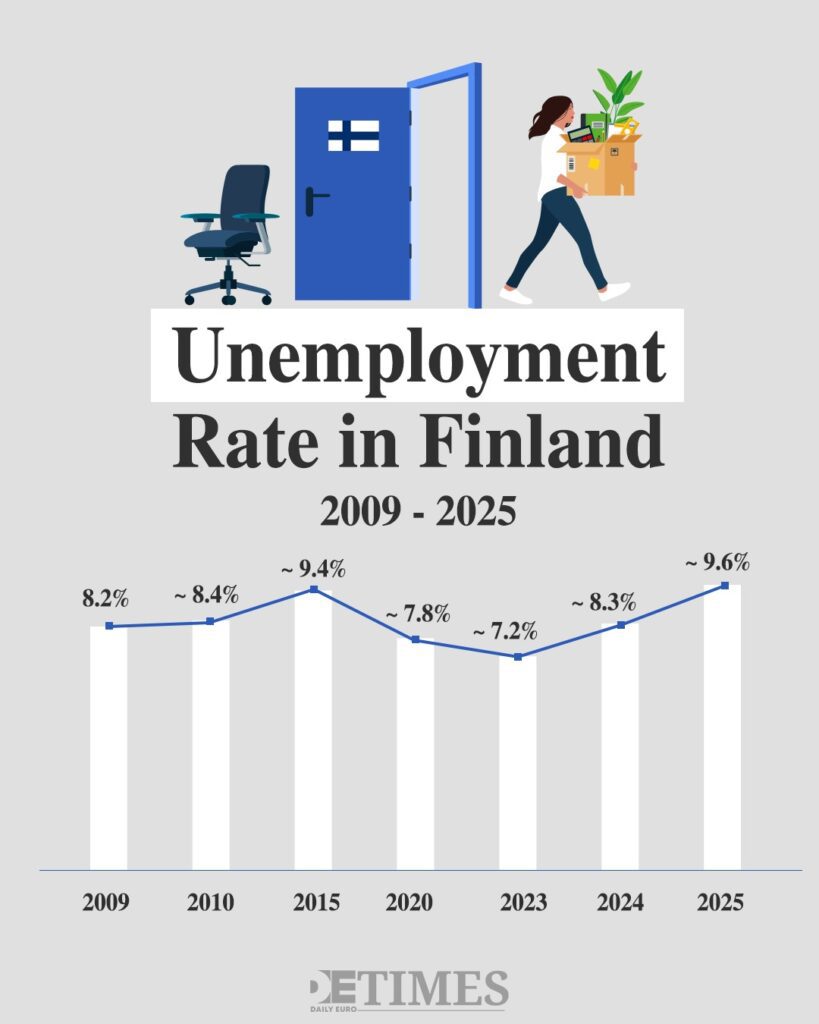
Finland reached its highest unemployment rate in 16 years, according to Statistics Finland.
Joblessness climbed to 10.3% in October 2025, with 276,000 people unemployed, an increase of 48,000 from the previous year. The figures might suggest a country entering crisis, yet the public conversation has taken a different tone.
Reporting from Yle shows younger Finns discussing unemployment in a way that mixes worry with unusual composure. Many describe the absence of work not as failure, but as temporary space. This signals a shift in how societies understand labour. Formal employment remains important, yet cultural assumptions around productivity and success are loosening.
Social Systems and Expectations
Finland’s welfare model partly explains this reaction. The state provides relatively consistent support, which allows citizens to navigate unemployment without immediate crisis.
The protection does not remove economic pressure, but it softens it. This changes how people interpret periods without work. Instead of an existential threat, it becomes a moment to reorganise daily life.
However, the cultural dimension matters just as much. Finnish society has long linked dignity to contribution rather than constant output. People value work, but they do not rely on professional identity alone. This creates a paradox for outside observers.
In countries where employment defines social status, high unemployment produces social instability. In Finland, the same figures coexist with a collective sense of equilibrium.
Finland now holds the second-highest unemployment rate in the EU, trailing only Spain at 10.4%. Youth unemployment reached 23% in June 2025, placing Finland fourth in the EU on that measure.
The reversal is dramatic: a decade ago, high unemployment was concentrated in southern Europe.
That pattern has now inverted.
Generational Differences
Younger people appear more willing to step outside traditional work patterns. Part-time roles, retraining programmes and creative projects have become common responses to unemployment. The number of part-time workers reached an all-time high in October 2025, with 539,000 employed persons working part-time, representing 20.7% of all employed individuals.
This does not imply indifference to economic challenges, but it suggests that work is no longer viewed as the centre of personal fulfilment. The trend highlights a broader European conversation. Many societies share concerns about automation, rising costs and insecure careers.
Yet reactions vary. In southern Europe, unemployment often leads to frustration and social fragmentation. In parts of northern Europe, the response is more experimental, even optimistic.
Lessons Beyond the Labour Market
The rise in unemployment still poses real economic difficulties. It pressures public finances and affects long-term planning for families and businesses.
Yet the cultural response deserves attention. Finland demonstrates that social resilience does not depend solely on job numbers. It emerges from education, community, stable institutions and collective norms that value equilibrium over constant performance.
This raises a question for Europe. If formal employment is no longer the only measure of stability, what should replace it? The Finnish example suggests that dignity can endure structural shifts when societies accept that work has limits.
People can feel useful even without constant productivity, especially when they live in environments where they trust public systems and each other.
Finland’s unemployment rate tells one story. The population’s reaction tells another. Together, they demonstrate that economic transitions can be lived with less fear when the social foundations are strong.
Keep up with Daily Euro Times for more updates!
Read also:
Greece’s €1.6 Billion Bet: Can Money Solve the Demographic Crisis
Finland: When Prosperity Packs on the Pounds
Foreigners Under Fire by Spanish Tax Hikes