

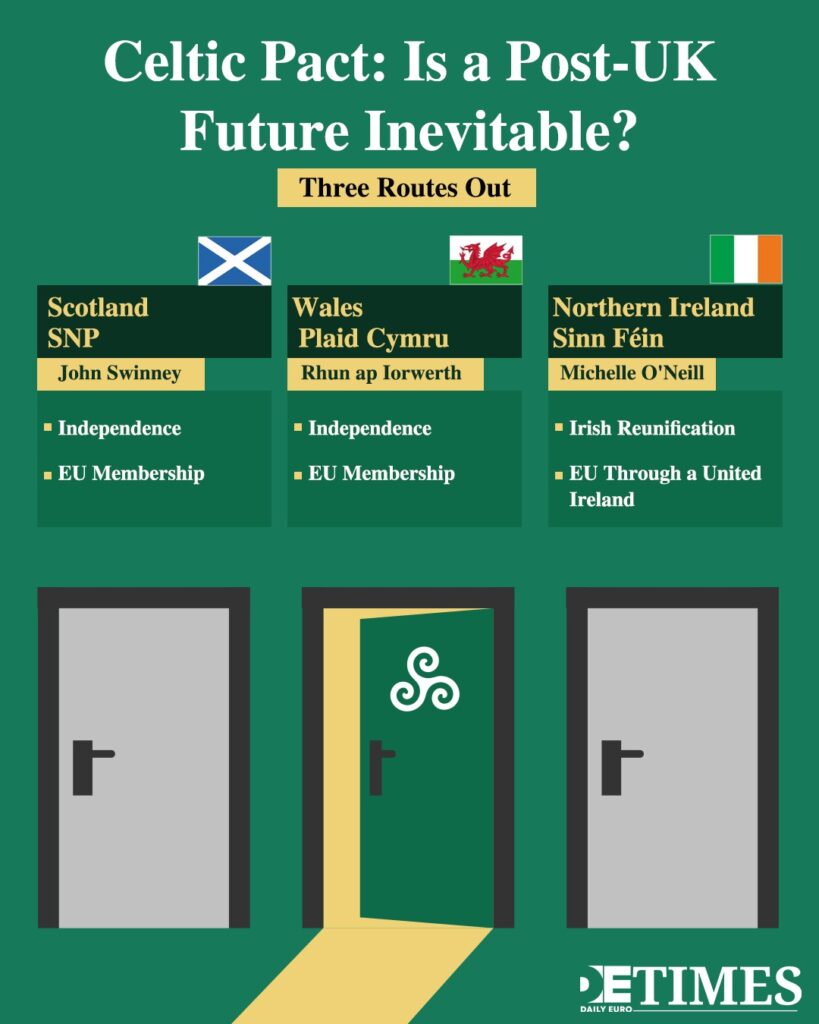
The three flags of Celtic nations stood together in Cardiff this week, an image unthinkable a decade ago. Swinney leads the Scottish National Party, ap Iorwerth leads Plaid Cymru, and O’Neill leads Sinn Féin, the first time all three parties have simultaneously held power in Britain’s devolved administrations.
On Monday the trio signed a memorandum declaring Westminster’s authority over the United Kingdom to be entering its final chapter. Swinney and ap Iorwerth seek independence for Scotland and Wales respectively. O’Neill seeks Ireland’s reunification. Their document names one destination for a post-UK future, membership of the European Union, sought separately by Scotland and Wales, and through unity with Dublin for the north.
Only days before the Cardiff signing, Donald Trump had told reporters in Dublin he would love to see a united Ireland. Weeks earlier he had questioned American backing for Britain over the Falklands.
Reading the Cardiff declaration as an answer to some new Washington doctrine of dismantling allies might tempt observers, given Alberta’s flirtation with American funding and Greenland’s unwanted hospital ship. The pact’s own text, however, points elsewhere.
The Pact Written For Brussels
Cardiff declaration authors have set their sights on Brussels, treating Trump’s remarks as a useful backdrop. Scotland and Wales would apply to Brussels as new members. The north, instead, would join the club through absorption into the Republic itself.
Support for membership has grown steadily since Britain’s departure from the European Union in 2020, a decision Scottish voters overwhelmingly opposed.
Wales adds a newer grievance. Plaid Cymru’s victory in May’s Senedd election gave the party its first taste of government, and independence remains its central goal.
Sinn Féin, for its part, has campaigned for unity since its founding, long before any American president took an interest in the subject.
Washington’s Precedents Loom Large
Alberta’s separatists nonetheless offer an uncomfortable template. Canadian oil-province campaigners have met State Department officials repeatedly and sought a five-hundred-billion-dollar credit line from the Treasury. Washington praised the province’s resources, without ruling out deeper involvement.
Greenland received its own overture. Trump floated a hospital ship on social media only hours after Greenlandic doctors had rescued an American sailor, a gesture Nuuk read as pressure dressed as charity.
If Alberta and Greenland are not yet moving toward Washington, Cardiff is moving toward Brussels. What links the three is simply a shared sense of great powers treating smaller territories as assets to be traded, a mood the Cardiff leaders can exploit without sharing its cause.
Falklands Remarks Widen the Distrust
Trump recently hinted he might personally settle Argentina’s claim to the Falklands, questioning Britain’s capacity to defend islands it fought for in 1982. Argentina’s president responded by calling the instant his country’s most sacred cause.
For Scottish and Welsh nationalists, the point lay closer to home, confirming Britain’s American guarantor no longer treats London’s territorial claims as fixed, a conclusion that applies just as easily to Westminster’s own regions.
Westminster’s Legal Options Are Narrow
Prime Minister Andy Burnham, Britain’s first Catholic-born premier, has ruled out a referendum until public opinion turns decisively, regardless of the mood in Dublin or Buenos Aires. His spokesman dismissed the pact as symbolic, without legal force, and constitutional lawyers largely agree.
Scotland’s parliament cannot legislate a referendum alone after the Supreme Court barred it from doing so in 2022, and Wales has no equivalent mechanism at all. Only a Section 30 order, which Westminster alone can grant, could authorise a legal vote, and no government has offered one since 2014.
What the Trio Could Do Next
Westminster has blocked the legal route, so the three governments say they intend to build a political case loud enough for refusal to become untenable, much as the Scottish National Party did before 2014.
Sinn Féin can still pursue a border poll under the Good Friday Agreement’s terms that leave the Northern Ireland secretary alone to judge unification likely before calling a vote.
Wales and Scotland have fewer formal levers, leaving public pressure and the ballot box as their chief instruments.
The union Burnham leads becomes easier to imagine leaving once its guarantor bargains openly over its own territories. Cardiff’s leaders have understood as much, without adopting any of Washington’s methods.
Keep up with Daily Euro Times for more updates
Read also:
Burnham Wants a Constitution. Does Anyone Else?
From Belfast to Gaza: Britain’s Attempt to Export the Good Friday Agreement
How Brexit Became an Unexpected Gift for Irish Unity