

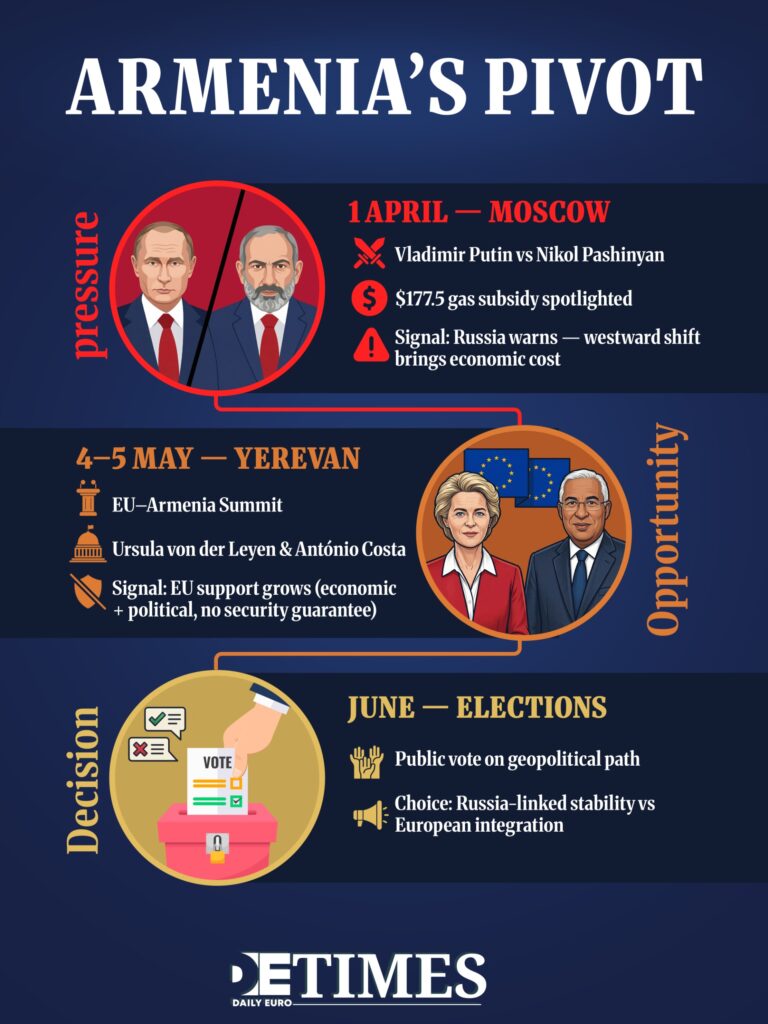
On 1 April, inside the Kremlin, Russian President Vladimir Putin and Armenian Prime Minister Nikol Pashinyan sat before cameras and held a talk that was rare and tense.
Putin reminded Pashinyan of the heavily subsidised $177.5 gas rate. The subtext carried a specific economic threat: Yerevan’s westward shift would drain Armenian homes in a way they would feel at once.
Three weeks later, the first-ever European Union–Armenia summit will convene in Yerevan on 4 and 5 May. European Council President António Costa and European Commission President Ursula von der Leyen will both go there, lending the gathering a gravity that measures the scale of Yerevan’s departure from Moscow’s orbit.
The two events, a month apart on the calendar, encapsulate Armenia’s gamble to maintain westward momentum while anchored to Russian economics. The government hopes this momentum can survive long enough to outlast Moscow’s patience.
A Rupture Forged in Karabakh’s Ruins
Armenia’s estrangement from Russia sped up after Azerbaijan reclaimed Nagorno-Karabakh in September 2023 during Russian inaction. Yerevan froze its membership in the Collective Security Treaty Organisation (CSTO) in 2024, citing the omission of alliance support during the 2022 escalation.
“In my opinion, the CSTO mechanisms should have been activated,” Pashinyan told Putin, adding that the resulting failure broke their dealings. Putin warned on camera that dual membership in these rival trade blocs remains excluded.
Pashinyan replied with a firm assertion: As soon as the processes reach the point where it will be necessary to make a decision, the citizens of the Republic of Armenia will make the choice. He made plain that Armenian foreign policy answers to its own people, a sharp word for a Kremlin used to a quiet Yerevan.
Putin cited the tenfold growth in exports to the EAEU to politicise the economic data. This added a layer of arithmetic to what was already a political confrontation.
Moscow Reframes Europe as Its Greater Adversary
Two days after the Kremlin session, Russian official Dmitry Medvedev wrote on social media that the EU’s military buildup makes Brussels a graver security threat than NATO. Medvedev warned of the militarised transformation of the EU, adding that Moscow ought to abandon its tolerant attitude toward neighbours joining the bloc.
Medvedev noted that Putin had already delivered that message neatly to Pashinyan—that Armenia cannot occupy two customs unions at once. For Yerevan, the post was a sign of what to expect on 5 May.
Iran’s War Rewrites Armenia’s Southern Exposure
The Medvedev post surfaced in the same week as Yerevan dealt with the active war in Iran. Armenia shares a border with Iran along a 44-kilometre frontier, and the government assembled a team in late February to assess the conflict’s effect on Caucasus geopolitics.
The United Nations estimated that 3.2 million people had been displaced inside Iran since 28 February. The economy, further strained by southern pressures alongside existing migrant flows, faced new risks.
Experts suggest that large refugee flows from the south would echo previous crises that destabilised the Near East and Europe. Armenia’s open border remains a critical pressure point.
The US Corridor and What Armenian Soil Carries
The Trump Route for International Peace and Prosperity (TRIPP) adds a further dimension of geopolitical risk. Under an implementation framework out in January, the United States would hold 74% of shares in a company overseeing a 43-kilometre rail corridor through Syunik province for 49 years.
The corridor would link mainland Azerbaijan to Turkey, bypassing Russia and Iran. Iranian officials have often stated opposition to the route, which runs precisely along their border.
A local resident in Meghri told researchers that “the Americans want Zangezur because of our minerals,” voicing a scepticism that predates any diplomatic framework. The TRIPP document identifies an extractive focus on rare minerals for American markets.
Armenian Eurobonds rose in 2025 as investors anticipated fiscal stability, though bond markets are rarely the group that votes in the June parliamentary elections.
Brussels Arrives in Yerevan in the Middle of a Storm
The summit for 4 and 5 May will discuss energy, transport, and South Caucasus peace. The EU is Armenia’s largest donor, and a 2021 deal has ruled the bilateral framework since.
Armenia’s parliament passed a law formally launching the accession process in March 2025, proving its ongoing commitment to shared European values. Brussels can offer investments and long-term plans, though its offer falls short of a binding security guarantee.
Armenia’s predicament arises from geography and the accumulated burden of historical alliances. Pashinyan’s government threads a route toward European integration amidst multi-front geopolitical pressures.
The citizens will vote in June, and their verdict is delivered before Brussels can ratify any big deals. The review in Yerevan centres on the preservation of dwindling sovereignty.
Every actor in the region seeks something from Armenia’s territory: the EU seeks a partner, the US seeks a corridor, Russia seeks a subordinate, and Iran seeks a neutral neighbour. Pashinyan must choose quickly while under great pressure, leading a government whose people expect tangible results.
Keep up with Daily Euro Times for more updates
Read also:
EU Accession: Armenia Takes a Leap of Faith
Iranian Heritage Under Threat From All Sides
Georgia’s 26% Reality: Occupied Land and Economics