

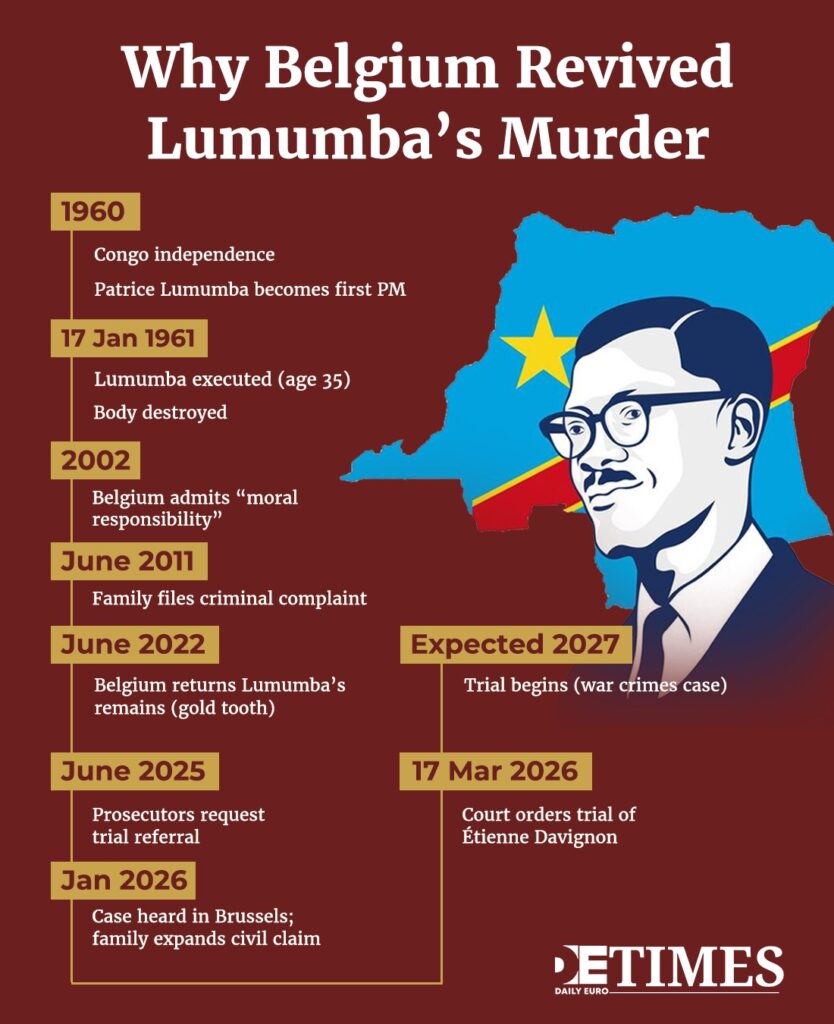
Patrice Lumumba was 35 years old when he was tortured and shot by a firing squad in Katanga on 17 January 1961, seven months after becoming Congo’s first democratically elected prime minister. His body was dissolved in acid.
The only remains recovered were a single gold-capped tooth, held for decades by the daughter of a Belgian police officer who had taken part in disposing of the corpse, and returned to Lumumba’s family by the Belgian government in June 2022.
That restitution came with a renewed apology for Belgium’s “moral responsibility” in his death, the same phrase a parliamentary inquiry had used in 2002. Moral responsibility, however, is a political category. On 17 March this week, a Brussels court moved the matter into a different register entirely. It ordered Étienne Davignon, 93, the last surviving member of eleven Belgians accused by the Lumumba family of complicity in the killing, to stand trial for war crimes.
The trial is expected to begin in 2027.
Who is Davignon and What He is Accused Of?
Davignon arrived in what was then Belgian Congo as a 28-year-old diplomatic intern on the eve of independence in 1960. He went on to become the first head of the International Energy Agency and served as a European Commissioner between 1977 and 1985. He later chaired the Belgian holding company Société Générale de Belgique and sat on the boards of numerous listed companies. In 2018, King Philippe elevated him to the rank of count.
He was not present in court on Tuesday and has consistently denied the charges. His lawyer Johan Verbist challenged the basis for a trial at the January hearing, arguing that the reasonable time for prosecution had passed and contesting the classification of war crimes. The court rejected both arguments. Prosecutors accuse Davignon on three counts: the illegal transfer of Lumumba and his associates from Léopoldville to Katanga, humiliating and degrading treatment of the men, and depriving them of a fair trial.
The prosecution’s theory is that Davignon, while not having fired a shot, was aware that transferring Lumumba to Katanga was functionally a death sentence given the hostility of local authorities there, and chose not to intervene. Lawyer Christophe Marchand, representing the Lumumba family, called Davignon “a link in a grim state-run criminal enterprise.”
The Case that Took 65 Years
Lumumba’s son filed the original criminal complaint in June 2011 against eleven Belgian citizens. The proceedings stagnated for years. In June 2025, the Belgian federal prosecutor finally requested referral to trial, and the case was heard for the first time before the Brussels Court of First Instance in January 2026, when ten grandchildren of Lumumba joined as civil parties.
The Brussels court went further than the prosecutors had requested, extending the scope of the trial to cover the killings of Lumumba’s political associates Maurice Mpolo and Joseph Okito, who were executed alongside him. That extension was noted by human rights lawyers as legally significant: it means the court is treating the three deaths as a connected criminal event rather than focusing narrowly on Lumumba’s individual case.
The European Centre for Constitutional and Human Rights, which has supported the family throughout, called the ruling “a historical precedent in criminal justice for European colonialism.” Human Rights Watch described it as a historic opportunity to establish facts about alleged war crimes committed during decolonisation.
What Justice Means After Six Decades
Lumumba’s granddaughter Yema Lumumba told Reuters the ruling was “a step in the right direction,” adding that “what we want is to search for truth and establish different responsibilities.” The family’s written statement was more expansive: “What changes today is that the legal system of Belgium begins, at last, to confront its own responsibilities for acts committed in the name of colonial rule.
For our family, this is not the end of a long fight, it is the beginning of a reckoning that history has long demanded.” The practical outcome of the trial remains genuinely uncertain. Davignon can appeal the referral order, which could delay proceedings further. He is 93. If the trial begins in 2027 as scheduled, he will be 94 or 95 when it concludes. The defence will argue that reasonable time has passed and that a fair trial is no longer possible.
These are not frivolous objections in criminal procedure. They are, however, objections that ten grandchildren of a man whose body was dissolved in acid are unlikely to find persuasive.
Keep up with Daily Euro Times for more updates
Read also:
Bukavu Falls to M23 in Eastern Congo
Bosma: Dutch Colonialism in Full Force on Belgium Partition
Chaos in the Congo: The Fall of Goma