

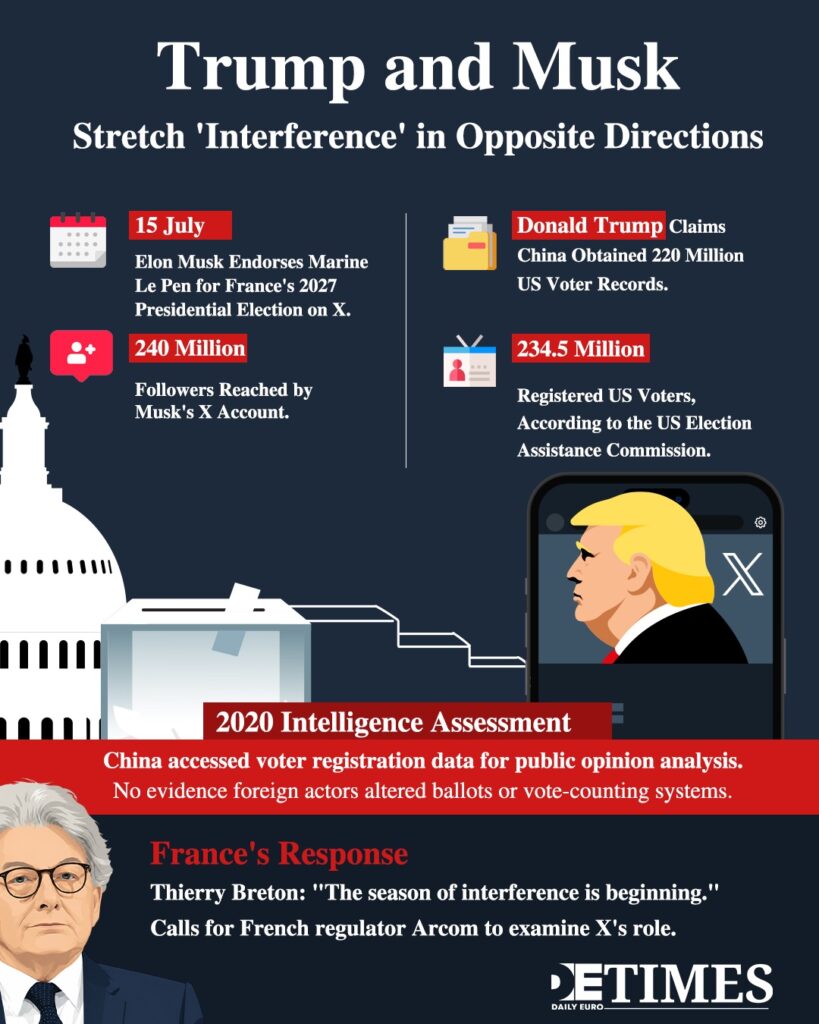
Two stories broke within 48 hours of each other this week that appear unrelated but belong to the same growing confusion over what interference now means. On 15 July, Elon Musk posted “She is France’s last hope” to his 240 million X followers, publicly endorsing Marine Le Pen for France’s 2027 presidential election — her fourth campaign, launched after an appeals court upheld her fraud conviction.
On 17 July, Donald Trump delivered a prime-time White House address alleging that China had obtained 220 million US voter files, covering almost all of the 234.5 million registered American voters according to the Election Assistance Commission, and that intelligence officials had deliberately concealed the scale of the breach. Beijing denied any involvement. A 2020 intelligence report, declassified four years earlier, had found that China obtained multiple states’ voter registration data to conduct public opinion analysis, but concluded that no foreign power had attempted to alter ballots or vote-counting systems.
Both episodes produced accusations of interference. But they describe very different phenomena. Trump’s claims arrive as he presses Congress to pass the SAVE America Act, requiring proof of citizenship to register to vote, with midterm elections approaching in November. Some GOP members privately told reporters they saw little benefit in revisiting 2020 with competitive races ahead. In that setting, “interference” functions less as a precise security description and more as a way of framing possible defeat in advance, keeping distrust alive as a governing political mood.
France Reaches for the Same Word
The French reaction to Musk’s endorsement used nearly identical language.
“The season of interference is beginning,” said Thierry Breton, former European Commissioner. Foreign Minister Jean-Noël Barrot replied to Musk directly: “Only fools never change their minds.” LFI MP Antoine Léaument called on communications regulator Arcom to investigate. Yet by the following day, even the party Musk had endorsed was stepping back. RN spokesperson Laurent Jacobelli told public radio the party did not seek international backing and that “it is the opinion of the French people” that decides elections. An endorsement so politically inconvenient to its own recipient illustrates the difficulty of treating platform speech and state espionage as the same category of threat.
The concern about Musk is nevertheless real and distinct from Trump’s voter-file claims. He is not simply a private citizen expressing a preference. He owns the platform on which he posted, commands 240 million followers and has now endorsed far-right figures in Germany, France, the UK, Romania and Hungary. Breton was careful to make the distinction: “Elon Musk is therefore backing Marine Le Pen. That is his right. It is up to the authorities to ensure that X’s algorithm does not favour any candidate.” That is the correct frame: not whether a foreign person may have an opinion, but whether the infrastructure through which that opinion spreads operates without democratic accountability.
The danger is that “interference” gets applied to both cases indiscriminately, making it harder to address either.
The Real Dispute Is Over Power, Not Just Nationality
The core issue is not foreignness alone.
It is politically consequential power exercised across borders without the accountability structures that domestic actors face. Trump invokes China to reinforce a long-running electoral grievance narrative timed to advance specific legislation. Musk uses ownership of a communications platform to amplify preferred candidates across multiple democracies simultaneously. Both are forms of cross-border political influence. Neither fits cleanly into the older model of clandestine state meddling.
Interference has become a fight over definition. Whoever controls that definition increasingly controls how democracies explain their own vulnerability. Inflating the word to cover every unwanted foreign voice makes it useless as a legal or security concept. Restricting it to covert espionage ignores how power now travels through platforms, money and algorithmic reach. Europe and the United States are both discovering, in different ways, that they have not yet built the conceptual or regulatory tools to handle the difference.
Keep up with Daily Euro Times for more updates
Read also:
Truth Social or X? Vice President Musk’s Latest
Guardians Go Radical: France’s Masonic Trial
Prison or Presidency: Le Pen’s Political Crucible