

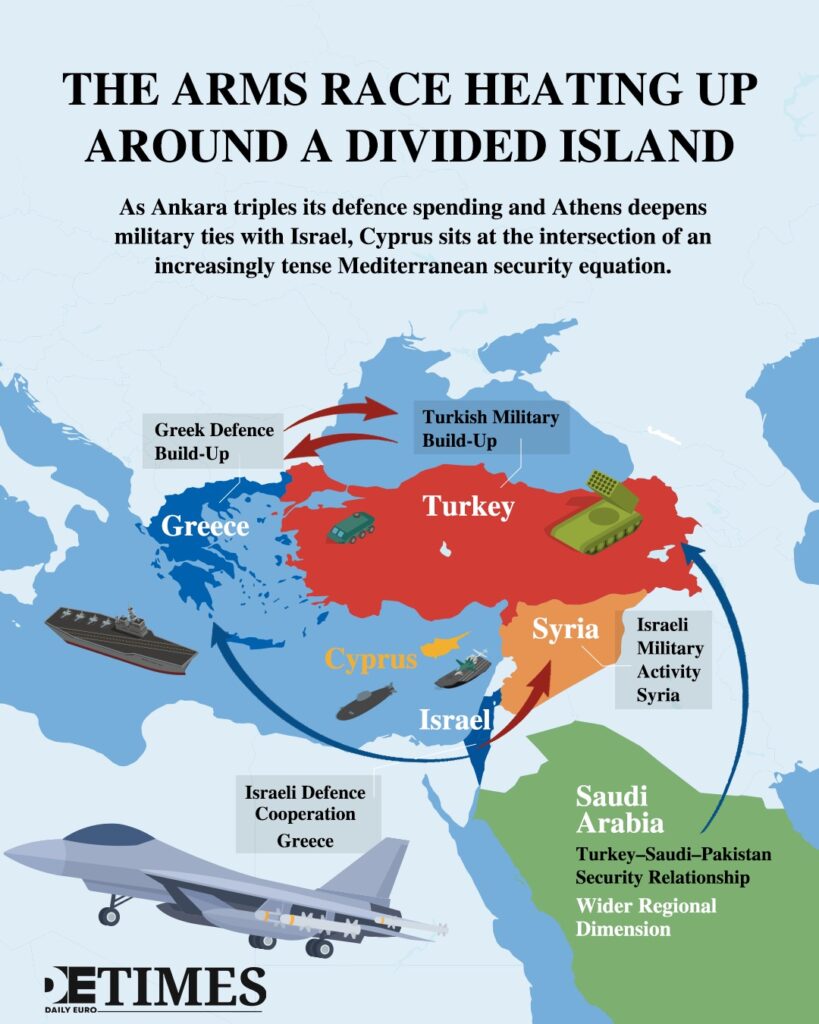
Turkish Vice President Cevdet Yilmaz announced earlier this week that Ankara will raise defence spending by 229% over the next three years. The new economic programme, running to 2029, funds domestic fighter jets, drones and tanks all because of a divided island.
The Stockholm International Peace Research Institute, SIPRI, already ranks Turkey eighteenth among the world’s military spenders, with last year’s outlay reaching $30bn.
Yilmaz described the increase as industrial ambition. The calendar points to something harsher.
Greece has recently sealed a $3.5bn air-defence pact with Israel, and Israeli jets bombed a Syrian airbase weeks earlier over an alleged Turkish deployment.
If Turkey and an Israel-backed Greece are heading for a collision course, Cyprus, still divided since Turkish troops entered its north in 1974, looks like the likeliest place their rival build-ups will meet.
Athens Answers with Superiority Talk
Greek Prime Minister Kyriakos Mitsotakis answered Yilmaz’s spending pledge in strong words.
Speaking days after Ankara’s announcement, he pointed to Greece’s upgraded F-16 fleet, its French Rafale jets and its incoming F-35s as proof of a decisive edge over Turkey. “I would even dare to call it superiority,” he said, adding that Athens could never leave such an advantage unused.
Greece’s defence budget has doubled this year to €6.13bn. This places the country alongside Poland, Estonia and Latvia among the handful of NATO members spending above 3% of output on arms.
Mitsotakis paired the boast with a pledge of independence, insisting Greece would decide its own purchases without seeking Ankara’s or Washington’s permission.
Israel Builds Greece a Shield
Greek air power leans heavily on Israeli technology, and Athens’s dependence on Israeli hardware grew last week.
The two countries signed a $3.5bn deal to build an integrated, multilayered network the two governments call the Achilles Shield.
The package brings together David’s Sling and Spyder interceptors from Rafael Advanced Defense Systems alongside the Barak missile system from Israel Aerospace Industries. It also adds a new command centre and anti-drone coverage.
Israel’s defence ministry called it the largest export deal in the history of Israeli-Greek relations. Cyprus’s defence minister, Vasilis Palmas, said “all three countries face a threat from Turkey.”
Syria, Another Battleground
Palmas spoke only days after Israel had already unsettled Ankara with a strike inside Syria. Israeli aircraft struck the Abu al-Duhur military airbase in northern Syria overnight last month, hitting the runway and storage facilities with eight strikes.
Syria condemned the raid as a violation of its sovereignty, and Turkey, which Israel accused of eyeing the base for its own troops, called the operation reckless.
Netanyahu’s office later confirmed the goal directly, saying Israel had acted to stop Turkish forces from taking up positions near Aleppo.
Tom Barrack, the United States envoy for Syria, called the strike an “unnecessary escalation” that undercut months of behind-the-scenes diplomacy between Syria, the United States and Israel.
For Ankara, the strike confirmed a suspicion already voiced in a leaked defence-ministry document, namely that Israeli-Greek cooperation and Israeli actions in Syria form one coordinated squeeze.
Riyadh Hedges without Naming Israel
Turkey’s answer to Israeli-Greek closeness carries a regional dimension too. Last month Saudi Arabia, Pakistan and Turkey agreed to oversee the Mecca Mutual Defence Agreement through a shared secretariat. The pact treats an attack on any one member as an attack on all three.
Saudi officials present the arrangement as a diversification of security relationships, one that stands alongside Riyadh’s long partnership with Washington instead of displacing it.
The three governments have named no adversary. Most readings of the pact centre on Iran instead of Israel.
For Riyadh, the draw lies mainly in shared production lines, including Turkish drone technology and a possible stake in Ankara’s Kaan fighter programme. The appeal has little to do with any taste for a clash with Israel or Iran.
Cyprus Stands at the Fault Line
The tracks seem to converges on Cyprus, where the events of 1974 still divide the island. Every country except Turkey still treats the island’s north as occupied territory.
A Turkish presidential adviser, İbrahim Karagül, wrote recently that Turkey would soon finish what it left incomplete on the island in 1974. He also warned that Israelis living or holidaying on Greek islands would become targets if Turkish forces there suffered an attack. Turkish officials distanced themselves from Karagül’s post.
A defence-ministry planning document leaked weeks earlier had already mapped scenarios of “crisis, tension, and war” involving Greece, Cyprus and Israeli-Greek cooperation.
Turkey keeps funding the island’s north directly, channelling roughly $453m in grants this year, with close to half earmarked for defence. Despite this, the NATO charter binds Turkey and Greece alike, and Ankara’s own economic programme hinges on the calm needed to attract the investment behind its rearmament drive.
Occasional flare-ups, such as the Abu al-Duhur strike, will keep probing how far each side is ready to go. But it seems that Cyprus remains the one place where a miscalculation could turn purchase orders into an actual clash.
Keep up with Daily Euro Times for more updates
Read also:
Cyprus’s Right Hardens as Turkey Looms
From Stalemate to Hope: Erhurman’s Win Rekindles UN-Led Cyprus Talks
Cyprus Corridor: A Hub Between India and Europe