

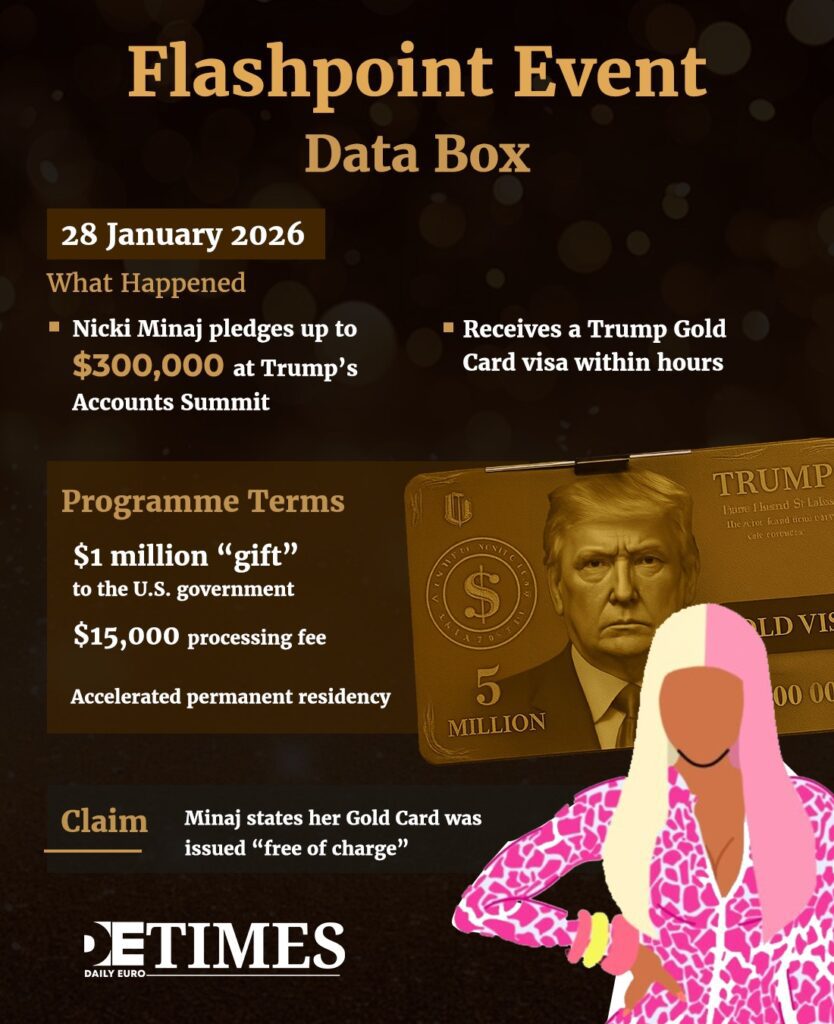
The spectacle was precise. A Trinidad-born rapper walks onto a stage in Washington, calls herself “probably the president’s No. 1 fan,” and pledges hundreds of thousands of dollars to children’s investment accounts backed by Donald Trump.
Within hours, she posts a photo of a Trump Gold Card, a $1 million visa programme offering accelerated permanent residency. By morning, her feud with journalist Don Lemon, whom she attacked with a homophobic slur days earlier, escalated when federal agents arrested him for allegedly interfering with worshippers whilst covering an anti-ICE protest.
What mattered was not the details. It was the speed with which one figure bent an entire news cycle to her will.
Fame as Infrastructure
Nicki Minaj is often discussed as a performer, provocateur, or businesswoman. Increasingly, she functions as something else: a form of cultural infrastructure.
Her posts act like junctions. Traffic gathers. Arguments branch. Media cycles bend. In an ecosystem built on clicks and reactions, that capacity is power.
According to The Entertainment Desk, Minaj doubled down on her slur against Lemon in a podcast clip released around the same time news broke of his arrest on 30 January 2026. She repeated the slur during an appearance on The Katie Miller Podcast, hosted by the wife of White House Deputy Chief of Staff Stephen Miller.
Beyond Music
Pop stars once relied on albums and tours to maintain relevance. Today, presence matters more than product. Visibility is the commodity, and controversy is one of its most reliable engines.
Minaj understands this terrain. She moves between humour, confrontation, vulnerability, and defiance with calculated ease. Each shift generates engagement.
Music remains central to her career, yet it now shares space with something broader: constant narrative production. Her appearance at the Trump Accounts Summit, where she mingled with Speaker Mike Johnson and filmed a TikTok with Trump, generated more traffic than any recent single.
Fandom as Force
Her influence rests partly on scale. Millions of followers do not merely observe. They mobilise. They defend. They amplify.
Online fandom operates like an informal political movement, complete with slogans, hierarchies, and enforcement mechanisms. Loyalty is rewarded. Dissent is punished.
This dynamic blurs entertainment and activism. A dispute about lyrics or opinions can quickly resemble a campaign. When Minaj’s feud with Don Lemon began on 18 January 2026 after he livestreamed protesters disrupting a Minneapolis church service led by an ICE official, her fans flooded timelines within hours.
Outrage as Currency
The attention economy thrives on intensity. Calm rarely spreads. Anger, irony, and ridicule do.
Minaj’s public disputes often generate more traffic than her releases. This is not accidental. Outrage keeps algorithms attentive. According to a 2018 Facebook post now resurfacing online, Minaj wrote: “I came to this country as an illegal immigrant at 5 years old.” That post, shared amid her current anti-immigration rhetoric and Trump alliance, reveals how easily narrative shifts when controversy demands it.
Yet this system carries costs. It flattens nuance. It encourages extremes. It rewards performance over reflection.
The Institutional Vacuum
Part of Minaj’s reach reflects institutional weakness. Trust in traditional media, parties, and civic bodies has thinned. Celebrities fill the space.
When public authority feels distant, personality feels accessible. A post feels more immediate than a policy statement. Minaj’s voice therefore travels farther than many official ones, regardless of subject.
The New Statesman described her pivot to Trump as abandoning her “Grande Armée of left-leaning, multiracial, largely LGBT Barbs” for “the Maga kingdom, a halfway house for the decrepit and the evil.” Yet that framing misses the point. Minaj did not betray principles. She demonstrated that principles were never the product.
Cultural Power Without Accountability
This influence comes without formal responsibility. Unlike politicians or editors, pop figures answer mainly to audiences and platforms.
That freedom allows creativity. It also enables recklessness. Mistakes can be reframed as entertainment. Harm can be absorbed by spectacle.
The system rewards those who master it, not those who moderate it. When Attorney General Pam Bondi announced Lemon’s arrest alongside three others “in connection with the coordinated attack on Cities Church,” Minaj’s earlier call for his imprisonment looked less like opinion and more like prophecy.
A Mirror of the Age
Minaj’s dominance is not an anomaly. It reflects how modern public life operates: fast, personalised, reactive.
Her career shows what happens when talent meets algorithmic amplification and disciplined self-branding. Fame becomes governance of attention. Whether that serves public life well is another matter. According to the Trump Gold Card programme, applicants pay a $15,000 processing fee and make a $1 million “gift” to the US government for permanent residency. Minaj received hers “free of charge,” she claimed.
The attention economy does not distinguish between art and transaction. It only measures traffic. Minaj has mastered that currency, and the system bends accordingly.
Keep up with Daily Euro Times for more updates!
Read also:
Selective Outrage: Whose Suffering Does Nicki Minaj Speak For?
Gus Jackson and Europe’s Complicated Memory of Michael Jackson
The US-Russia Peace for Ukraine Leaves Europe in the Cold