

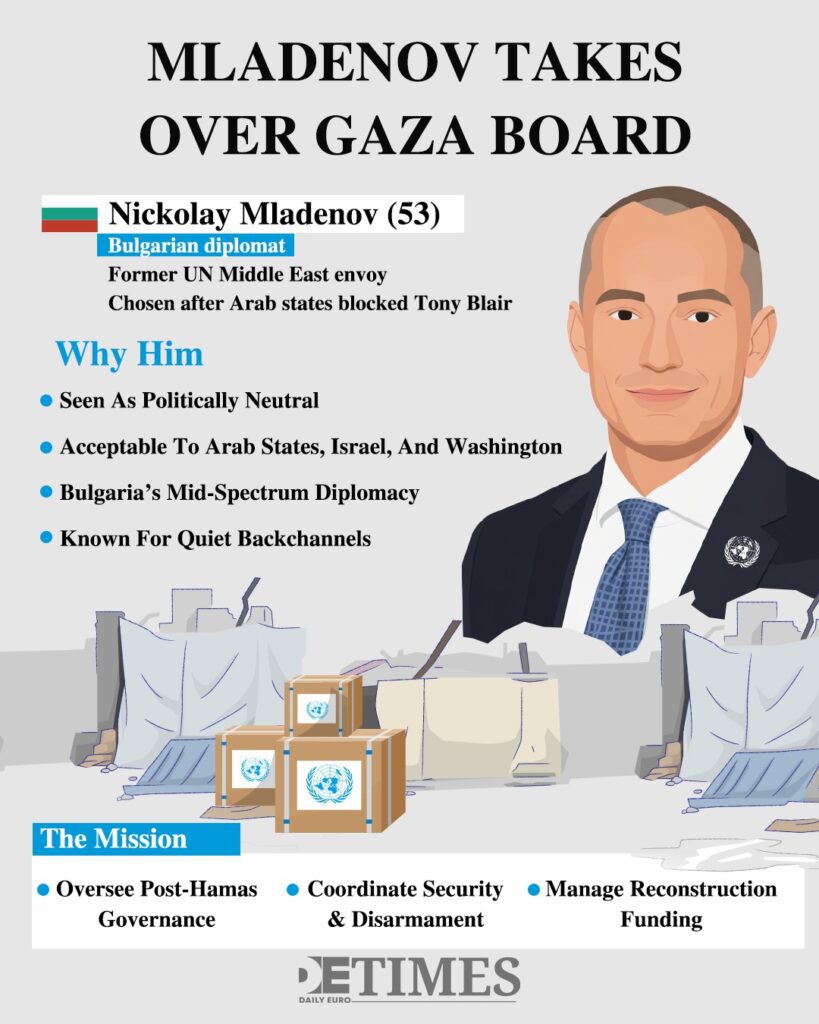
Benjamin Netanyahu announced Nickolay Mladenov as director for the Board of Peace on Thursday, filling a seat after Arab governments turned away Tony Blair.
The Bulgarian diplomat’s selection maps current regional leverage.
A Career Built on Neutrality
The former British Prime Minister had sought the post through a group that worked with Israeli commercial interests to develop blueprints for the enclave, a board intended to oversee a new Palestinian administration and manage the removal of Hamas weaponry.
The regional memory of the 2003 Iraq war rendered the previous candidate an impossible choice for many leaders.
Washington reportedly presented Mr Mladenov only after the first option collapsed, a step suggesting Gulf leverage has overtaken the traditional weight of European powers.
Measured Diplomacy in a Broken Land
Milen Keremedchiev noted Bulgaria stays in a mid-spectrum space, and a reputation for balance aided Mr Mladenov with both Arab leaders and Jerusalem during his tenure as foreign minister.
At 53, Mr Mladenov has spent years navigating regional circles, having worked as the UN envoy from 2015 to 2020. Ahmed Majdalani, a former Palestinian minister, noted that the envoy understands the local actors with a granular expertise.
He returns to a cycle of violence that has only intensified; since the October ceasefire, over 425 Palestinians have died in Israeli operations, and the diplomat returns to a terrain in ruins.
Retired Israeli diplomat Alon Bar pointed to Mr Mladenov’s use of quiet backchannels in the search for common ground.
The Struggle for Local Control
Hussein al-Sheikh, the Palestinian vice president, met Mr Mladenov in Ramallah just after the Netanyahu meeting to discuss putting Palestinian Authority security forces back in Gaza.
Mr al-Sheikh held firm that Palestinians must retain their own sovereignty during any period of transition. The US-backed plan includes nations like Britain, Saudi Arabia, and Turkey, as it effectively treats Gaza as a separate administrative space.
Hamas says it will step down once a board of experts takes over, leaving Mr Mladenov as the primary go-between for security requirements and political hopes.
The Cost of Rebuilding
Mr Mladenov leads a school in the United Arab Emirates, which provides him with the access needed to organise the necessary financing.
The UAE has the funds to help, and Gulf states are positioning themselves as the architects of the new economy as European governments contend with domestic budgets.
Kaja Kallas, the EU’s foreign policy head, mentioned that aid remains hindered by current restrictions.
The crisis calls for tangible results in the present; although Mr Mladenov received a high decoration from the Palestinian president in 2021, he must now secure actual breakthroughs.
Lessons from the Past
Mr Mladenov’s history shows the arduous nature of this work, such as in 2012 when he organised the first meeting for the Syrian opposition, only for that conflict to worsen.
A risk persists that the board will become another institutionalised waiting room as the fighting persists. Washington’s choice satisfies the political requirements of its allies for now, and a formal news release is expected next week.
In the end, what happens to the people in Gaza hinges on who controls the funds and the territory. Mr Mladenov’s role was defined by the regional power realignments that led to his name being called, and his fruition will be judged by the same forces.
Keep up with Daily Euro Times for more updates!
Read also:
From Belfast to Gaza: Britain’s Attempt to Export the Good Friday Agreement
Viceroy Blair: Why Europe Matters More Than Washington in Gaza?
Economics Via Mediation: Gaza and Ukraine Wars Offer Europe Opportunities