

The United States and Iran agreed to a two-week ceasefire on 7 April after Pakistani Prime Minister Shehbaz Sharif and Army Chief Asim Munir brokered the deal in the final hours before a threatened American strike. Iran promised safe passage through the Strait of Hormuz for the duration, and markets responded instantly as Brent crude fell 13–16 percent.
The war that began 28 February with United States-Israeli strikes on Iranian nuclear sites paused, and the pause created space for Islamabad talks scheduled for 10 April.
Traders priced relief before diplomats finished statements. The Strait carries roughly a fifth of traded oil, and its brief reopening allowed insurers to reconsider transit. Gulf Cooperation Council finance ministries watched the price move with quiet satisfaction, because lower energy volatility protects budget planning across Saudi Arabia, the United Arab Emirates, Qatar, Kuwait, Bahrain and Oman.
The same ministries noted that the ceasefire excludes Lebanon.
Gulf Capitals Read Unity
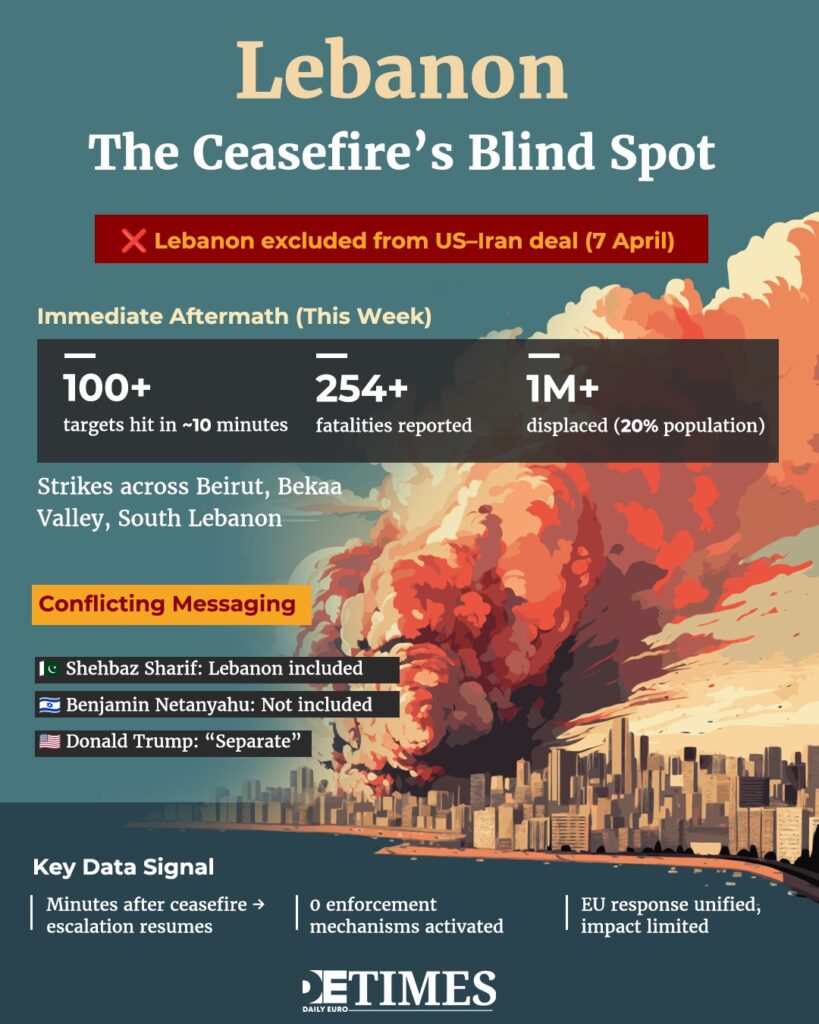
Lebanese civil defence counted 254 dead after Israeli forces struck more than 100 sites in ten minutes across Beirut, the Bekaa Valley and southern Lebanon. Images of smoke over central Beirut travelled quickly across Gulf media, and public commentary emphasized shared concern for civilian life.
In Riyadh and Abu Dhabi, official statements welcomed Pakistani mediation and praised the restraint shown by Washington and Tehran. GCC governments have prioritized tension reduction with Iran since 2022, preferring political agreement in Yemen over renewed confrontation.
Short-run sentiment inside the GCC points toward greater cohesion. Leadership circles interpret the ceasefire as proof that non-traditional partners can deliver results where older security architectures stalled.
The GCC as an institution may regain impetus, with renewed working groups on maritime security and energy coordination. Such momentum fits a worldview that values economic emancipation over rhetorical alignment, and that treats economic power as outcome of history rather than exceptionalism.
Diversification Becomes Doctrine
Long-run planning remains conditional on whether the pause holds. GCC energy ministries already treat volatility as a structural feature, and the April episode reinforced that view.
Saudi Arabia and the UAE have expanded refining capacity, invested in hydrogen and solar, and built logistics hubs at Jeddah and Jebel Ali precisely to reduce exposure to a single chokepoint.
Defence procurement follows a similar logic, with joint air defence exercises and domestic production programmes receiving fresh funding after February strikes demonstrated vulnerability of critical infrastructure.
The UAE foreign ministry said Iran should provide clarification on full cessation of hostilities and unconditional reopening of the Strait, adding that reparations for Gulf damage remain on the agenda. That language reflects confidence, rather than hostility, and aligns with a preference for rules-based commerce.
Economic diversification, therefore, proceeds as a natural consequence of recent events, with structural sectors like energy and defence receiving accelerated capital.
Europe Speaks With One Voice
Hours after the United States-Iran ceasefire was announced, Israel struck more than 100 targets across Lebanon in ten minutes.
Pakistani Prime Minister Shehbaz Sharif announced the deal explicitly included Lebanon. Israeli Prime Minister Benjamin Netanyahu’s office said the opposite within hours. United States President Donald Trump said Lebanon was “separate.”
What followed was intensification: the largest Israeli wave of strikes since the war began, hitting central Beirut, the Bekaa Valley, and southern Lebanon, targeting densely populated residential and commercial areas without prior warning.
European Union governments reacted with unusual unity. EU top diplomat Kaja Kallas said Israeli actions were putting the United States-Iran ceasefire under “severe strain” and posted that the truce “should extend to Lebanon.” France, Germany, and the United Kingdom issued a joint statement calling on all parties to implement a ceasefire that included Lebanon.
French President Emmanuel Macron condemned the Israeli strikes “in the strongest possible terms” in a statement. Italy’s Prime Minister Giorgia Meloni said Israel had “disrespected” the ongoing truce. Germany’s Foreign Minister Johann Wadephul called on Israel to limit operations to self-defence. Spain went further: Prime Minister Pedro Sánchez urged the EU to suspend its Association Agreement with Israel, accusing Israel of violating international law.
Words Without Levers
None of these statements produced immediate change on the ground. The EU has called for ceasefires in the region for years with limited effect, and the gap between strength of language and absence of enforceable consequence has become a defining feature of European foreign policy in the conflict.
Kallas’s post paired condemnation with a demand that Hezbollah disarm, a position that reflects genuine EU policy and gives Israel political cover to characterise the situation as ongoing counter-terrorism rather than a ceasefire violation.
Analyst commentary focused on structural flaws. Andreas Krieg, a professor at King’s College London, called Lebanon the “Achilles heel” of the deal, warning that the arrangement may force Iran to retaliate against Israel to maintain credibility as a security partner for Hezbollah. The question of Lebanon’s fate remains acute.
More than one million people have been displaced in a country of five million. Lebanon’s economy minister said the five weeks of war cost the country an estimated 5 to 7 per cent of GDP, erasing the cautious recovery of 2025. At a displacement camp on Beirut’s waterfront, families had begun packing tents after hearing news of the ceasefire. Netanyahu’s statement stopped them. “We can’t take this anymore,” one man told Euronews.
Modular Peace Tested
What emerges in the region is compartmentalisation: one front frozen, another active, agreements that apply selectively depending on who is asked.
Such compartmentalisation may represent the only diplomacy currently achievable, given the number of actors and grievances involved.
A ceasefire that explicitly excludes a country being bombed at the moment of signing manages escalation into separate containers, each of which can be reopened independently.
Lebanon provided the first test of whether the model holds, and the test failed on day one. Large-scale strikes and mass civilian casualties make any deal look hollow to regional publics, regardless of legal distinctions drawn in press releases.
The risk of chain reactions grows: Hezbollah has said it reserves the right to respond; Iran has warned that ceasefire violations will carry “explicit costs”; the Strait of Hormuz, briefly reopened, was reported closed again within hours of the ceasefire announcement. The paperwork said one thing. The region did another.
For Gulf capitals, the lesson reinforces a pragmatic course. Short-run unity sentiment offers political capital for GCC institutions to coordinate maritime insurance pools, strategic reserves and joint procurement. Long-run uncertainty reinforces commitment to diversification, with capital flowing toward industries that generate value independent of Hormuz traffic. For European capitals, the lesson points toward limits of declaratory diplomacy without matching economic instruments.
The UAE and Saudi Arabia gained leverage by staying out of direct combat while actively protecting commercial lifelines. European governments gained moral clarity by speaking together, and lost credibility by lacking means to enforce preferences.
Economic emancipation, rather than rhetorical positioning, will determine who writes the next chapter.
Keep up with Daily Euro Times for more updates
Read also:
EU Targets Stablecoins as Iran Forces Digital Tolls
The Iran War Splits the Balkans
Mojtaba: Who is Iran’s New Strongman?