

As Hargeisa filled with flags for Somaliland’s National Day on 18 May, the territory’s newly appointed ambassador presented his credentials to the Israeli President, the first ceremony of its kind in Somaliland’s modern history.
Somaliland has run its own affairs, held peaceful elections, and kept its borders secure through three and a half decades of regional turmoil, all without a seat at the United Nations or access to international credit.
Last December, Benjamin Netanyahu and Foreign Minister Gideon Sa’ar formally signed a mutual recognition declaration with Somaliland’s President Abdirahman Mohamed Abdullahi, describing it as being “in the spirit of the Abraham Accords.” The declaration made Israel the first, and so far the only, United Nations member state to recognise Somaliland as a sovereign country.
The weeks that followed reinforced Hargeisa’s oldest conviction: the toughest diplomatic fights for Somaliland happen in Addis Ababa, Nairobi, and Abuja, and the result there counts more than a dozen declarations signed in Jerusalem.
The African Union’s Frozen Legal Doctrine
The African Union’s resistance to Somaliland’s claim draws on a legal principle which, read carefully, actually supports Hargeisa.
Somaliland gained independence from Britain in 1960, received recognition from Israel and 34 other countries, and freely chose to merge with the former Italian colony of Somalia days later. As that union collapsed and Somaliland reasserted its pre-1960 borders in 1991, Hargeisa did exactly what the AU’s foundational doctrine, uti possidetis juris, asks of a post-colonial polity, by honouring the colonial demarcations the 1964 Cairo Declaration turned into continental law.
The AU has consistently categorised Somaliland’s 1991 reassertion as secession, a reading that overlooks the territory’s existence as a separate colonial entity with its own sovereignty, set up before the union ever took place.
The European Union joined the AU in condemning Israel’s recognition last December, a convergence that put Brussels at odds with a territory whose governance record many European officials privately admire.
The South African government put the dominant continental position in writing last December. “We distinguish unequivocally between decolonisation and secession,” the statement read. “The former restores sovereignty; the latter dismantles it.”
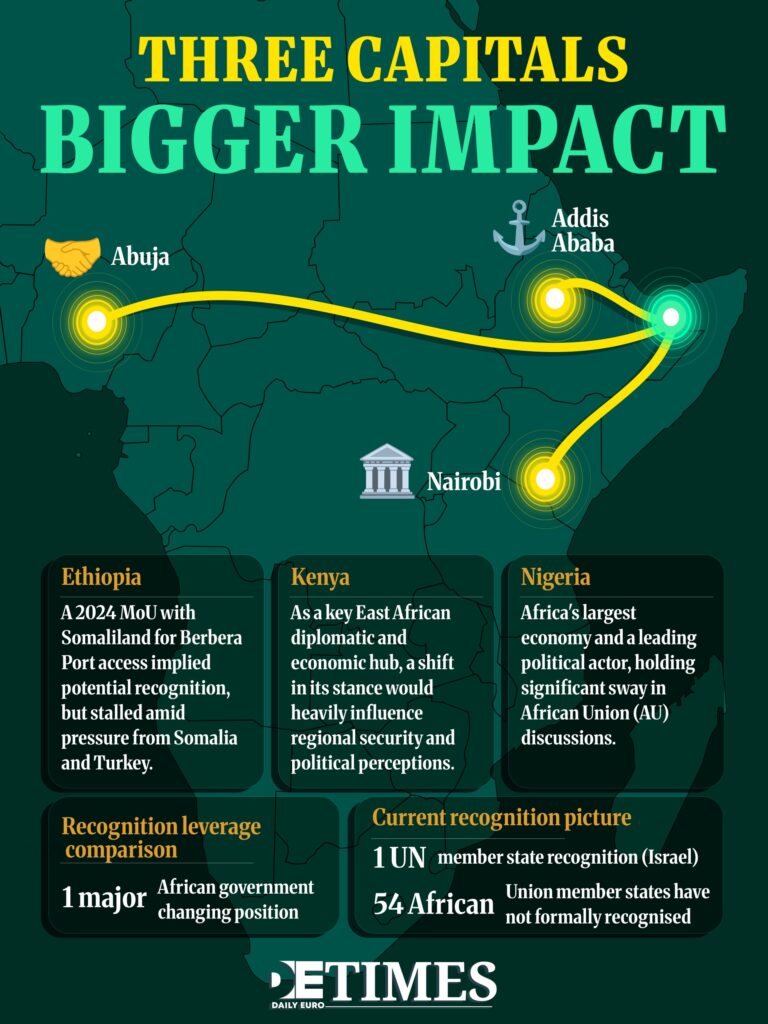
Why Nairobi, Abuja, and Addis Ababa Count
The AU’s institutional resistance is, in broad terms, a collective act of self-preservation among states that worry about the precedents recognition might set inside their own borders.
That is why the states with the most to consider are the ones whose stance matters most. Ethiopia almost tipped the balance in 2024, signing a memorandum of understanding with Somaliland that offered Addis Ababa sea access through the port of Berbera along with an implicit pledge of recognition, before pulling back under pressure from Mogadishu and Ankara.
The pullback displayed the power of the Egypt-Somalia-Turkey axis in regional calculations, and the limits of a recognition arrangement that lacks broader African backing. Kenya and Nigeria carry a different kind of pull.
A public signal from either Nairobi or Abuja that Somaliland’s colonial history warrants distinct treatment would split the AU’s unified front far more than many declarations from outside the continent. Somaliland’s Foreign Minister Abdirahman Adam observed in a recent interview that “Somaliland governs itself, secures its borders, and maintains peace in a volatile region” and insisted that “Somalia simply does not speak for us.” African leaders prepared to make that distinction publicly would recast the continental conversation.
A Leak that Rattled the Wrong Room
Israel’s recognition counts as an opening, but its current leadership introduces a variable Hargeisa has every reason to treat with caution.
Reports surfaced this week that Benjamin Netanyahu’s decision to publicise his wartime visit to the United Arab Emirates, a trip Abu Dhabi had asked to keep confidential, arose from purely electoral calculations, with Netanyahu’s office fearing the optics of being upstaged by former Prime Minister Naftali Bennett’s planned Abu Dhabi meeting. The UAE denied the visit took place.
The affair is, to put it directly, a textbook example of a leader putting a central alliance below personal political survival.
The UAE’s discomfort has consequences for Somaliland because Abu Dhabi has been a structural enabler of the Somaliland-Israel connection, mediating early talks and managing the Berbera port concession.
Recognition Must Take Root in African Soil
Last December, Puntland’s interior minister Juha Farah offered the most candid framing, observing that “Israel’s message is that if you provide strategic value, recognition becomes transactional rather than principled.”
Somaliland has offered base access and mineral rights, joined the Abraham Accords framework, and kept the Berbera port open with the Red Sea coastline stable. What Hargeisa still needs is an African backer willing to absorb the diplomatic price of committing first.
For as long as the recognition question stays a dispute between Hargeisa and Mogadishu with external referees, the AU’s unified front holds.
Keep up with Daily Euro Times for more updates
Read also:
Exclusive: Hargeisa to Berbera Port
Piracy Around the Horn of Africa is Going Global
Two Arteries, One Lifeline: Somaliland and Taiwan Talk Maritime Cooperation