
As Spain and Portugal have retreated from property-based golden visas, Greece continues to promote residence through investment. The programme grants renewable five-year residence permits to non-EU investors and their families, normally without requiring them to live in Greece.
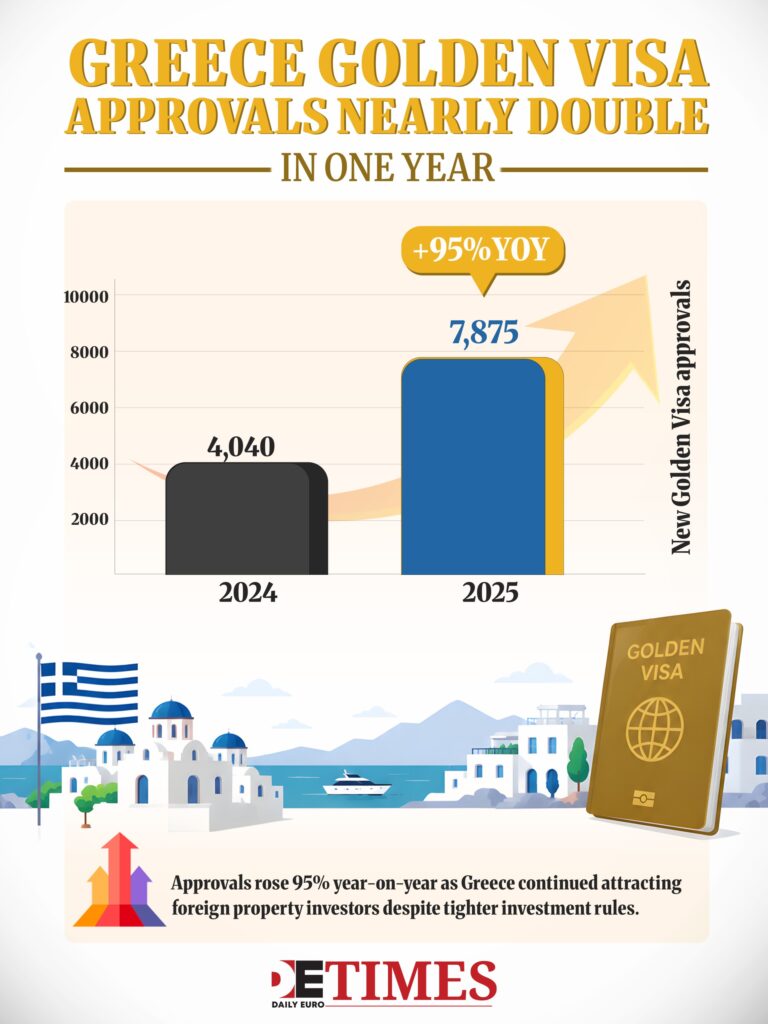
According to official data from the Ministry of Migration and Asylum, 7,875 new golden visa residence permits were approved between January and November 2025, a 95% increase on the prior year, bringing the total of valid permits issued to 27,786 as of December 2025. The programme has attracted approximately €5.54 billion into Greek real estate up to 2023. Chinese investors remain the dominant nationality, with Turkish investors the second-fastest-growing group.
The government has tightened the programme rather than abolishing it. Minimum property investment now stands at €800,000 in high-demand locations including Athens, Thessaloniki, Mykonos and Santorini, and €400,000 in most other areas. A €250,000 route remains available specifically for conversions of commercial buildings into residential housing and the restoration of listed properties. Short-term rentals of qualifying golden visa properties are now banned outright, with a €50,000 fine for violation and risk of permit revocation.
Greece Wants Capital That Stays
Athens sees golden visas as a relatively simple way to attract foreign direct investment without direct public spending.
Buyers bring capital into property, construction, legal services and banking, whilst creating demand for renovation and development. For a country still shaped by the long debt crisis, investment remains central to the government’s economic narrative. Although growth has returned and Greece is repaying bailout loans ahead of schedule, the programme offers a direct route for foreign capital into domestic assets, which is why Athens has opted to reform it rather than follow Lisbon and Madrid in phasing it out.
Unlike ordinary tourism revenue, which fluctuates by season, a property purchase places foreign capital permanently into a domestic asset. Golden visas also market Greece as a Schengen entry point, combining European mobility with Mediterranean property and flexible residency conditions. Applications fell 43% in the first four months of 2026 compared with the same period in 2025, perhaps reflecting the impact of higher thresholds in prime areas, but approvals rose 11% over the same comparison, suggesting a backlog of previously filed applications is still working through the system.
Housing Costs are Growing
The difficulty is that investment property is also housing.
Greece faces a shortage estimated at around 180,000 homes in its major cities. Since the mid-2010s, approximately 20,000 properties have been sold through the golden visa system, whilst another 150,000 have moved into the short-term rental market. Rents in Athens rose by more than 50% between 2019 and 2024, whilst wages increased far more slowly. Greeks now spend a larger proportion of their income on housing than residents of any other EU country, and home ownership has fallen below 70%.
Golden visas are not the only cause. Construction collapsed during the debt crisis, tourism has intensified demand and short-term rentals have removed homes from the ordinary market. But foreign investment adds pressure in neighbourhoods where supply is already limited. That pressure is precisely why the tiered thresholds and the short-term rental ban were introduced: an attempt to preserve the investment whilst redirecting it towards less strained parts of the market and towards the conversion of unused commercial property rather than speculation in existing housing stock.
The Bet Remains Risky
Greece is effectively betting that it can capture the benefits of mobile global wealth without pricing its own population out of major cities.
Golden visas can generate investment, restore buildings and strengthen Greece’s image as an international destination. But capital concentrated in existing housing does less for productivity than investment in businesses, technology or new construction. The programme will remain politically defensible only if Greece can demonstrate that foreign money is increasing the housing supply rather than merely competing for it.
Otherwise, a policy designed to demonstrate economic recovery may become another symbol of why many Greeks feel excluded from it. The higher thresholds and rental restrictions suggest Athens is aware of that risk. Whether the reforms are enough to contain it, or whether a programme built on mobile capital can ever reliably serve a housing market built on scarce local supply, is the question the next few years will answer.
Keep up with Daily Euro Times for more updates
Read also:
Greece Courts Haftar as Türkiye Expands Role in West
Greek Prosecutors Score Wins Amid Political Resistance
Portugal’s Golden Visa Fight Tests State Credibility