
As Fuad Hussein’s name circulated again in Baghdad this month amid renewed talks over Iraq’s presidency, it exposed not only how tired the country’s confessional formula has become, but how absurd.
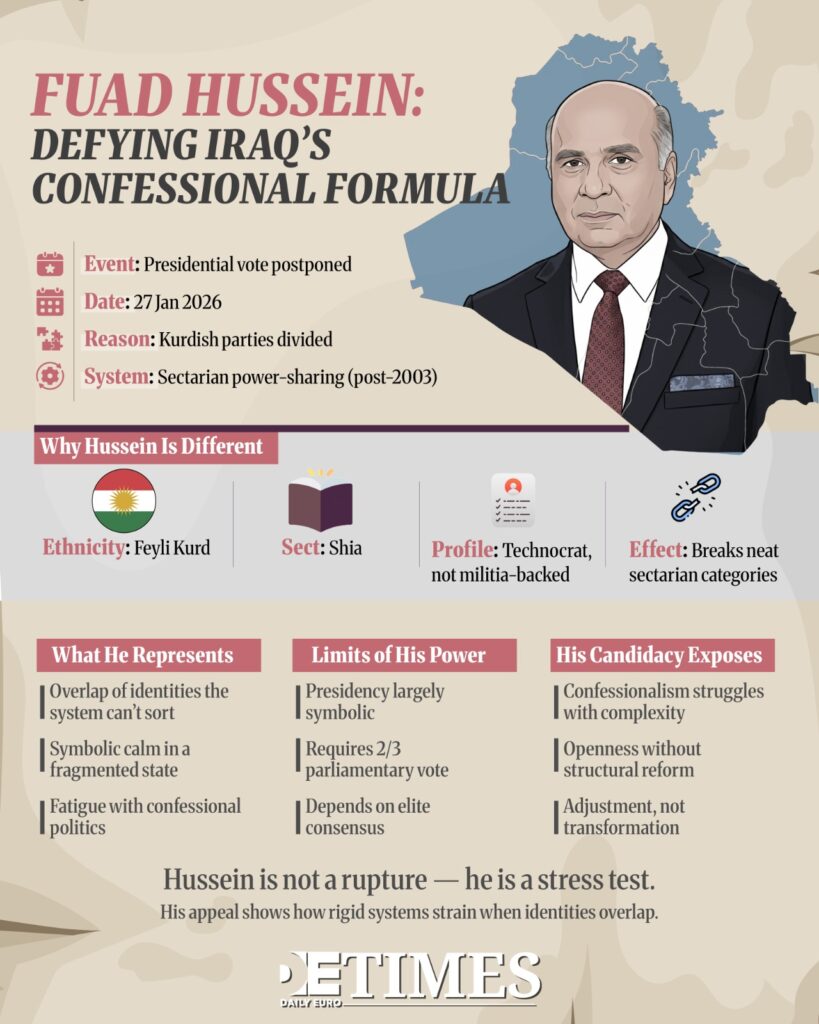
Hussein is Feyli Kurdish, a Shia minority within the Kurdish community. His late wife Carolina was a Dutch-Italian Protestant from the prominent Montessori family, granddaughter of famed educator Maria Montessori. In a system designed to sort people into neat sectarian boxes, Hussein’s life defies the categories.
The Candidate Who Breaks the Formula
Iraq’s post-2003 system distributes power along sectarian and ethnic lines. The presidency is reserved for a Kurd, the prime ministership for a Shia Arab, and the speakership for a Sunni Arab. These arrangements were designed to prevent exclusion after dictatorship.
Yet Hussein complicates the arithmetic. He is Kurdish, satisfying the ethnic requirement for president. But he is also Shia, technically qualifying him for the prime ministership reserved for Shia Arabs. Born in 1949 in Khanaqin into a Feyli Kurdish family, he belongs to a Shia minority within the broader Sunni-majority Kurdish population.
The Feyli Kurds, who live primarily in eastern Iraq outside the Kurdistan region, have historically occupied an uncomfortable position. Too Kurdish for Arab Iraq, too Shia for Sunni Kurdistan. Hussein’s heritage alone ridicules the logic of confessional division.
A European Connection that Unsettled Baghdad
Hussein’s personal life further defied Iraq’s identity politics. During his exile in the Netherlands following the 1975 collapse of the Kurdish resistance, he completed a PhD in international relations at Vrije Universiteit Amsterdam. There he met and married Carolina Montessori, a Dutch-Italian Protestant whose grandfather Mario was the son of Maria Montessori, the Italian physician who revolutionised early childhood education.
According to reports from 2018, when Hussein was first nominated for the presidency, rival Kurdish factions weaponised his marriage. Jalal Talabani’s nephew falsely claimed Hussein’s wife was Jewish, warning that Iraqis would face their first “Jewish First Lady”. Hussein responded by clarifying that Carolina was Protestant, from the prestigious Montessori family. She passed away in 2024, with senior Kurdish leaders attending her funeral in Erbil.
The controversy revealed how deeply confessional thinking permeates Iraqi politics. Hussein’s decades-long marriage to a European Christian was treated as a liability, not a bridge. According to parliament, 44 candidates initially registered for the presidency, with 19 making the final list after vetting, including Hussein and his main rival, Nizar Amedi of the Patriotic Union of Kurdistan.
Fluent in Five Languages, Homeless in One System
Hussein speaks Kurdish, Arabic, Persian, English, and Dutch. He has served as finance minister, foreign minister, and chief of staff to Kurdistan President Masoud Barzani. He worked as an adviser to Iraq’s Ministry of Education after 2003, redesigning the curriculum to remove Baathist ideology.
Unlike many senior figures, he does not command a militia, a party machine, or a confessional bloc. His career rewards negotiation rather than mobilisation. That flexibility is both his appeal and his weakness.
In a political order built on fixed identities, Hussein’s intersectionality unsettles the system. He fits multiple boxes simultaneously, which means he fits none perfectly.
Symbolism Without Power
The Iraqi presidency carries limited executive authority. Real power sits with the prime minister and parliament. According to Iraq’s constitution, parliament must elect a president with a two-thirds majority, approximately 220 out of 329 votes.
Yet symbolism matters in fragmented states, especially when trust is thin. A president is meant to reassure, to represent continuity, and to speak above faction. When names like Hussein surface, it reflects a search for calm rather than control.
This is not a revolution in waiting. It is a pause, a moment where political actors test whether familiarity still persuades the public. The postponement of the vote followed joint requests from both the Kurdistan Democratic Party and Patriotic Union of Kurdistan for more time to reach agreement.
The Technocrat Dilemma
Iraq has seen this before. During moments of crisis or exhaustion, technocratic figures gain attention. They promise competence, stability, and fewer slogans.
Yet technocrats struggle in systems that reward mobilisation over management. Without a loyal base, they depend on elite consensus, which is fragile and often temporary. Hussein’s appeal follows this familiar arc. He reassures without threatening, but reassurance alone rarely wins power in Baghdad.
What His Candidacy Exposes
Whether or not Fuad Hussein becomes president matters less than what his candidacy reveals about Iraq’s confessional system. His Feyli Kurdish-Shia heritage makes a mockery of neat ethnic and sectarian divisions. His marriage to a Dutch-Italian Protestant Montessori made him suspect in 2018, even as it demonstrated the kind of cosmopolitanism Iraq claims to value.
The renewed interest in Hussein reflects political fatigue more than ideological change. Many Iraqis are weary of endless negotiations that recycle the same faces and formulas. That fatigue does not automatically translate to reform. Confessional systems can absorb dissent by offering symbolic adjustments whilst preserving structure.
Hussein’s name functions as such an adjustment. It signals openness without committing to overhaul. Iraq is not abandoning its confessional order. Yet it is probing for figures who can soften it, manage it, or at least make it less abrasive.
That is a modest ambition, but in Iraqi politics, modesty itself marks a shift. The interest in Hussein shows a desire to believe that representation can still evolve, even when structure resists it.
Keep up with Daily Euro Times for more updates!
Read also:
Iraqi Kurdistan: Lost Stability and Baghdad’s Strengthened Position
Old Myths, New Realities: A New Middle East
Syria at Crossroads: Geostrategy Amid Turmoil