

African leaders launched the Africa Credit Rating Agency in Port Louis last month, prompting sceptics to ask whether the continent can credibly grade itself. Observers warn investors will treat the agency as a self-grading exercise until it downgrades a local government.
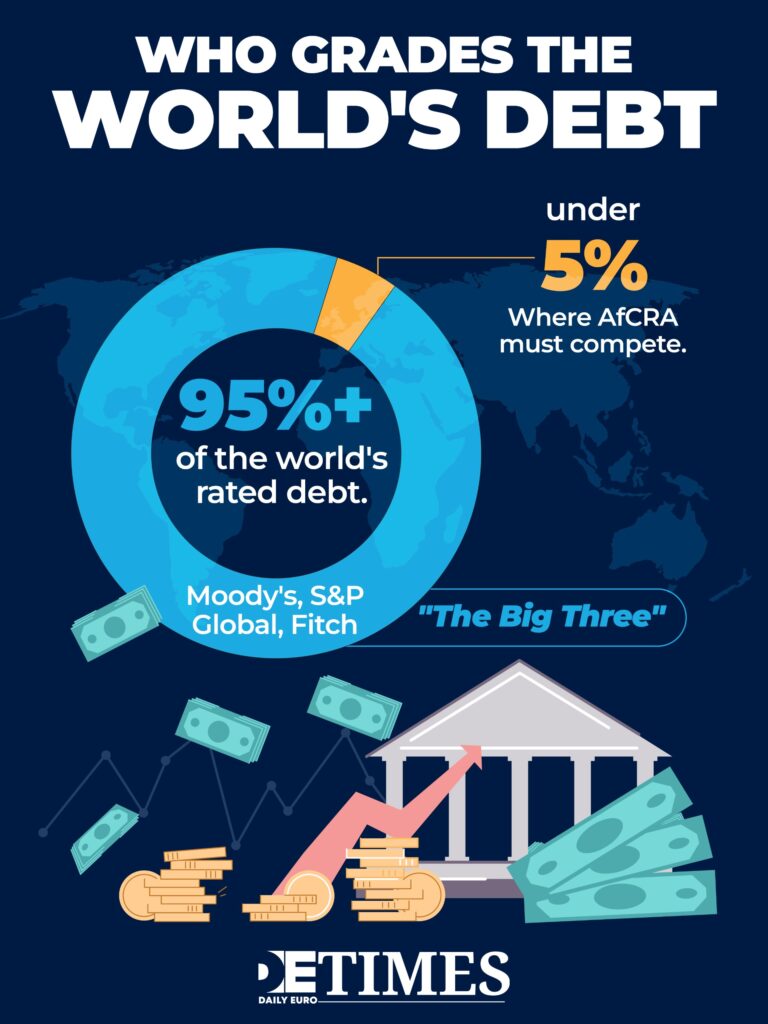
The African Union endorsed the project in 2018 after years of grievances against Moody’s, S&P Global and Fitch, three American firms whose ratings set borrowing terms for more than 95% of the world’s rated debt.
African officials say the grievance is justified. The new agency, known as AfCRA, will earn authority only through independence and rigour. At the same time, regulators are also questioning those very qualities at Egan-Jones, the Pennsylvania firm behind thousands of private credit grades.
Disruptive African American Credit Raters Take Acid Test
Why Africa Wants Its Own Rater
The cost of borrowing drives the project. Every downgrade raises the interest bill for governments and companies alike. The African Union’s peer review body attributed turbulence in Kenya’s Eurobond market between 2023 and 2025 to Moody’s commentary and rating actions. These included a statement that a planned buyback would count as a default.
Coverage gaps add to the cost. The AU counts 23 African economies without ratings from the major agencies, which leaves investors little to price against.
AfCRA, led by chief executive Sifiso Falala, is private-sector-led and self-funded. It will rate sovereigns, sub-sovereign borrowers and companies. Its founders promise freedom from government interference, a pledge investors will examine early.
Investor recognition will prove harder than winning government support. Many institutions operate under mandates written around the dominant firms’ ratings. The three majors reject claims of systematic bias, so AfCRA will need to win its case with data.
Independence Is Scarce in Private Credit
Private credit, the market that propelled Egan-Jones into prominence, lacks the independence AfCRA promises. Tighter bank capital rules after the financial crisis pushed lenders away from mid-sized companies, while funds offering high yields filled the space.
Insurers hold much of the paper and use the ratings to calculate capital requirements, so a generous grade can reduce the capital an insurer must hold.
Concerns about ratings quality reached the Financial Stability Board, which warned last year of “ratings shopping” in the $1.7 trillion market. Issuers there can solicit grades from several providers and keep the most flattering.
The European Central Bank judges direct euro area holdings limited, though European investors place about 60% of their private credit allocations with foreign funds.
Stress came in March. Blackstone’s flagship vehicle received redemption requests worth about 7.9% of its $82 billion in assets, while Apollo and Ares limited withdrawals after requests topped 11%.
The Egan-Jones Warning Signs
The redemption queues raised a question about who had graded the loans, and Egan-Jones provided much of the answer. The firm assigned ratings on more than 3,000 private credit deals two years ago with roughly 20 rating staff. Larger agencies rarely attempt that pace because their due diligence takes weeks.
In March, the Securities and Exchange Commission questioned whether the firm could “consistently produce credit ratings with integrity” given its financial and managerial resources.
The order also queried qualified institutional buyer certifications in the firm’s applications. Egan-Jones has defended its practice.
Reports last year said enforcement staff were examining whether executives exerted improper commercial influence over ratings. Bermuda’s regulator has also dropped the firm from its recognised list.
Last month, Egan-Jones hired Kenneth Godwin, a former SEC examiner, to oversee ratings under direct board supervision. The hire followed a public rebuke and appears to be a repair effort. Investors will judge it by the ratings the firm publishes next.
Keep up with Daily Euro Times for more updates
Read also:
AfDB Turns to Gulf as Western Funders Step Back
Data Centre Silence: Europe’s Secret Sauce?
Bahrain’s Economic Reforms: On Pause For Now