
The European Union’s ambassador to Qatar, Antonino Maggiore, said “every crisis brings opportunities” as Brussels prepares a defence-technology seminar in Doha on 3 December. The seminar is intended to revive the partnership between the EU and the Gulf Cooperation Council, which was disrupted when tensions forced the postponement of a summit planned for 24 October.
Since late February, Iranian missiles and drones have repeatedly struck the Gulf, and Kuwait and Bahrain have taken many strikes. In July, Iranian lawmaker Ahmad Bakhshayesh Ardestani warned of ground attacks on Kuwait and Bahrain if American forces enter Iran.
Against that backdrop, the Doha talks will give Europe an industrial and technological role in Gulf defence, limited by Europe’s own confrontation with Russia over Ukraine. Yemen’s widening war and Iran’s threats make the offer welcome, but its limits are set by Europe’s own arsenals.
What Brussels Wants From Doha
The seminar on defence technology and AI will connect private defence firms from the EU’s 27 member states with Qatari counterparts and, possibly, companies from across the GCC. The European Commission will present plans for a common European defence industry.
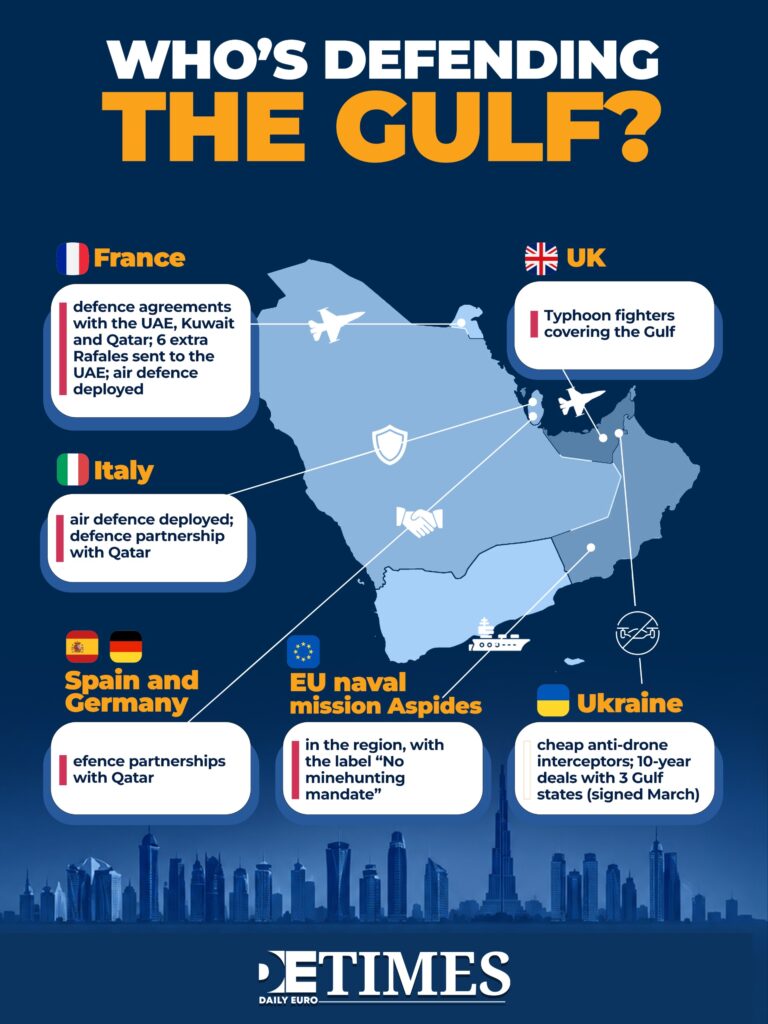
Maggiore wants to build on Qatar’s existing defence partnerships with France, Italy, Spain and Germany, adding a European platform for industrial contacts.
Luigi Di Maio, the EU special envoy to the Gulf, says every GCC state wants defence and security as a core chapter of its strategic partnership agreement. Maritime security and cybersecurity are among the practical fields. The list focuses on industry and does not mention bases.
Outcomes Within Sight
Such a practical agenda is likely to produce modest, measurable outcomes: industrial contacts, joint projects and the groundwork for defence chapters in the partnership agreements. Troop guarantees are not on the agenda.
Gulf armies are pursuing their own integration. Kuwait’s army chief met the commander of the GCC Unified Military Command last week to discuss tighter integration across Gulf forces.
Researchers at the EU Institute for Security Studies judge that returns will remain limited because tighter Gulf budgets and a smaller capital pool for outside investment limit what partners can finance. Their caution is reasonable. Gulf capitals already diversify partners as they diversify their economies.
Will Doha Talks Build Europe an Industrial Defence Role
How a European Role Would Look
Modest outcomes still allow visible contributions. France has defence agreements with the United Arab Emirates, Kuwait and Qatar, and it sent six more Rafale jets to the Emirates after the war began. Italy and France have deployed air defence systems, and Britain has sent Typhoon fighters to cover the Gulf.
Europe’s naval mission Aspides lacks a minehunting mandate, so frigates and air defence escorts must fill the gap. Doha is a suitable host because its diplomats have kept the Iran file together, a record that lends credibility to security discussions. Maggiore also wants cooperation on mediation, where Doha already talks to every party.
Yemen adds a southern front. UN envoy Hans Grundberg said the country had effectively slid back into “full-scale war”, and Houthi forces have struck Saudi airports and oil sites.
Ukraine, which has learned to defeat Iranian-designed Shahed drones, offers the Gulf cheap interceptors, and three Gulf states signed 10-year defence agreements with Kyiv in March. Europe can broker such an exchange as industries in EU member states helped develop much of the Ukrainian equipment already aiding the Gulf.
Ukraine Sets the Ceiling
All ambitions out of Doha depend on stockpiles that also arm Ukraine.
In March, European Commissioner for Defence Andrius Kubilius warned the United States cannot provide enough missiles for the Gulf states and Ukraine alike. EU foreign policy chief Kaja Kallas admitted drone-interceptor production struggles to keep pace with demand from Ukraine and the Middle East.
Italy’s offer of air defence to Gulf partners raised concerns in Kyiv after Rome had declined a similar Ukrainian request. Every interceptor sent south leaves a gap in the east. Europe has too few interceptors to defend the Gulf and shield Kyiv, so production lines are central to its offer.
Keep up with Daily Euro Times for more updates
Read also:
Qatar Attack Pushes Gulf States Toward European Security
Mecca Pact Reorders the Region’s Power Balance
Strategic Autonomy: How the UAE Chose to Self-Arm