
As new tariffs loom and tech rivalry intensifies, one of the most important relationships hangs in the balance in 2025.
The United States and China will unsurprisingly confront new challenges in 2025 on economics, technology, and geopolitics. New tariffs and retaliatory measures could escalate trade disputes into a broader conflict, while both world powers amplify their technological competition.
Despite the strain, there are opportunities to cooperate on global challenges like climate change and AI governance, offering a vital yet fragile counterbalance to an otherwise fraught relationship.
Economic Ties Under Strain
The economy will be one of the main points of tension, between Washington and Beijing, in 2025. Economic headwinds and potential trade conflicts threaten to undermine China’s economy. The U.S. has announced tariff increases on Chinese exports, including electric vehicles and solar cells, which will take effect in 2025 and 2026. Such tariffs target sectors where China aims to build a monopoly, namely semiconductors and critical minerals. The tariff modifications, set to come into effect in 2025, will apply to relevant goods after the 1st of January of each year.
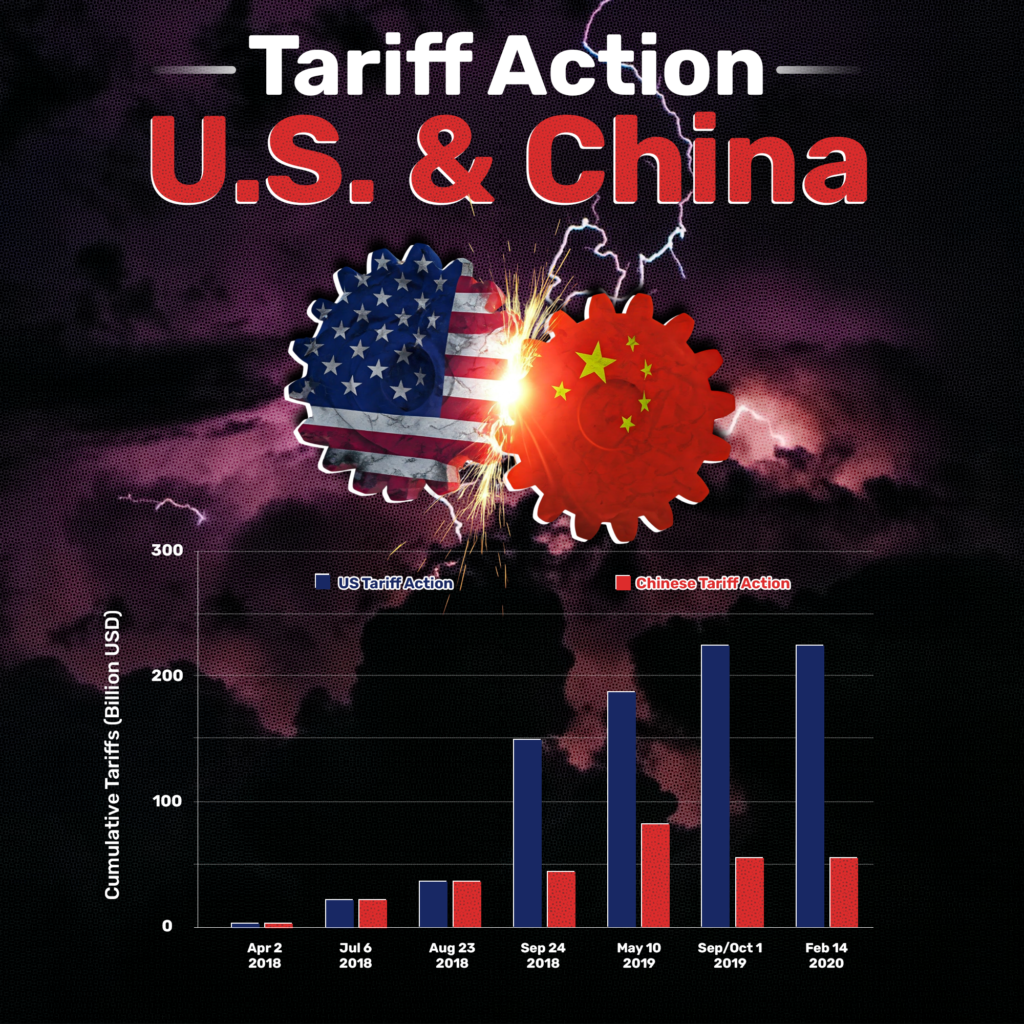
In response, China has launched anti-dumping probes on chemical imports from the U.S., European Union, Japan, and Taiwan. This move signals China’s willingness to retaliate against perceived economic aggression. The metals targeted in these probes are crucial for high-tech applications, from semiconductors to satellites and night-vision goggles. This tit-for-tat approach could escalate tensions and lead to a full-blown trade war, with both sides imposing cyclical rounds of tariffs and non-tariff barriers.
Technological Rivalry Intensified
The technological rivalry between China and the U.S. will continue to intensify in 2025. The U.S. imposed export controls on various Chinese goods due to their purported dual military use. This includes drones, which the U.S. sees as a potential threat to national security. The Countering CCP Drones Act, part of the National Defense Authorisation Act for the year 2025, exemplifies the U.S. approach to containing China’s technological advancements.
Despite this, China continues to accelerate its “Made in China 2025” plan. This initiative aims for macro industrial expansion and technological self-sufficiency. The plan focuses on key industries such as robotics, aerospace, and new energy vehicles. China’s push for indigenous innovation and reduced dependence on foreign technology aligns with its broader strategy of “dual circulation.” This policy seeks to boost domestic consumption and innovation while diversifying trading relations to reduce reliance on the U.S.
Geopolitical Tensions and the Russia Factor
Geopolitical tensions will continue to shape bilateral relations in 2025. The U.S. criticised China’s protectionism, intellectual property practices, and state subsidies to key export industries. Washington sees these practices as anti-market, in turn, undermining American export-led industries that follow global IP practices. The human rights situation in Xinjiang and Hong Kong, China’s deepening relationship with Russia despite the war in Ukraine, and its multi-vector approach to diplomacy in the Middle East continues to add fuel to the fire.
In 2025, China will likely maintain its support for Russia while building bridges with certain EU member states. This dual approach aims to leverage transatlantic tensions, exploit EU dependency on Russia’s natural gas exports to select Central and Eastern European states, whilst building a coalition of like-minded partners to resist U.S. pressure on trade. Russia will be a key partner in this strategy, but Beijing will most likely follow suit. While any offer to improve relations may have little substance, Beijing will try to leverage transatlantic tensions under the second Donald Trump administration.
U.S. Alliance Building
The U.S. continues to strengthen its relations with allies in Asia and Europe. The Biden administration has developed a foreign policy framework rooted in deepening bilateral relations with its European and Asian allies in the Indo-Pacific. This approach has generated closer alignment on economic and national security issues. The security situation in the South China Sea, the Taiwan Strait, and along the China-India border has contributed to this alignment.Areas for Potential Cooperation in 2025
Despite these tensions, there is a recognition for cooperation on areas of mutual interest. Climate change, artificial intelligence governance, nuclear risks, and pandemic prevention are areas where China and the U.S. could find common ground.
All in all, China-U.S. relations in 2025 will see economic strain, technological rivalry, and geopolitical tensions. However, there is also potential for cooperation on global challenges. The delicate balance between competition and cooperation will set the tone for any rapprochement in the coming year.

