July14 , 2026

Protests in Syria Over the Burning of a Christmas Tree

Related

Is Farage Heading for the Dustbin?

Nigel Farage quit Parliament to fight a rubbish-bin mascot for his own seat, wagering that grievance beats scrutiny in the court of public opinion.

Attal Uses Clavicular to Redefine His Political Brand

When a presidential candidate attacks an American streamer for mocking France, the influencer arena stops being parallel to politics and starts becoming part of it.

Buried Circle in Scotland Rewrites Violence Before Rome

Scotland's Buried Circle Rewrites Violence Before Rome Keywords: Neolithic Scotland, Machrie Moor, conflict, stone circles, archaeology, Roman Britain Brief: Standing stones in moorland mist; a bronze blade laid beside excavated earth.New discoveries at Machrie Moor and a major Edinburgh exhibition are pushing Scotland's prehistory away from pastoral myth and closer to a landscape of ritual, memory and organised violence.Scotland's ancient past is often imagined in stone, fog and silence. The newest archaeology suggests something noisier. Historic Environment Scotland this week announced the detection of a possible new prehistoric ring beneath the peat on the Isle of Arran: a circle of 12 pit-like anomalies forming a feature approximately 28 metres across, with space for two additional settings that may bring the original total to 14 posts or stones. Led by Dr Nick Hannon, the survey team used geophysical scanning equipment that detects underground disturbances without lifting a single turf. "The discovery of a new circle completely surpassed our expectations," Dr Hannon said. The find arrives at the same moment as the National Museum of Scotland opens Scotland's First Warriors, an exhibition tracing 4,000 years of conflict from the Neolithic to the Romans, covering more than 200 objects and asking how and why people fought, what weapons they used and what early conflict did to communities. Taken together, the two stories complicate the old image of early Scotland as a remote edge of prehistory waiting passively for civilisation to arrive. Ritual and Conflict Shared the Same Landscape It is tempting to separate ceremonial monuments from warfare, as if one belonged to religion and the other to politics. The new exhibition suggests prehistoric Scotland did not organise life so neatly. Machrie Moor's circles date from between roughly 3500 and 1500 BCE, and excavations have shown that several were preceded by timber circles in the same positions. The timber circle at Machrie Moor 1 has been radiocarbon-dated to 2030 ± 180 BCE, before the wooden posts were replaced with stone around 2000 BCE. The circles align with a prominent notch at the head of Machrie Glen, where the midsummer sunrise would have been visible, and later served as burial grounds for cremations and inhumations. The Edinburgh exhibition changes the emotional map of prehistoric Scotland. Stone circles were not necessarily built by peaceful mystics untouched by danger. They belonged to societies capable of both ceremony and force, burial and battle, symbolic order and lethal dispute. As the exhibition makes clear, interpersonal violence, fortification and organised conflict were real parts of Scotland's deep past, not marginal episodes but structural features of life on the moor. The landscape was never only sacred space. It was lived space. Before Rome, There Was Already History The most useful thing about these discoveries is that they pull Scottish prehistory out of the shadow of Rome. Too often, Britain's northern story begins when classical writers notice it. The Arran circle and the "first warriors" frame both insist that Scotland already had long, structured histories of monument-building, territorial meaning and conflict before Roman contact ever entered the picture. The Arran cursus, a ceremonial enclosure approximately 1.1 kilometres long sitting adjacent to the stone circles, underlines the landscape's sustained importance as a gathering place across millennia. The new ring at Machrie Moor has not yet been excavated, and the evidence for prehistoric violence remains open to interpretation. But the direction of travel is clear. Early Scotland looks less like an empty northern fringe and more like a dense world of ritual landscapes, armed communities and social memory stretching back 5,000 years. The stones were never mute. We are only getting better at hearing what kind of world they belonged to.Keep up with Daily Euro Times for more updates! Read also: The Outlander Effect: How the Show Put Scotland on the Map Rural Europe Pushes Back Against Megafarms Homer in a Mummy Rewrites Cultural Borders

Sahel Grows Increasingly Hostile Towards Foreign Powers

Rebel fighters push deeper into northern Mali as Sahel rulers sever old alliances and gamble on defending their territory alone.

Europe vs. America: The World Cup’s Hidden Culture War

A racist jibe, a disputed red card and a peace prize have turned the 2026 World Cup into an unlikely stage for transatlantic tension.

Share

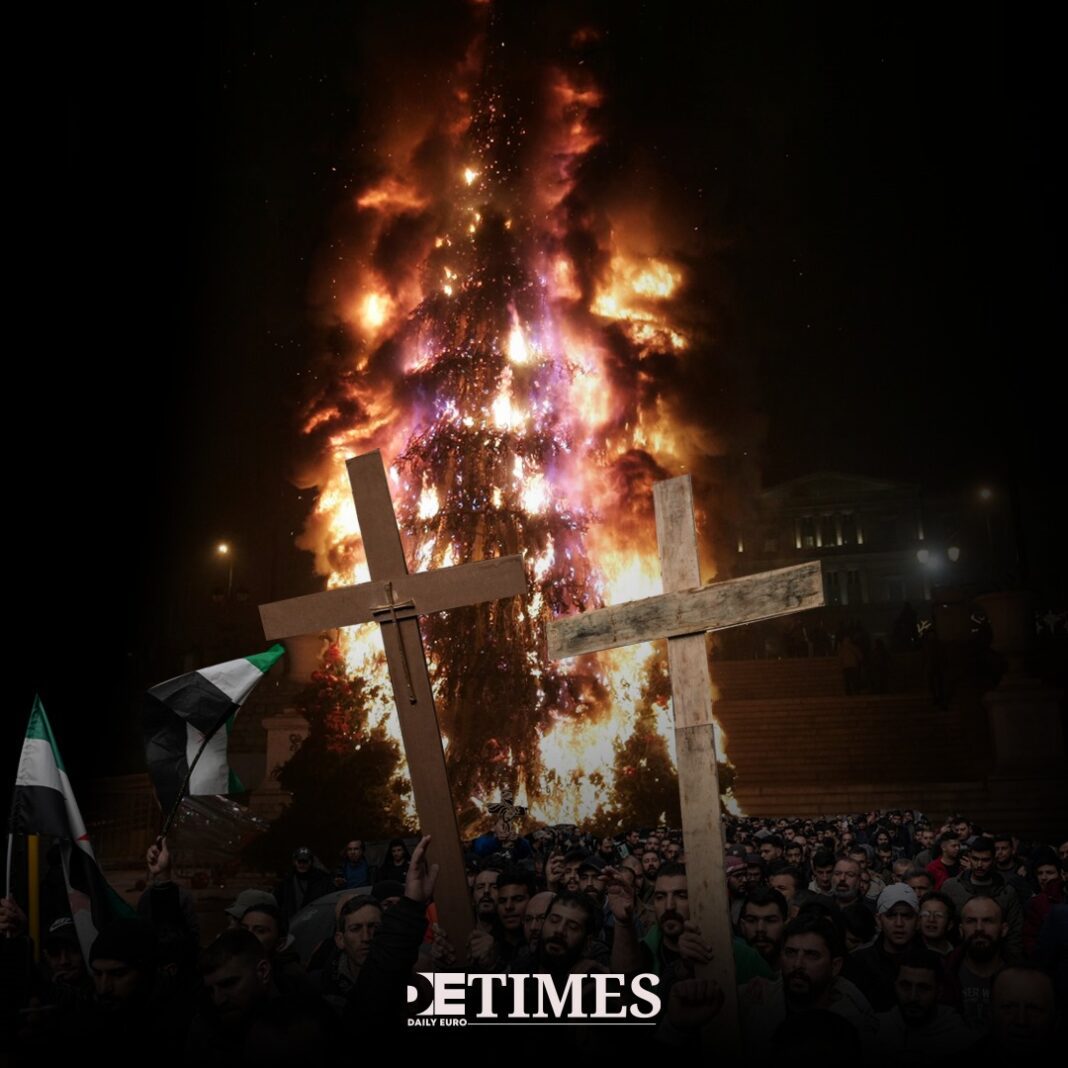
Protests erupted in Syria following the burning of a Christmas tree in Al-Suqaylabiyah, a Christian-majority town in central Syria. The incident has raised questions about the protection of minorities under the new Islamist-led authorities.

A video circulating on social media shows the Christmas tree engulfed in flames in Al-Suqaylabiyah’s main square. Hayat Tahrir al-Sham, the Islamist group now in control after the fall of President Bashar al-Assad’s regime, stated that foreign fighters were detained in connection with the arson. HTS has pledged to safeguard the rights of Syria’s religious and ethnic minorities, though the incident casts doubt on their ability to deliver on this promise.

Find the video here.

A Shocking Incident

Footage posted online shows masked men pouring an unidentified liquid on the Christmas tree just hours before Christians in Syria were set to celebrate Christmas Eve. Whether they intended to extinguish the fire or accelerate its spread remains unclear.

A religious representative from HTS responded to the gathered crowd, assuring them that the tree would be restored before morning. In a rare gesture of solidarity, he held up a cross—a symbolic act uncharacteristic of Islamist conservatives.

Nationwide Protests

The arson sparked demonstrations beyond Suqaylabiyah, with protesters taking to the streets in Damascus. In the Kassa neighbourhood, demonstrators called for the departure of foreign fighters, chanting, “Syria is free; non-Syrians should leave.” Meanwhile, in Bab Touma, a Christian district, protesters marched with crosses and Syrian flags, declaring, “We will sacrifice our souls for our cross.”

One protester, Georges, voiced his frustration: “If we’re not allowed to live our Christian faith in our country, as we used to, then we don’t belong here anymore.”

A Diverse Nation Seeking Security

Syria is home to a mosaic of religious and ethnic groups, including Christians, Kurds, Druze, Alawites, and Arab Sunnis, who form the majority of the Muslim population. Following the collapse of the Assad regime, many displaced Syrians have begun returning home. On Tuesday, Turkey reported that over 25,000 Syrians had crossed the Turkish-Syrian border back home for Christmas.

However, the arson attack reaffirms underscores the challenges HTS faces as it transitions from an Islamist group in charge of rebel-held areas to a fully functioning state apparatus governing Syria. The group, once rooted in hardline ideology, has pledged to create a Syria for all Syrians citizens. Incidents like this, before Christmas day, highlight the complexities of making such a shift.

A New Era, New Challenges

HTS announced plans to dissolve independent armed factions under a unified Ministry of Defense, aiming to centralise authority. However, questions remain about which groups will join this merger and how HTS will govern a fragmented nation.

While HTS remains a designated a terrorist organisation by the UN and Western nations, diplomatic overtures suggest a potential shift. Recently, the US removed a $10 million bounty on HTS leader Ahmed al-Sharaa following meetings with group representatives. However, the group still faces scrutiny over its ability to ensure security and uphold minority rights in a volatile post-Assad Syria.

A Test of Leadership

The Christmas tree arson incident is a test of HTS’s leadership and their commitment to inclusivity. Protecting minorities, managing foreign fighters, and addressing extremist threats will be crucial to stabilising Syria and fostering trust among its diverse population.

Keep up with Daily Euro Times for more updates!

Read also: 

Syria at a Crossroads: The Southern Border

International Backlash to Settlement Expansion in Golan

From Terrorists to Rebels: Hay’at Tahrir al-Sham

Your Mirror to Europe and the Middle East.

We don’t spam! Read more in our privacy policy