

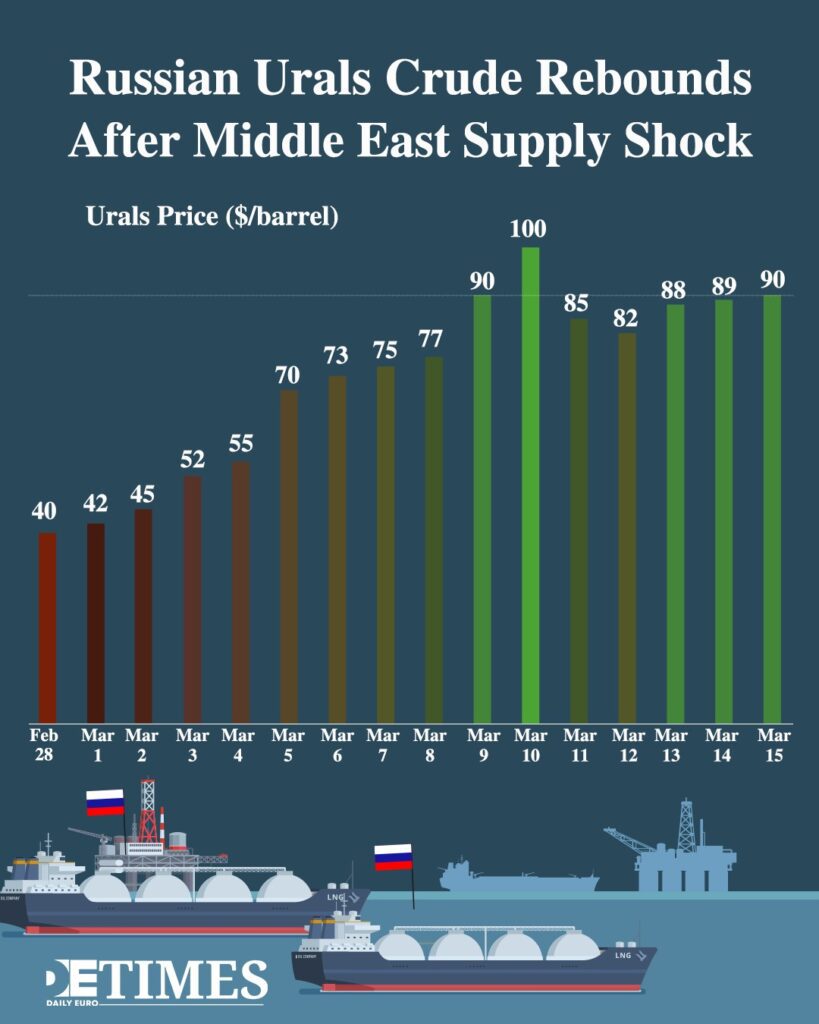
During the final days of February, Russia’s Urals crude plummeted to forty dollars per barrel under the weight of Western sanctions over the conflict in Ukraine. The Kremlin had even based the 2026 budget on an optimistic fifty-nine dollar price tag that appeared out of reach until everything shifted on the twenty-eighth of February.
As Israel and the United States launched coordinated airstrikes on Iran, closing the Strait of Hormuz to commercial shipping, Vladimir Putin reaped the benefits without firing a single shot outside of Ukraine.
The ledger provides a window into the financial recovery as oil and gas profits had shrunk from 45% of the federal budget in 2021 to 20% by 2025 before the current spike. Within days of the regional conflict, Russian Urals crude regained value to trade at a premium of five dollars.
Kremlin spokesman Dmitry Peskov announced a pronounced increase in demand for Russian energy products and linked the growth to the Iran conflict. At a gathering shortly after, Vladimir Putin told ministers and business leaders that Russian energy companies must use the current drive.
Refinery chemistry explains the advantage because Russia, Iran, and Venezuela are the primary sources of heavy crude that global refineries must obtain to function. With Venezuela and Iran sidelined, global refineries are now tethered to Russia’s supply of Urals.
The arrangement is lucrative because Russian seaborne exports travel via Baltic and Black Sea ports to reach India and China without navigating the blocked Strait of Hormuz. Deputy Prime Minister Alexander Novak was direct in stating that Russian oil is in high demand and Moscow is prepared to provide it.
Sanctions Architecture Dissolves Under Oil Price Pressure
Europe spent four years building a sanctions apparatus that leaned on American political willpower. On the thirteenth of March, the United States temporarily lifted restrictions on Russian oil to lower energy prices that were sent soaring by the conflict.
Treasury Secretary Scott Bessent called the benefit to Russia an unintended side effect but the transition happened anyway. European Council President António Costa wrote that the choice hurts European safety and warned that the move gives Moscow more resources for war. British Foreign Secretary Yvette Cooper, visiting Saudi Arabia, accused Tehran and Moscow of steering the global economy their way.
Former United Nations weapons inspector Scott Ritter framed the Kremlin’s position by noting that the United States had to turn to Russia for an answer. The return of Russian oil to eighty dollars per barrel on the open market provides the massive surplus that funds armies.
A Mediator’s Seat Restores Diplomatic Standing
Vladimir Putin held calls with the presidents of Iran and the United States and spoke separately with leaders in Qatar, Saudi Arabia, Bahrain, and the United Arab Emirates. He is making Russia the indispensable arbiter between Washington and Tehran.
The Kremlin readout from Bahrain stated that Moscow is ready to use all its resources to calm the region. The implications are evident since Moscow’s newfound pull as a regional mediator is granting it leverage over the terms of peace in Ukraine and a way back to global prominence. Robert Person of the Foreign Policy Research Institute noted that the role as a mediator allows Vladimir Putin to fix Russia’s reputation.
Russia’s history of military support for Iran bolsters the new standing after Moscow had supplied Tehran with air defence gear, helicopters, and jets in deals struck over several years. A longstanding military bond existed before the current war.
Now, countries looking for weapons outside of American control are watching Russian hardware handle a sustained aerial campaign. The results have commercial consequences as Keir Giles of Chatham House described Russia as the winner of current American actions. He pointed to oil prices and the way Western militaries are spread thin as massive gains for the Kremlin.
Europe Meets the Depletion of its Arsenal
European officials admitted recently that the sudden demand for air defence in the Iran war is making it hard to support Ukraine. Russian overnight missile strikes in February reached their highest intensity in four years and some attacks involved thirty ballistic missiles at once.
The strikes happened exactly as Western stocks were being used up in the Gulf. Vladimir Putin told his team at the Kremlin that the European Union would be forced to work with Moscow again. The prediction carries a new gravity in Berlin and Paris now that the sanctions have a visible hole in them.
The 2022 energy shock taught Europe that wealth flows to the one who holds the supply and today the trend is being repeated on a global scale. Moscow is enjoying higher oil revenues along with a break from economic pressure and a powerful diplomatic role in the Middle East.
Europe must now try to convince Washington to restore the economic pressure that the Treasury secretary has already sacrificed for the sake of the market. The history of American foreign policy suggests that the need for oil market stability takes priority over other promises so Russia is waiting by a ringing telephone to collect the profits.
Keep up with Daily Euro Times for more updates!
Read also:
Sanctions, Fees, and Excuses: Hungary’s Energy Ties to Russia Under Fire
Playing Both Sides: Russia and the Strategic Windfall
Shadow Mail: Moscow Pushes the Envelope on Sanctions